Peregraf– Ammar Aziz
"All Christians are feeling pain and sorrow. Beyond the attacks and assaults, there is a growing mentality of rejection against one another, and voices against our rituals are rising," said Sanwar Daniel, a Christian citizen in Duhok, expressing their concerns and fears.
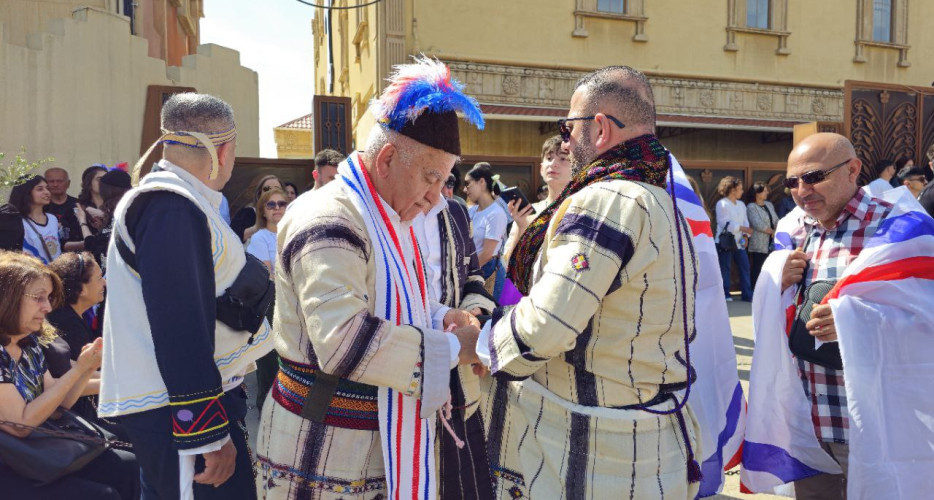
These fears emerged following this year's Akitu festival celebrations, the Chaldean-Syriac-Assyrian New Year, when on April 1st 2025, an assailant armed with a sickle attacked their festivities in Duhok, injuring two citizens—one of whom was a 70-year-old woman who is still receiving medical treatment in the hospital.
Daniel, a member of the political bureau of the Assyrian Democratic Movement, told Peregraf: "The incident occurred on a special day, a day of joy, in the heart of Duhok, and what is worse are its repercussions. On many social media pages, the writings and comments have been posted against Christians."
The Akitu festival, celebrated for nearly 30 years with grand and diverse activities in Duhok, has never before faced such an attack. According to the Kurdistan Region Security Council, the attacker "belongs to ISIS." After his arrest and confession, it was revealed that he acted on the orders of the organization, is a Syrian refugee, and resides in a camp in Duhok governorate.
In this year's festival, according to unofficial statistics obtained by Peregraf, more than 35,000 Christians participated, some of whom came from different regions of Iraq or returned from abroad.

Clara Odisho Yaqoub, a former Kurdish parliamentarian from the Christian component, believes the incident requires investigation and follow-up, not just the arrest of the attacker, because "a kind of fear has spread among Christians." There is a risk of it affecting religious coexistence in the Kurdistan Region and the recurrence of similar incidents.
"There are also people on social media criticizing our rituals and asking why they are held in Duhok, while we respect their rituals. We must all sow the seeds of coexistence, not discord," Clara told Peregraf.
Every component has the freedom to practice their religious beliefs—discrimination against them is prohibited, and they have the right to express their culture and traditions. The government is obligated to protect their rights under the Kurdistan Region’s Law on the Protection of Component Rights, No. 5 of 2015.
Christianity is the second-largest religion in Iraq after Islam and is constitutionally recognized. Christians have the right to use their language, practice their religion, and preserve their culture—their rights are protected.
Clara Odisho stated, "We are a peace-loving nation; we desire peace and coexistence... All sides must cooperate to sustain this coexistence, and we must not allow anyone to disrupt it." She also suggested that educational programs clarify for students that each component has its own religious and national holidays and how mutual respect should be upheld.
In various areas of the Kurdistan Region, Christians, Turkmen, Yazidis, Shabaks, Kakais, Mandaeans, and other ethnic and religious components live together. Law recognizes their rights. Christians alone number over 200,000, with about 60,000 in Duhok.

Shamoun Shlimon, Duhok’s Deputy Governor for Administrative Affairs, told Peregraf: "Any incident that becomes a source of frustration and concern affects religious coexistence." He noted that this is the first time such an attack has targeted the Akitu celebrations and called it a "terrorist act."
The Kurdistan Regional Government’s record emphasizes coexistence among components and rejects any discrimination.
"Whenever someone attacks another without knowing who they are—only knowing they are Christian or Muslim—it means the attack was based on ethnicity and falls under terrorism," Shlimon said.
In 2014, ISIS gave Christians in the areas they controlled, particularly the Nineveh Plains, three options: leave, pay a tax (jizya), or convert to Islam. Most refused and were displaced.
Sanwar Daniel explained that people have questions about the details and motives behind the Duhok incident—who is behind it and why—because the hostility "has spread widely, reaching social media, where inappropriate and hateful comments against Christians and our rituals are being written."
The total number of Christians in Iraq does not exceed 300,000, whereas before the 2003 events and the fall of the Ba'ath regime, their numbers exceeded 1.5 million.