Turkish Airstrikes Continue as Nechirvan Barzani and Yaşar Güler Emphasize 'Revitalizing the Peace Process'
Peregraf
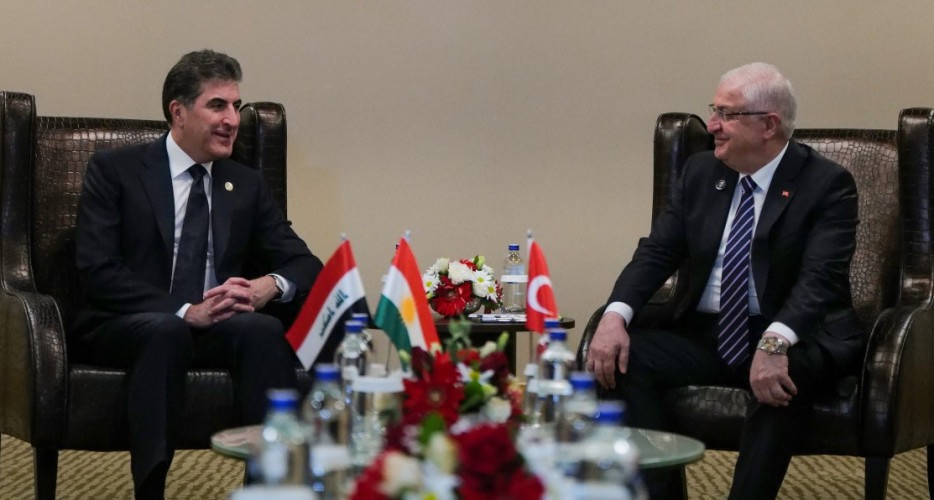
The President of the Kurdistan Region and Turkey’s Minister of Defense held a meeting, stressing the importance of revitalizing the peace process in Turkey, describing it as "critical and historic." This comes as Turkey continues its attacks and airstrikes in the Kurdistan Region under the pretext of targeting PKK guerrillas.
Nechirvan Barzani, President of the Kurdistan Region, met today with Yaşar Güler, Turkey’s Minister of Defense, on the sidelines of the Antalya Diplomacy Forum. According to the Kurdistan Region Presidency, the meeting addressed relations between Turkey, Iraq, and the Kurdistan Region, as well as joint efforts to maintain stability and security in the area.
"Both sides emphasized the importance and historic nature of the peace process in Turkey and stressed the need to work toward its advancement. They also agreed on the importance of regional cooperation among neighboring countries to preserve stability, prevent further escalation, and distance the region from crises," the Kurdistan Region Presidency stated.
This meeting takes place amid the PKK’s declaration of a unilateral ceasefire and the initiation of a new peace process in Turkey to address the Kurdish issue. However, Turkey’s military operations and airstrikes in the Kurdistan Region persist.
According to the Community Peacemaker Teams – Iraqi Kurdistan (CPT), which monitors conflict zones, Turkish warplanes bombed the Qandil and Gara mountains in Duhok province on the night of the 9th of this month. Additionally, Turkish soldiers opened fire on villages in the Shiladze area.
Kamaran Osman from CPT reported, "Turkish soldiers fired from their military outposts toward the village of Birya Sheikh in the foothills of Mount Qandil. A bullet struck the home of a civilian named Bakhtiar Muhammad Rasul, who is married with two children. The entire family was asleep when the bullet penetrated their window."
No civilians were killed in the attack, but it caused fear and panic among local residents.
According to ongoing monitoring, Turkish airstrikes and cross-border military operations, particularly in Duhok province, continue under the pretext of preempting PKK movements. This comes after Abdullah Öcalan, in late February 2025, announced a peace initiative, which was welcomed by Turkish authorities.
The PKK leadership, while declaring a unilateral ceasefire within the framework of Öcalan’s initiative, retains the right to retaliate against ongoing Turkish military aggression.
In the context of Turkey’s peace process, a delegation from the Peoples' Equality and Democracy Party (Dem Party) met with Turkish President Recep Tayyip Erdoğan on the 10th of this month at the Presidential Palace. The delegation plans to visit Abdullah Öcalan in İmralı Prison and relay the content of their discussions with Erdoğan.
Pervin Buldan, a Dem Party parliamentarian and member of the delegation, described their meeting with Erdoğan as a "new phase" in the resolution process. She stated, "We discussed steps toward resolving the issue, including improving Öcalan’s conditions and initiating a process regarding prisoners, particularly those who are ill or eligible for amnesty. President Erdoğan did not react negatively."
Buldan added that the Turkish Parliament is crucial for advancing the peace process, requiring legal steps, including the potential physical freedom of Abdullah Öcalan. To this end, the Dem Party delegation plans to meet with Turkey’s Minister of Justice to discuss legal measures.
Abdullah Öcalan, on February 27 of this year, called on PKK guerrillas to lay down their arms and dissolve the Kurdistan Workers' Party. In response, the PKK declared a ceasefire but emphasized its readiness to participate in a congress under Öcalan’s leadership to decide on disarmament and dissolution.
Öcalan, imprisoned in Turkey for 26 years, has previously initiated peace efforts, including a 2013 ceasefire that lasted until mid-2015 before collapsing into renewed conflict.
Villagers in Duhok province hope for the success of the peace process and the silencing of weapons between the Turkish military and PKK fighters so that calm can return to their areas and village life can resume. However, the peace process has yet to reach the borders of the Kurdistan Region.
The decades-long conflict between Turkey and the PKK, which has intensified in Duhok over the past year, has led to the displacement of residents from 1,190 villages in the Kurdistan Region. According to the Community Peacemaker Teams – Iraqi Kurdistan, 721 civilians in the region have been killed.
Iraq shares a 362-kilometer border with Turkey, 300 kilometers of which is land and the rest water. The rugged, mountainous terrain, particularly in the tri-border area between Iraq, Iran, and Turkey, makes it difficult for Iraq to maintain control. Historically, there have been no permanent military posts along this border.
Turkey has effectively occupied over 86% of its border with Iraq, penetrating 5 to 40 kilometers deep, and has established 74 military bases and outposts within the Kurdistan Region’s territory.