Peregraf Exclusive: Al-Maliki Pushes to Extend Al-Sudani Government, Seeking Early Elections Following Trump’s Rejection
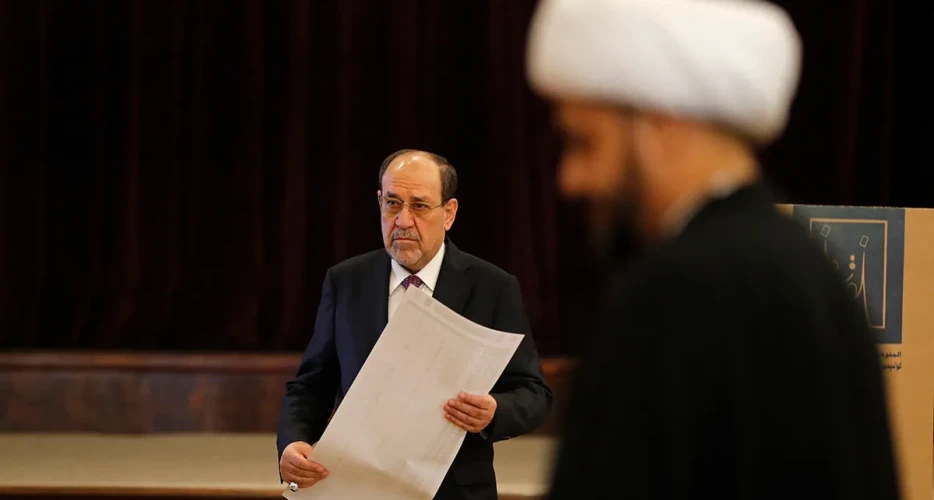
Peregraf - As Iraq’s post-election negotiations stall, former Prime Minister Nouri al-Maliki—the official nominee of the Shiite Coordination Framework to form a new cabinet—has proposed a plan that would significantly reshape the country’s political timeline: extending the tenure of Prime Minister Mohammed Shia’ al-Sudani’s caretaker government for two years to pave the way for early parliamentary elections.
According to three senior Kurdish and Arab political sources in Baghdad, al-Maliki is pressing for this extension to break the deadlock following U.S. President Donald Trump’s public opposition to his return to the premiership. The sources indicate that the move reflects al-Maliki’s calculation that early elections could reset the political balance in his favor while avoiding an immediate confrontation over naming a new prime minister.
The proposal comes at a moment of deep division within Iraq’s Shiite political sphere. Al-Maliki is the official nominee of the Shiite Coordination Framework, the parliamentary bloc that holds a majority, but Trump’s intervention has fractured what was already a fragile alliance. Some Shiite parties insist on backing al-Maliki as a matter of principle and sovereignty, while others are quietly searching for an alternative candidate to avoid provoking Washington.
"He wants early parliamentary elections, and for that, he is asking that the current al-Sudani cabinet continue for another two years," one high-ranking source told Peregraf. The same source added that the proposal is facing resistance from within the Shiite coalition itself, where many factions fear the political risks of returning to the polls.
These fears are both practical and political. Several parties worry they would fail to repeat their success from the November 2025 elections. Among them, according to a senior informed source, is Asa’ib Ahl al-Haq, led by Qais al-Khazali. Others fear that early elections could open the door to a political comeback by the populist cleric Muqtada al-Sadr, whose withdrawal from parliament reshaped Iraq’s political landscape but whose support base remains highly mobilized.
There are also legal and administrative obstacles. Eight ministers from al-Sudani’s current cabinet have since been elected to parliament, taken their constitutional oaths, and vacated their ministerial posts. Extending the life of a cabinet that has already been partially depleted would raise complex constitutional questions.
Publicly, Shiite leaders have often framed the stalemate as a consequence of the unresolved presidential election—a position traditionally allocated to the Kurds, who remain divided between the Kurdistan Democratic Party (KDP) and the Patriotic Union of Kurdistan (PUK). However, reporting by Peregraf suggests that this explanation obscures the deeper issue.
Under Iraq’s constitution, once a president is elected, they must immediately task the nominee of the largest parliamentary bloc—in this case, the Shiite Coordination Framework—with forming a government. The real delay, several sources said, lies in the Shiite camp’s inability to agree on whether al-Maliki should be that nominee.
Trump’s rejection has forced Shiite leaders into what one political insider described as "two bitter options." Replacing al-Maliki would be viewed by his supporters as an erosion of Iraqi sovereignty and a humiliating retreat under foreign pressure. However, insisting on his nomination risks a direct rupture with the United States—a scenario many fear could push Iraq into economic and diplomatic isolation.
The warning from Washington has been unusually blunt. On January 27, President Trump stated he was hearing that Iraq "might make a very bad choice by reinstalling Nouri al-Maliki as Prime Minister," arguing that during al-Maliki’s previous tenure the country "descended into poverty and total chaos." Trump added that if al-Maliki were to return, the United States would withdraw its support, leaving Iraq with "ZERO chance of success, prosperity, or freedom," and punctuated his message with the slogan "MAKE IRAQ GREAT AGAIN!"
These remarks came just days after the Coordination Framework, meeting at the office of Hadi al-Amiri on January 24, formally announced al-Maliki as its candidate for prime minister. The alliance cited a majority vote and al-Maliki’s experience, insisting it was acting within constitutional bounds.
Nouri al-Maliki responded to the sharp criticism from the U.S. President by stressing respect for Iraq’s national will and rejecting what his party described as foreign interference in the country’s internal affairs.
Al-Maliki’s record, however, remains deeply polarizing. He served as prime minister from 2006 to 2014, a period marked by sectarian division, mass protests, and severe security breakdowns, culminating in the rise of ISIS and the collapse of large parts of the Iraqi security forces.
What elevates the current standoff from a familiar political crisis to a potential existential threat is Iraq’s economic vulnerability. Nearly all of the country’s oil revenues are held in U.S. dollars under American oversight, a system that gives Washington enormous leverage.
Finance Minister Taif Sami has sought to reassure public employees that salaries will continue to be paid on time this year. Privately, however, she has warned lawmakers that a deterioration in relations with the Trump administration could have devastating consequences. According to Ahmed Haji Rashid, a member of parliament, Sami told a meeting on February 8 that Iraq’s economy remains acutely exposed to shifts in U.S. policy. "If our relationship with Trump breaks down, our economic situation will become very dire," she said.
Warnings have also come from within the Coordination Framework itself. Ammar al-Hakim, head of the National State Powers Alliance, expressed "deep regret" on January 31 over Trump’s statement rejecting al-Maliki, while urging adherence to constitutional timelines and the election of a president to resolve the crisis. He cautioned that escalating tensions with Washington could carry serious economic costs.
From outside the Shiite camp, the language has been even harsher. Mohammed al-Halbousi, leader of the Sunni Taqadum Party, called backing al-Maliki against Trump "catastrophic." Speaking to Dijlah TV on February 5, al-Halbousi said Iraq was still paying the price for al-Maliki’s years in power. "Our experience with al-Maliki was bitter for all Iraqis, and even after ten years, we have not escaped the problems of that era," he said.
Al-Halbousi argued that Iraq needs a prime minister with strong international and Arab ties—qualities he claimed al-Maliki lacks. He revealed that U.S. officials had privately warned Iraqi leaders before Trump’s public statements that al-Maliki’s nomination would be unacceptable, even raising the possibility of closing the U.S. Embassy in Baghdad and relocating it to Erbil.
"Not a single Arab or Western country supports al-Maliki," al-Halbousi said. "Iran is his only supporter."
As Baghdad weighs al-Maliki’s proposal to extend the al-Sudani government, Iraq finds itself trapped between constitutional maneuvering, factional rivalries, and unprecedented external pressure. Whether the political class can find a compromise before these forces collide may determine not only the next government but the country’s economic and diplomatic future.