Minorities Fear Demographic Shift: Land Distribution Policies Spark Concern in The Kurdistan Region
By Peregraf — Duhok
The distribution of residential land in the Kurdistan Region, intended as a reward for civil servants, has conversely become a source of distress for religious and ethnic minorities.
A wave of intense concern and fear has emerged among minority groups, particularly Christians and Yazidis, regarding the areas designated for land allocation. They view these policies as a threat that could lead to "demographic change" in their ancestral homelands.
While the government’s land distribution campaign is underway across all provinces of the Kurdistan Region, nowhere has it met as much resistance as in Duhok, followed by Erbil.
A Sensitive Region
In the Duhok Governorate, two rounds of land distribution have taken place so far, totaling nearly 2,000 plots. Most of these plots are located in the Simel District, a sensitive area inhabited by Yazidis and Christians.
"According to the law and all official procedures, these lands belong to us. We will not accept any individual or party seizing our property, and we will not allow the re-zoning (extinguishing) of our agricultural lands for residential use," Shmuel Zaya, the Mukhtar of Bakhtme village, told Peregraf.
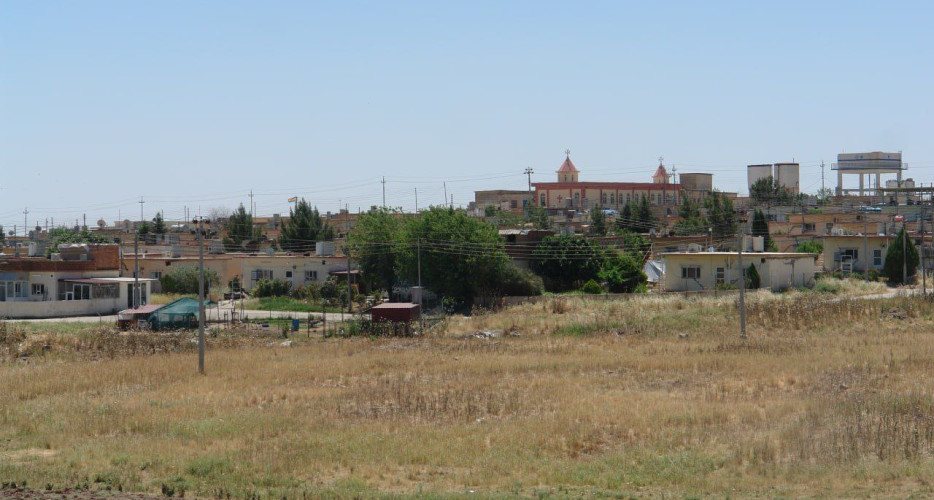
Bakhtme is an ancient Christian village in the Simel District covering more than 5,500 dunams. Of the more than 5,000 families that once belonged to the village, only about 100 families remain today.
The total Christian population in Iraq has dwindled to fewer than 300,000. Before the 2003 invasion and the fall of the Ba'ath regime, the population exceeded 1.5 million. Since 2014, the majority were forced into displacement or migration by ISIS.
The Mukhtar of Bakhtme explained that those who remain depend on the land for their livelihoods, primarily farming wheat and barley. According to local residents, these lands were officially registered (Tapu) and purchased from the Iraqi government decades ago.
Efforts to stop land distribution in Christian areas have reached the Kurdistan Parliament and the international community. "We are working to ensure our lands remain ours. If any action is taken against this community, no one will remain in the village; it will be completely abandoned," Zaya added.
Christianity is the second-largest religion in Iraq after Islam. It is recognized by the Iraqi Constitution, which guarantees the community the right to use their language, practice their religion, and preserve their culture.
Various regions of the Kurdistan Region are home to Christians, Turkmen, Yazidis, Shabaks, Kaka’is, and Mandeans. There are over 200,000 Christians in the region, with approximately 60,000 residing in Duhok.
"Throughout history, there have been frequent attempts to change the demographics of Yazidi-populated areas, particularly in this border region and the Shariya complex. But the Yazidis have never accepted it," said Shukri Rashid, a Yazidi woman living in the Khanke sub-district of Simel. "We have defended our land with our lives, and we are ready to do so again."
Khanke consists of 18 villages with a population of over 10,000, mostly Yazidis. Recent protests were sparked when 41 plots of land were allocated to Muslim and Christian civil servants in the area. Before 2014, the Yazidi population in Iraq was 550,000; however, 360,000 were displaced and over 100,000 migrated abroad, according to KRG statistics. Most currently reside in Sinjar, Sheikhan, Bashiqa, and the Nineveh Plains.
Rashid is suspicious of why these issues resurface periodically. "This matter is regulated by law. No party should be allowed to change the demographic character of Yazidi areas."
Under the Law for the Protection of the Rights of Components in the Kurdistan Region, any policy or action that results in a demographic change in areas where specific minorities reside is prohibited.
Domestic Despair and International Attention
Concerns over demographic change are not new. Various committees were formed in 2018, 2020, and 2021 to address Christian land disputes, yet the issues persist.
The General Directorate of Christian Affairs in the Kurdistan Region has expressed "a degree of hopelessness" regarding a permanent solution.
Khalid Jamal, Director of Christian Affairs at the KRG Ministry of Endowment and Religious Affairs, told Peregraf: "The issue of demographic change in Christian areas exists in Duhok and Erbil, including Ankawa and lands near the Erbil International Airport. Some have been compensated, but others have not."
Jamal noted that these cases have gained international attention and are featured in annual reports by organizations such as Amnesty International.
Despite the formation of committees, the reality on the ground suggests that the issue remains a serious threat to coexistence and the survival of indigenous communities. Minorities are now demanding practical action rather than promises.
Recently, four Christian political parties (the Assyrian Democratic Movement, the Beth Nahrain Democratic Party, the Beth Nahrain Patriotic Union, and the Assyrian Patriotic Party) issued a statement demanding a halt to the re-zoning of agricultural land in Christian areas and the legal return of properties to their original owners.
Yazidi political representatives have also voiced concerns. Khal Ali, spokesperson for the Yazidi Cause Alliance in Sinjar, told Peregraf that while they do not object to the government rewarding civil servants, it should not be done on Yazidi land. He suggested that land for Muslim employees be allocated in Muslim-populated areas, and Yazidi land be reserved for Yazidis.
"Unfortunately, there is a concerted effort to change the demographics of Yazidi areas like Khanke and Shariya, which is illegal," Ali said. He pointed to the district of Sheikhan—a disputed area administered by Duhok—as a cautionary tale. "Yazidis were once the majority in Sheikhan; now they are a minority. We fear other areas will suffer the same fate."
The Iraqi Constitution prohibits ownership of property for the purpose of demographic engineering. Khalid Jamal explained that there are two types of land in the region: Mulk Sirf (private property) and Mamluk lil Dawla (state-owned but traditionally farmed by families).
"The problem is that even when courts issue a ruling, it is often not implemented due to the influence of tribal leaders or nepotism," Jamal concluded. "But justice must eventually be served, and rights must be returned to their owners."