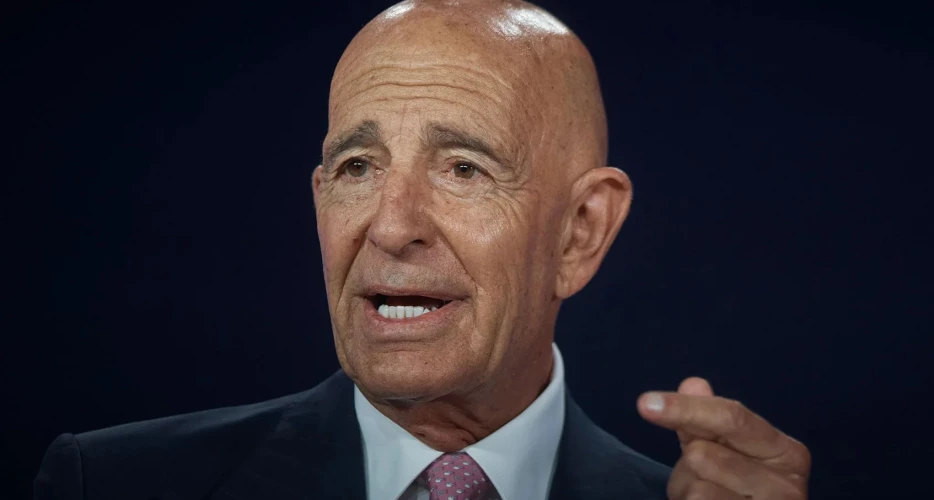
Peregraf - For many Kurds, the name Tom Barrack has come to symbolize a deepening mistrust—a belief that American diplomacy in the Middle East is tilting toward Ankara, and that Washington’s commitments to its Kurdish partners are being quietly revised.
That resentment has sharpened in recent days after Barrack’s name appeared in newly released Justice Department records related to the late financier and convicted sex offender Jeffrey Epstein.
Barrack, a billionaire real estate investor and longtime confidant of President Donald Trump, occupies an unusually influential position in U.S. foreign policy. He serves simultaneously as ambassador to Türkiye and as the president’s special envoy for Syria, with expectations that he will assume responsibility for Iraq as well. Few American officials exert comparable influence over the future of northeastern Syria, where Kurdish-led forces continue to govern large areas known to Kurds as Rojava.
Among Kurds, Barrack is a polarizing figure. His public statements and diplomatic engagement over the past year have been widely interpreted as aligning U.S. policy more closely with Turkish priorities—particularly Ankara’s insistence that the Syrian Democratic Forces (SDF), Washington’s principal partner in the fight against the Islamic State, are inseparable from the Kurdistan Workers’ Party (PKK), which Türkiye designates as a terrorist organization.
Kurdish officials and civil society leaders say their unease stems less from any single statement than from a consistent shift in tone. Since assuming his role as Syria envoy, Barrack has emphasized Türkiye’s "legitimate security concerns," while largely avoiding public references to Kurdish self-administration or political rights.
Barrack has rejected accusations that he is acting on Türkiye’s behalf. Still, critics argue that his dual role as ambassador to Ankara and envoy to Syria blurs diplomatic boundaries that are typically kept distinct—particularly when U.S. allies and partners find themselves in conflict.
The Epstein Documents
The renewed attention follows the January 30 release of millions of pages of Justice Department records related to Jeffrey Epstein, made public under a congressional transparency law passed last year. The files include emails, schedules, and contact lists spanning decades.
Among them are email exchanges between Epstein and Barrack from 2016 and 2017, when Barrack was advising Donald Trump’s presidential campaign and later chaired the president’s inaugural committee. In one 2016 email, Epstein asked Barrack to "send photos of you and child — make me smile," later responding, "Photos look good."
The documents do not clarify what Epstein meant by "child," nor what images, if any, were sent. Barrack held no government position at the time of the correspondence. The Justice Department has emphasized that inclusion in the files does not imply criminal conduct, and there is no allegation linking Barrack to Epstein’s sexual crimes.
The records also show that Epstein and Barrack exchanged messages about dinner invitations, business introductions, and meetings with prominent figures in finance and politics. Epstein at one point facilitated an introduction between Barrack and technology investor Peter Thiel, and encouraged Bill Gates to meet with Barrack, describing him as a central figure in Washington.
For Kurdish observers already skeptical of Barrack’s role, the disclosures have reinforced an image of a diplomat deeply embedded in elite global networks where power, money, and influence often operate beyond public scrutiny.
A History of Controversy
Questions about Barrack’s proximity to power are not new. In 2021, he was indicted on charges of acting as an unregistered agent of the United Arab Emirates while lobbying the Trump administration. He was acquitted the following year. Though unrelated to the Epstein documents, the case underscored broader concerns about the intersection of private business interests, foreign governments, and U.S. policy.
For many Kurds, these episodes form a pattern. They view Barrack as a diplomat shaped less by human rights considerations than by relationships with states that regard Kurdish autonomy as a strategic threat.
The timing of the Epstein disclosures has intensified, rather than created, Kurdish frustration. In northeastern Syria, where American forces continue to operate alongside Kurdish-led units, the sense of abandonment is already pronounced. Barrack’s role is not merely symbolic; Kurdish leaders believe decisions affecting their security and political future are increasingly being made by officials whose priorities lie elsewhere.
A Test of Trust
Barrack remains one of President Trump’s closest allies, valued for his deal-making instincts and regional connections. The White House has given no indication that the Epstein disclosures will affect his standing, and in Washington, the matter is widely considered closed.
In Kurdish regions—from Erbil and Sulaymaniyah to Qamishli—it is not. There, Barrack’s name has become shorthand for a broader anxiety: that loyalty in war does not guarantee protection in peace.
As the United States recalibrates its role in a volatile Middle East, many Kurds say the central question is no longer whether Tom Barrack knew Jeffrey Epstein, but whether Washington fully grasps what it risks losing by distancing itself from those who once fought its wars.