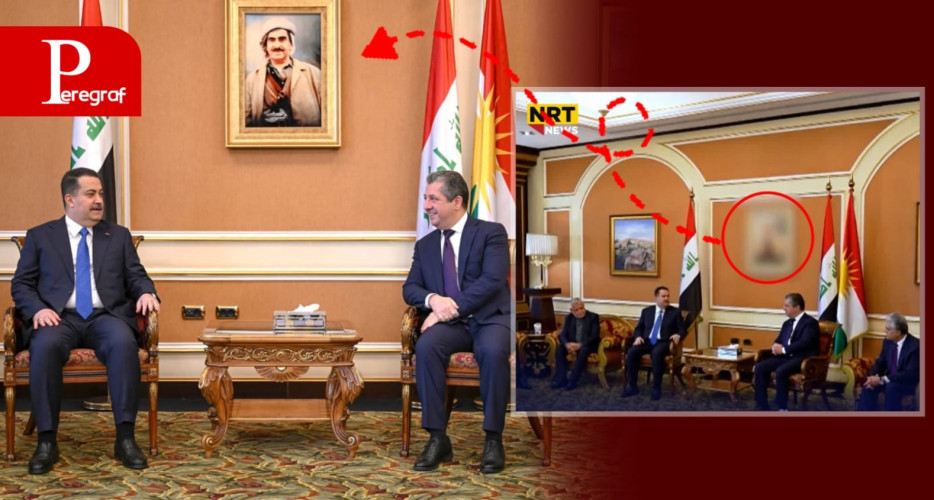
Peregraf- Kurdistan region government (KRG) Security forces on Tuesday closed the offices of NRT television channel in Erbil and Duhok, a move that has reignited controversy over media freedom and the legal basis for shutting down media outlets in the Kurdistan Region.
According to NRT management, the closures were carried out without prior notice or the presentation of a court order at the time of the raids. Hersh Qadir, Director of NRT’s Erbil office, said two security units entered the premises and ordered an immediate shutdown, describing the decision as “political rather than legal.”
Erbil Governor Omed Khoshnaw later confirmed the closure, stating that the Public Prosecutor had filed a lawsuit against NRT, and that a judge ordered the closure based on Decision No. 7 of 1997, issued by the Kurdistan Parliament. The decision mandates the display of a photograph of the late Kurdish leader Mullah Mustafa Barzani in all official institutions of the Kurdistan Region.
Speaking to KDP-affiliated media, Khoshnaw rejected claims that a party force was involved, saying the action was purely legal. He accused NRT of repeatedly “disrespecting national symbols” and of “distorting Barzani’s image” in its recent coverage. He added that NRT’s Erbil office had been summoned by officials from the Governorate, Internal Affairs, Legal Affairs, and the Ministry of Culture, and was shown documentation related to the case.
“The Public Prosecutor initiated the lawsuit, and once the judge’s order was issued, the Governorate referred it to the police for implementation,” Khoshnaw said, stressing that the closure was carried out after legal procedures were completed.
However, the decision has drawn sharp criticism from journalists, legal experts, and media rights advocates, who argue that Decision No. 7 of 1997 does not provide any legal basis for closing a media outlet, particularly one operating under the Press Law.
Decision No. 7 of 1997 consists of three articles, the first of which requires the photograph of Mullah Mustafa Barzani to be displayed in official institutions affiliated with the Kurdistan National Assembly and Kurdistan Region authorities. The decision does not specify penalties, enforcement mechanisms, or sanctions for non-compliance, nor does it mention media organizations or news channels.
In contrast, Press Law No. 35 of 2007, which regulates journalistic and media activity in the Kurdistan Region, explicitly protects freedom of the press and does not include any article or clause permitting the closure of media outlets. The law emphasizes judicial due process, proportional penalties, and the protection of journalistic work, even in cases of alleged violations.
In a strongly worded statement, Nalia Media Corporation, the owner of NRT, condemned the closures as “a blatant assault on journalism and journalists.” The company said its offices were raided “through the use of security forces and in the name of the government,” and that NRT teams were prevented from removing their equipment. It also claimed that a de facto ban had been imposed on NRT’s work in KDP-controlled areas.
The statement noted that the Ministry of Culture had expressed a lack of awareness regarding the decision and stressed that the Press Law does not allow for the shutdown of media institutions. Nalia Media Corporation called on foreign consulates and local and international organizations defending journalists to intervene and pressure the authorities.
“The closure of media outlets under any pretext narrows the space for freedom of expression and damages the reputation of the Kurdistan Region,” the statement said, adding that NRT would continue its journalistic mission despite the closure.
The incident has once again highlighted the ongoing tension between political authority and press freedom in the Kurdistan Region, particularly amid the absence of a unified and consistently applied legal framework governing media activity.