Second Collapse of Iraq’s Presidential Session Amid Kurdish Divisions and Maliki Dispute
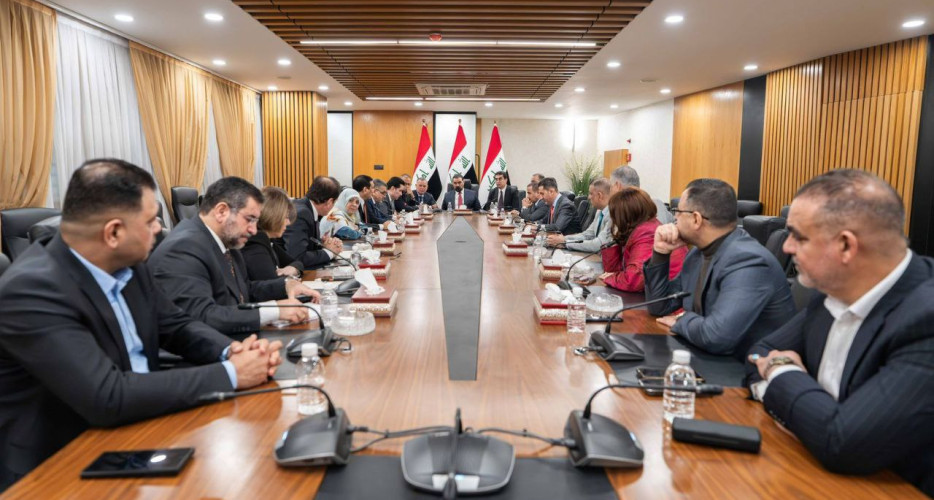
Peregraf — Iraq’s Parliament has postponed the presidential election for a second time, as entrenched disputes among Kurdish and Shiite political forces continue to block consensus, pushing the country deeper into a constitutional and political impasse.
Following the failure on Sunday to convene a session to elect the President of the Republic—despite it being widely described as the final constitutional deadline—the Presidency of Parliament met with the heads of major political blocs and agreed to delay the session until either next Thursday or Saturday. Officials described the new date as the “final opportunity” to resolve outstanding disputes.
A political source in Baghdad told Peregraf that the exact date has not yet been finalized. “The decision has been left to developments over the next few days and the extent to which political parties can reach agreements,” the source said, stressing that “this is the last chance for the parties to settle their differences and agree on candidates for both the presidency and the prime ministership.”
Kurdish and Shiite Disputes at the Core
The presidency, constitutionally allocated to the Kurds, remains stalled due to disagreements between the Kurdistan Democratic Party (KDP) and the Patriotic Union of Kurdistan (PUK), which have failed to agree on a single joint candidate.
Muthanna Amin, head of the Kurdistan Islamic Union (KIU) bloc and himself a presidential candidate, placed responsibility squarely on the two dominant Kurdish parties. “The main reason for the delays is the KDP and the PUK, which cannot agree on one candidate and refuse to accept anyone outside their own circles,” Amin said.
He added that divisions within the Shiite Coordination Framework over the nomination of a prime minister have compounded the crisis. “Conflicts over the prime ministerial candidate have also played a major role in disrupting parliamentary sessions,” he noted.
A high-level informed source told Peregraf that Shiite forces, despite their own internal disagreements, have increasingly blamed the Kurdish parties for the paralysis. According to the source, Shiite blocs have warned that if either the KDP or the PUK boycotts the session, they too will refrain from attending, making it impossible to reach the required quorum.
“Without a prior agreement between the two main Kurdish parties—or a broader understanding between the Kurds and the Shiite forces, which hold a parliamentary majority—the session will not be held,” the source said.
Constitutional Deadlines Missed
The presidential election was initially scheduled for Tuesday, January 27, 2026. At that time, January 28 was identified as the constitutional deadline, marking the end of the 30-day period stipulated for electing a president. Later, Sunday was described as the final deadline, yet Parliament again failed to convene.
While the earlier postponement was made at the request of the KDP and PUK to allow time to reach a joint Kurdish nominee, Sunday’s delay was primarily attributed to Shiite disputes over the prime ministerial candidate. Under Iraqi law, the election of the president must be immediately followed by the designation of a prime minister to form the cabinet, linking the two processes inseparably.
According to Parliament’s official agenda, Sunday’s session was scheduled to begin at 11:00 a.m., but more than an hour passed without proceedings starting, confirming the lack of quorum.
Maliki Nomination and U.S. Factor
The political deadlock has been further complicated by controversy surrounding the nomination of Nouri Kamil al-Maliki for prime minister. A senior source described the situation within Shiite ranks as “a state of political complexity.”
“Replacing Maliki is seen by some as a failure or humiliation, while keeping him poses a serious problem for Iraq,” the source said, warning that following U.S. President Donald Trump’s public rejection of al-Maliki’s nomination, Iraq could face a major crisis if Washington refuses to engage with the next government.
Despite this, Iraq’s Shia Coordination Framework on Saturday reaffirmed its commitment to nominating al-Maliki. In a statement issued after its 261st regular meeting, held at al-Maliki’s office on January 31, the Framework said the selection of the prime minister is a purely Iraqi constitutional matter, conducted according to political mechanisms and national interests, and free from external interference.
The bloc emphasized its desire to maintain balanced relations with the international community while rejecting outside pressure. Iraqi media reported that Ammar al-Hakim, head of the National State Powers Alliance, did not attend the meeting.
Earlier, al-Hakim had expressed deep regret over Trump’s rejection of al-Maliki’s nomination, stressing the importance of adhering to constitutional deadlines and prioritizing Iraq’s national interests. He warned that escalating political tensions could carry serious economic consequences and said his movement does not seek obstruction, but rather solutions that serve the public interest.
Talks with Kurdistan Leaders
In an effort to break the deadlock, a delegation from the Coordination Framework—including Hadi al-Amiri, Mohammed Shia’ al-Sudani, and Mohsin al-Mandalawi—is scheduled to visit the Kurdistan Region on Monday. The delegation is expected to meet KDP leader Masoud Barzani in Erbil and PUK leader Bafel Talabani in Sulaymaniyah.
Kurdistan Region Prime Minister Masrour Barzani said on Saturday that no agreement has yet been reached. “Erbil is awaiting the arrival of the Coordination Framework delegation to discuss both the presidential and prime ministerial files,” he told reporters.
Growing Pressure and Threats of Dissolution
The repeated postponements have created what many describe as a constitutional vacuum, fueling public frustration and political criticism. Mahmoud Falih, a member of Parliament, accused the legislature of violating the constitution and exceeding all specified deadlines.
“If the situation remains unchanged in the next session, I will initiate a petition to dissolve the current parliamentary term,” Falih warned.
Meanwhile, Iraq’s Supreme Judicial Council reiterated the need for full adherence to constitutional timelines for electing the president and appointing the prime minister, cautioning that continued delays could threaten political stability and undermine the democratic process.
As Iraq’s political forces prepare for what is being billed as a final opportunity to resolve the crisis, the coming days are expected to determine whether compromise can be reached—or whether the country will slide further into uncertainty.