Al-Sudani Launches Iraq’s Largest Pharmaceutical City, Signs Major Agreements with Global Companies
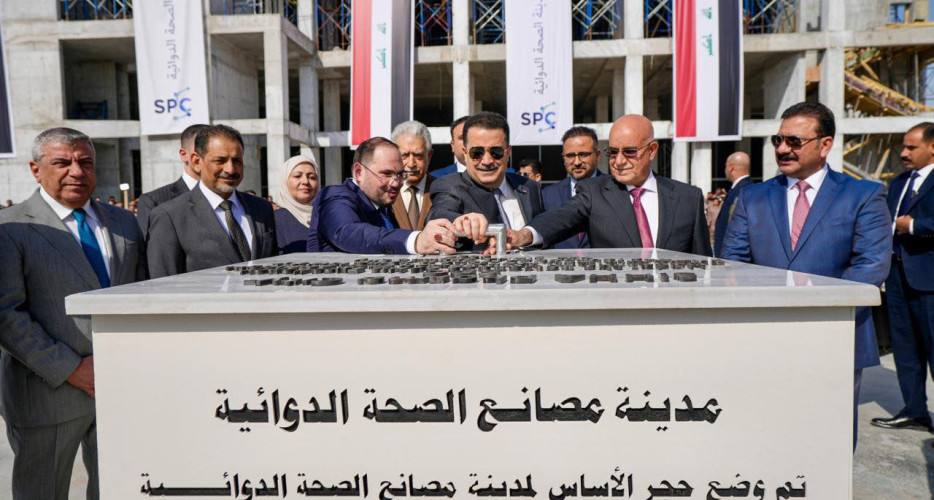
Peregraf- Prime Minister Mohammed Shia Al-Sudani on Sunday inaugurated the construction of Iraq’s largest pharmaceutical project, the Health City for Pharmaceutical Industries, in southern Baghdad, in a move he described as a landmark step toward advancing and localizing drug manufacturing in the country.
The project, spanning 120,000 square meters, was launched in the presence of Health Minister Saleh Mahdi al-Hasnawi and senior representatives of international pharmaceutical companies participating in its development.
$500 Million Investment in Five Major Factories
The Health City includes the construction of five specialized pharmaceutical manufacturing facilities, with total investments exceeding $500 million. According to government officials, the factories will focus on producing advanced medicines and medical supplies that Iraq currently imports at high costs.
The facilities are:
-
A biosimilar medicines plant in partnership with Hetero.
-
A plasma derivatives production plant in collaboration with Accord Healthcare (UK) and Prothya Biosolutions (Netherlands).
-
A peritoneal dialysis solutions plant, developed with Vantive (USA).
-
A pharmaceutical manufacturing facility in partnership with global firms.
-
A factory for medical textiles and disposable supplies, including sterile gowns, gloves, and masks.
The city will also feature supporting infrastructure such as refrigerated and sterile medical warehouses and solar-powered electricity generation stations, intended to make the project more sustainable and resilient.
Research and Development Center
Another key component of the project is the establishment of a pharmaceutical research and development center, in partnership with Sartorius (Germany). Officials said the center will serve as a hub for transferring technology, training local staff, and developing innovative medicines within Iraq.
"This is not only about building factories," Al-Sudani said at the launch ceremony. "It is about creating a comprehensive ecosystem for pharmaceutical production — from research and development to manufacturing and distribution."
From the project site, Al-Sudani inaugurated via videoconference three new peritoneal dialysis centers in Baghdad, Nineveh, and Erbil. These facilities are designed to improve access to treatment for patients with kidney failure, many of whom struggle with limited availability of dialysis services.
The Ministry of Health said the centers will reduce pressure on existing facilities and provide life-saving care closer to patients’ homes.
Agreements with Global Companies
In parallel with the launch, Al-Sudani oversaw the signing of three memorandums of principles with leading international pharmaceutical technology companies. The agreements cover the production of biosimilar medicines for cancer and autoimmune diseases, plasma-derived therapies, and the establishment of the research and development center.
The first agreement was signed between the Ministry of Health, the Iraqi private sector, and Accord UK. The second was signed between the Health City investor company and Abbott (USA). The third involved the same investor and Sartorius (Germany).
"These partnerships mark the beginning of a new era in Iraq’s healthcare sector," Al-Sudani said. "They will help ensure that Iraqis have access to high-quality, life-saving medicines without relying entirely on imports."
A Strategic Step for Iraq’s Health Sector
The prime minister hailed the collective efforts that led to the launch of the Health City, calling it one of the largest strategic projects in Iraq’s pharmaceutical sector. He stressed that the initiative reflects his government’s ambition to localize drug production, reduce dependency on imports, and enhance Iraq’s self-sufficiency.
Al-Sudani also underlined the project’s role in job creation, saying that the health sector could become a key source of employment for Iraqi youth in different specializations.
In his remarks, the prime minister emphasized the importance of securing Iraq’s pharmaceutical needs, comparing it to ensuring food and military security.
"Pharmaceutical security is no less important than food and military security," he said. "A country that cannot provide its people with medicines cannot claim to have a strong health system or national resilience."
He also reiterated his government’s support for the private sector, noting that Baghdad would take the lead in facilitating investments in healthcare.
"The government advances ten steps for every single step taken by the private sector toward investment in Iraq," he said. "Our role is to create an environment where local and international companies can invest with confidence."
Officials said the Health City has been designed to attract some of the world’s leading pharmaceutical companies. The aim is to bring advanced technology to Iraq, strengthen local capacity, and gradually position the country as a regional hub for drug manufacturing.
By focusing on biosimilars, plasma derivatives, and medicines for cancer and chronic diseases, the project addresses some of the most pressing healthcare needs in Iraq, where patients often face shortages and high costs for specialized treatments.
The government considers the Health City for Pharmaceutical Industries a cornerstone of its strategy to reform the healthcare sector. By combining local resources with international expertise, the project seeks to create a more sustainable and self-reliant system.
Al-Sudani stressed that the government will continue to take steps to modernize Iraq’s health services and ensure that investment projects benefit ordinary citizens.
"This is not a short-term initiative," he said. "It is a long-term vision that will help protect our people’s health, strengthen our economy, and provide opportunities for generations to come."
The launch of the Health City for Pharmaceutical Industries and the signing of agreements with global companies represent one of the most ambitious steps taken by Iraq in recent years to overhaul its healthcare sector. If successfully implemented, the project could reduce Iraq’s reliance on imported medicines, improve access to treatment for patients with cancer and chronic diseases, and create thousands of jobs.
For now, the government has set the foundation, but much will depend on effective implementation, cooperation with international partners, and sustained investment in Iraq’s pharmaceutical future.