Iraqi President at UN Highlights Climate Change and Economic Diversification as Key to Iraq’s Future
Peregraf
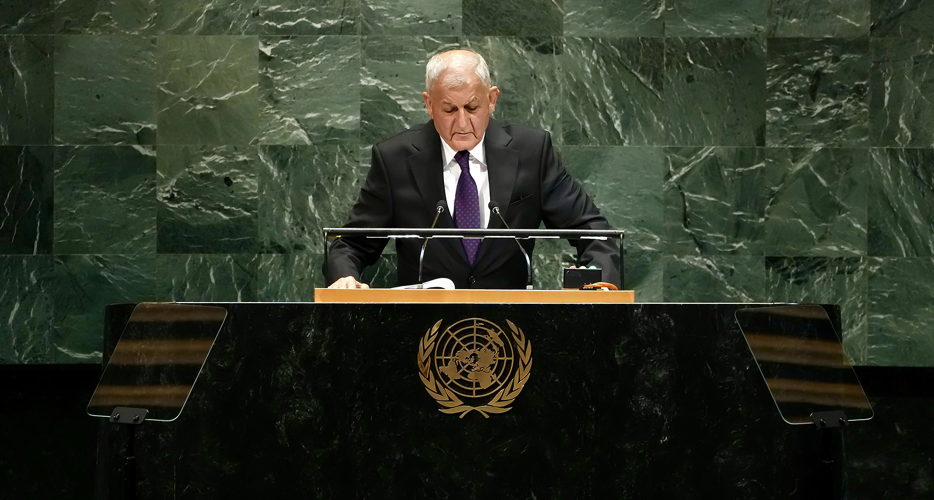
Iraqi President Dr. Abdullatif Jamal Rashid delivered a wide-ranging speech at the 80th session of the United Nations General Assembly, highlighting Iraq’s progress in democracy and stability while underscoring urgent challenges, particularly climate change and economic diversification.
Addressing world leaders in New York, President Rashid stressed that Iraq has "restored its natural position in the international community," pointing to its current presidency of the Arab Summit and the Group of 77 and China. He emphasized Iraq’s role in global and regional organizations, including the United Nations, OPEC, and the Non-Aligned Movement, describing the country as "a point of connection between East and West."
The President reaffirmed Iraq’s commitment to democratic principles, noting preparations for the sixth parliamentary elections in the coming weeks. "We are committed to ensuring free, fair, and transparent elections, maintaining equal distance from all parties," he said, describing Iraq’s experience with peaceful transfers of power as a rare example in the region.
Turning to security, Rashid reminded the Assembly that Iraq had overcome "the most dangerous terrorist threat the world has witnessed," but urged international accountability for those who fund or shelter extremist groups. He also underlined Iraq’s ongoing work to return displaced families and reconstruct cities devastated by the Islamic State.
A significant portion of the address was devoted to Iraq’s economic and environmental future. The President stressed the need to move beyond oil dependency and build a diversified economy. "Iraq is working to achieve sustainable economic and social development by activating and investing in our country’s enormous potential," he said, pointing to opportunities in agriculture, industry, electricity, water projects, and renewable energy.
On climate change, Rashid delivered one of the speech’s strongest messages. He warned that Iraq is among the countries most affected by rising temperatures, desertification, and water scarcity, with dust storms and declining river flows posing existential threats. "Water scarcity has become an existential challenge," he said, calling for international cooperation to manage shared rivers with neighboring Turkey and Iran.
He outlined Iraq’s environmental strategy, including developing renewable energy projects, reducing carbon emissions, and expanding green spaces. "We call on the international community to support our efforts technically and financially," Rashid added, stressing that climate action is tied to economic security and regional stability.
The President also used his platform to address regional conflicts, calling for an end to the war in Gaza and renewed efforts for a just solution to the Palestinian issue. He condemned attacks on neighboring countries and reiterated Iraq’s call for a Middle East free of weapons of mass destruction.
Concluding his address, Rashid framed Iraq’s vision as one of partnership rather than dependency. "Iraq’s message is clear: we do not ask for sympathy, but for partnership - to heal our land, secure our rivers, achieve our security, and empower our youth," he said.
The speech reinforced Iraq’s bid to reassert itself as a constructive regional player while seeking international backing to confront climate threats and economic challenges.