Peregraf
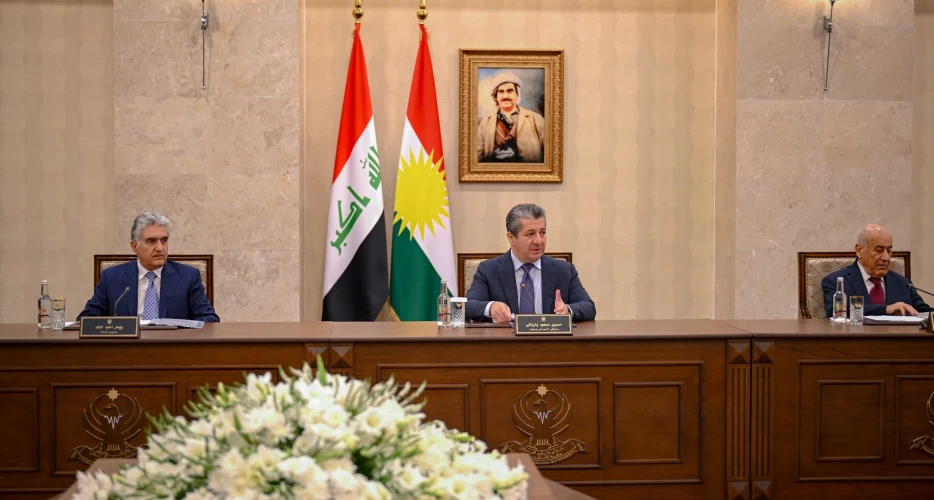
The Kurdistan Regional Government (KRG), in a meeting chaired by Prime Minister Masrour Barzani, announced that under a new understanding with Baghdad, all of the Kurdistan Region’s oil-except that used for domestic consumption-will be handed over to Iraq’s State Oil Marketing Organization (SOMO).
The KRG said the export of Kurdistan oil abroad now depends on the signing of a tripartite agreement between the KRG, the Iraqi federal government, and international oil companies. According to the KRG statement, negotiations have made "good progress" and a draft agreement is expected by the end of this week.
Until then, the KRG will initiate to deliver its share of oil to the federal Ministry of Oil. The Kurdistan Region Council of Ministers authorized the Minister of Natural Resources and the negotiating delegation to take all necessary measures, stressing that the Iraqi federal government must, in return, immediately send salaries.
The Council further underlined that the Iraqi Ministry of Finance must release the overdue salaries of July and August for Kurdistan Region employees and guarantee timely monthly payments going forward, in line with other parts of Iraq.
KRG spokesperson Peshawa Hawramani confirmed that an official written request has already been submitted to SOMO to hand over Kurdistan’s share of oil. "There is no justification for not sending salaries," Hawramani said. "The KRG has fulfilled all its obligations, and withholding salaries is unjustified," Hawramani claims.
Hawramani also noted that in its latest meeting, the Iraqi Council of Ministers gave the federal Oil Minister 48 hours to resolve the issue of Kurdistan’s oil exports. He added that oil production companies have agreed to operate under Iraqi law, dropping demands for foreign legal protection of their contracts.
According to the KRG, oil production capacity has returned to 233,000 barrels per day. Officials stressed that the resumption of exports would improve the financial situation of both Iraq and the Kurdistan Region.
The KRG reiterated its commitment to managing domestic revenues in line with Iraqi law, affirming that all its efforts are aimed at ensuring the protection of public sector salaries in the Kurdistan Region.
On Tuesday, SOMO announced it had completed all contracts and commitments with companies purchasing Kurdistan oil, emphasizing that renewed exports from the Region would help restore Iraq’s position as a key supplier to Europe.
Ali Nazar Al-Shatri, SOMO’s Director General, said that recent developments represented "a matter of understanding and establishing working mechanisms," underscoring that "the law applies to everyone." He explained that Baghdad and Erbil are now operating under a unified framework: "The oil produced is Iraqi oil, with the distinction being only in the relationship between the KRG and the operating companies."
Talks are ongoing between Baghdad, the KRG, and international companies to finalize mechanisms under the 2025 budget law to restart crude flows to Turkey’s Ceyhan port. For now, oil produced in the Kurdistan Region is used domestically, with exports to resume once surplus volumes become available.
"The resumption of exports will restore Iraq’s prestige as a primary source for the underserved European market, especially in light of the Russia-Europe crisis," Al-Shatri said, stressing that SOMO is ready to receive supplies once Erbil formally delivers them.
Under recent arrangements, the KRG must deliver at least 230,000 barrels per day to SOMO, in exchange for $16 per barrel in cash or derivatives. Current production stands at about 270,000 barrels, with 50,000 set aside for domestic needs and the rest earmarked for SOMO. Erbil officials have blamed drone attacks for limiting deliveries but have reiterated their commitment to hand over available volumes.
Exports from Kurdistan Region and Kirkuk have been halted since March 25, 2023, after an arbitration ruling stopped independent Kurdish sales via Ceyhan. The suspension has cost the Region and Iraq billions: Peregraf estimates Kurdistan’s direct losses at over $28 billion, while combined losses for both governments could exceed $50 billion.
A breakthrough agreement signed on August 11 set new terms for resumption, granting the KRG 50,000 barrels daily for domestic use while transferring the rest to SOMO. Still, challenges remain, including restoring full production capacity and addressing international companies’ demands for arrears and cost recovery.
Meanwhile, KRG public sector employees continue to face financial hardship, with many only now receiving their June salaries in September. Observers warn that progress on revenue-sharing talks will be decisive not only for restarting oil exports but also for easing the economic strain on citizens across the Kurdistan Region.