Peregraf
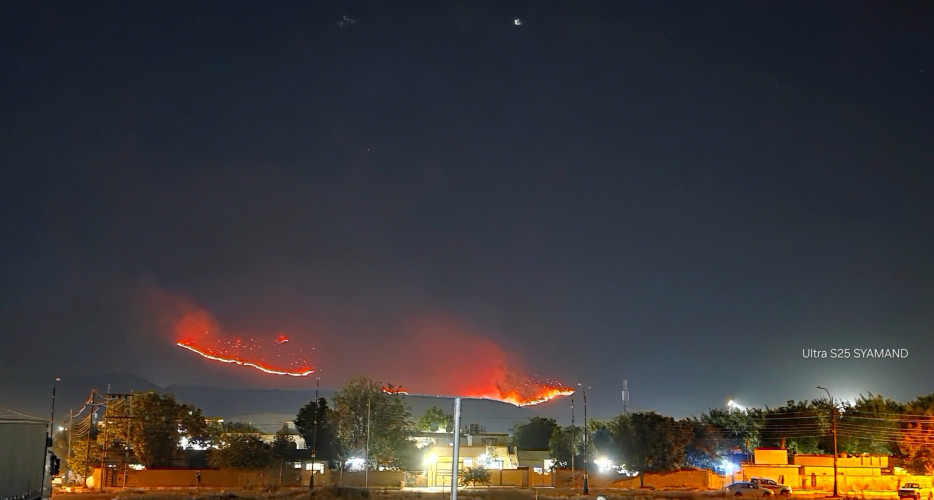
For the second consecutive day, wildfires have engulfed the mountains of Penjwen district in eastern Sulaymaniyah province, causing extensive damage to the region’s forests and agricultural lands. Despite continuous efforts, the fires have not yet been fully brought under control, local officials confirmed.
Two volunteer environmentalists were injured while attempting to extinguish the flames, with one of them reported to be in unstable condition. Firefighting teams and volunteers face mounting challenges in containing the blaze, as the mountainous terrain is rugged and littered with landmines and unexploded ordnance left from the 1980s Iran-Iraq war. The presence of these hidden dangers has forced teams to operate with extreme caution, slowing containment efforts.
The Penjwen wildfire comes on the heels of another deadly blaze in Halabja province earlier this month, where authorities declared two days of public mourning beginning August 19 after two men lost their lives during firefighting operations.
The victims were identified as Mohammed Haidar, a member of the Kurdistan Region’s Forest and Environment Police, and Ari Mukhtar, a prominent environmental activist. Haidar died on Sunday, August 18, while battling the flames, while Mukhtar lost his life a day earlier during efforts to control the fire in steep and heavily forested terrain.
Halabja Governor Nuxsha Nasih announced the mourning period, describing both men as “martyrs of Halabja and Kurdistan.” The fire, fanned by strong winds and fueled by the dense forests of Halabja’s mountains, raged for more than 48 hours, destroying thousands of trees, orchards, and large areas of farmland across several villages.
Deputy Prime Minister Qubad Talabani paid tribute to Mukhtar, calling him a “martyr environmentalist” and commending the bravery of those risking their lives to defend Kurdistan’s natural heritage.
“The martyrdom of Mr. Ari and the efforts of environmentalists to protect the forests, mountains, and nature of Kurdistan carry a deep humanitarian and patriotic message. Love and protection of the environment know no limits,” Talabani said, adding that the government would honor Mukhtar’s legacy by naming a site in Halabja after him.
Wildfires have increasingly threatened Iraq’s Kurdistan Region in recent years, driven by rising summer temperatures, prolonged droughts, and climate change. Experts warn that limited firefighting infrastructure and the lack of aerial firefighting equipment further hinder the response.
In both Halabja and Penjwen, local firefighters, civil defense units, and volunteers continue to struggle against the flames with minimal resources, while residents remain on alert for possible spread into nearby communities. Authorities have urged caution but admitted that without stronger support, the risk of further destruction remains high.
As Penjwen battles its ongoing blaze and Halabja mourns its losses, environmentalists warn that Kurdistan’s forests—already under severe pressure from logging and urban expansion—face irreversible damage unless urgent investment and stronger protection policies are introduced.