Turkey’s Parliamentary Commission on PKK Peace Process Convenes Again, Discussions to Remain Secret for 10 Years
Peregraf
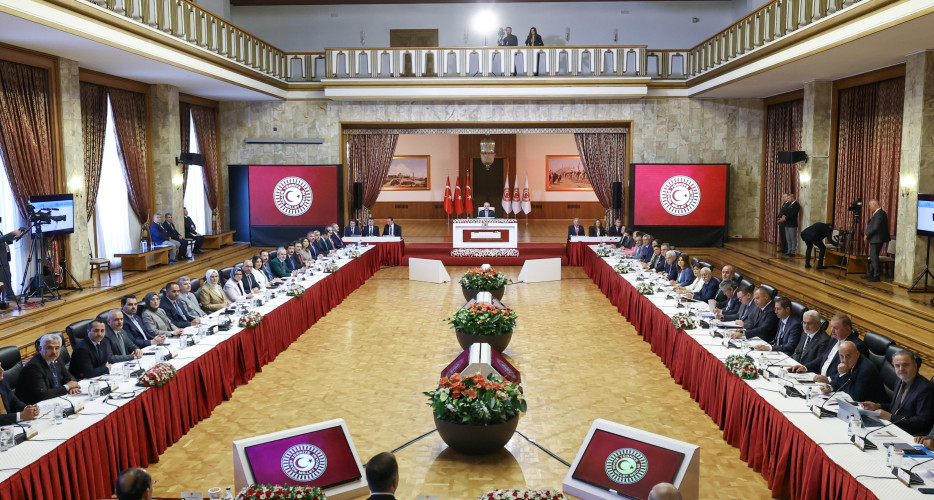
Turkey’s newly formed Parliamentary Commission on Democracy, Brotherhood and National Unity held its second closed-door session on Thursday, amid cautious optimism over renewed efforts to resolve the decades-long Kurdish issue and facilitate a peaceful settlement with the Kurdistan Workers’ Party (PKK).
The meeting took place in the guest hall of the Turkish Parliament and included high-level briefings from National Intelligence Organization (MIT) Chief İbrahim Kalın, Interior Minister Ali Yerlikaya, and Defense Minister Yaşar Güler. The trio addressed questions from commission members about the prospects for peace and the evolving status of negotiations.
Commission Chair and Speaker of Parliament Numan Kurtulmuş emphasized the sensitive nature of the proceedings, stating, “The discussions will be recorded, but they will not be made public. All the issues discussed at the meetings will remain confidential for up to 10 years.”
Following the precedent set by its inaugural session, the commission agreed that all subsequent meetings would be held behind closed doors, away from media coverage. Kurtulmuş cited the importance of discretion and unity in the process, stating, “The spirit of coalition is essential for the implementation of the decisions reached here through negotiation.”
He also stressed the broad representation of the body: “This commission represents 98 percent of Turkish society. We must carry out this process in line with the wishes and expectations of our people.”
Kurtulmuş further reiterated that the commission’s establishment signals a new phase of dialogue. “The formation of this body brings hope across Turkey. The main motivation behind it is the organization’s [PKK] declared willingness to end its armed struggle following the message conveyed from Imrali,” he said, referring to the prison where PKK leader Abdullah Öcalan is held.
The commission was established following a symbolic PKK disarmament ceremony held on July 11 in the Jasana Cave, located in Iraq’s Sulaymaniyah province within the Kurdistan Region. In the first public act of disarmament since the PKK’s founding nearly five decades ago, 30 guerrilla fighters—15 men and 15 women—burned their weapons before returning to their mountain bases to begin preparing for a transition into civilian political life.
The event came just two days after Abdullah Öcalan, imprisoned since 1999, made a surprise video appearance—his first in 26 years—announcing the end of the PKK’s armed campaign. “The details of the laying down of the arms will be specified and expeditiously implemented,” Öcalan declared, calling on the group to adopt democratic political methods instead of armed resistance.
The commission itself includes representatives from across the Turkish political spectrum: the ruling Justice and Development Party (AKP), the main opposition Republican People’s Party (CHP), the ultranationalist Nationalist Movement Party (MHP), and the pro-Kurdish Peoples’ Equality and Democracy Party (DEM Party), which has played a key mediating role in the peace process. Several smaller Kurdish and minority parties are also represented.
The broader peace initiative has received strong support from Turkish President Recep Tayyip Erdoğan, who called the PKK’s move “a historic turning point” during a July 12 speech at the AKP’s 32nd Consultation and Evaluation Meeting in Ankara. “The problem of terror that has been lingering in our nation for 47 years has, God willing, entered the process of ending,” he said. “The wall of terror is being obliterated.”
Erdoğan also acknowledged the cooperation of both the Iraqi federal government and the Kurdistan Regional Government (KRG), and emphasized that Ankara now seeks a political solution over repression. “Today marks the dawn of a great and powerful Türkiye,” he proclaimed. “The doors to the Century of Türkiye have been fully opened.”
In a rare moment of reflection, Erdoğan criticized past Turkish governments for their oppressive policies toward the Kurds, saying the new commission represents a path toward genuine national reconciliation.