Peregraf
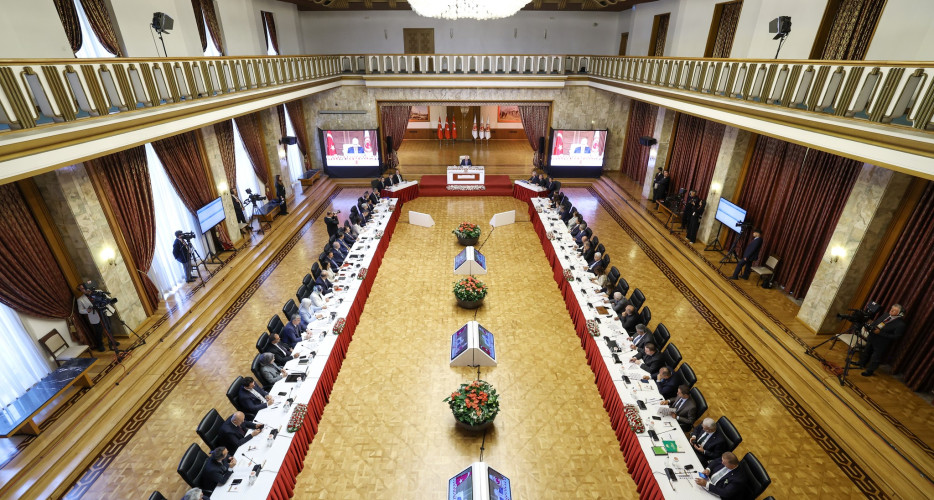
Turkey’s newly formed parliamentary commission, tasked with establishing a legal framework for peace negotiations between Ankara and the Kurdistan Workers’ Party (PKK), held its first meeting Tuesday, marking a pivotal step in a historic reconciliation process.
Parliament Speaker Numan Kurtulmuş opened the session by emphasizing transparency and national unity. "Every briefing will be conducted transparently and inclusively. The work carried out under this roof will proceed in front of the public's eyes, with the guarantee of the nation's will," he said. "This meeting is not only the beginning of our commission's work but also the beginning of the flourishing of our dear nation's hopes for the future."
The commission was established following a symbolic PKK disarmament ceremony on July 11 in the Jasana Cave in Sulaymaniyah province of Iraq’s Kurdistan Region. In the first public act of disarmament in nearly five decades of armed struggle, 30 PKK fighters—15 men and 15 women—burned their weapons before returning to their mountain bases to prepare for a political transition.
The event came two days after imprisoned PKK leader Abdullah Öcalan made a surprise video appearance—his first in 26 years—officially calling an end to the PKK’s armed campaign and urging the group to embrace democratic politics. "The details of the laying down of the arms will be specified and expeditiously implemented," Öcalan said.
The parliamentary commission includes members from the ruling Justice and Development Party (AKP), the main opposition Republican People's Party (CHP), the ultranationalist Nationalist Movement Party (MHP), and the pro-Kurdish Peoples’ Equality and Democracy Party (DEM Party), which has played a central role in mediating the peace talks. Smaller Kurdish parties and other political groups are also represented.
The peace initiative received strong backing from Turkish President Recep Tayyip Erdoğan, who hailed the PKK’s disarmament as a "historic turning point" during a July 12 speech at the AKP’s 32nd Consultation and Evaluation Meeting in Ankara. "The problem of terror that has been lingering in our nation for 47 years has, God willing, entered the process of ending," Erdoğan said. "The wall of terror is being obliterated."
He credited the Iraqi government and the Kurdistan Regional Government (KRG) for their cooperation and said Türkiye would now seek a political solution rather than repression. "Today marks the dawn of a great and powerful Türkiye," Erdoğan declared. "The doors to the Century of Türkiye have been fully opened."
Erdoğan also criticized previous Turkish governments for policies of oppression toward Kurds and argued that the new commission would pave the way for lasting national reconciliation.
Representatives from the KRG, the Iraqi government, and Kurdish parties attended the disarmament ceremony, signaling broad regional support. With the commission now officially underway, Turkey enters a critical phase of translating symbolic steps into lasting political outcomes.