Peregraf
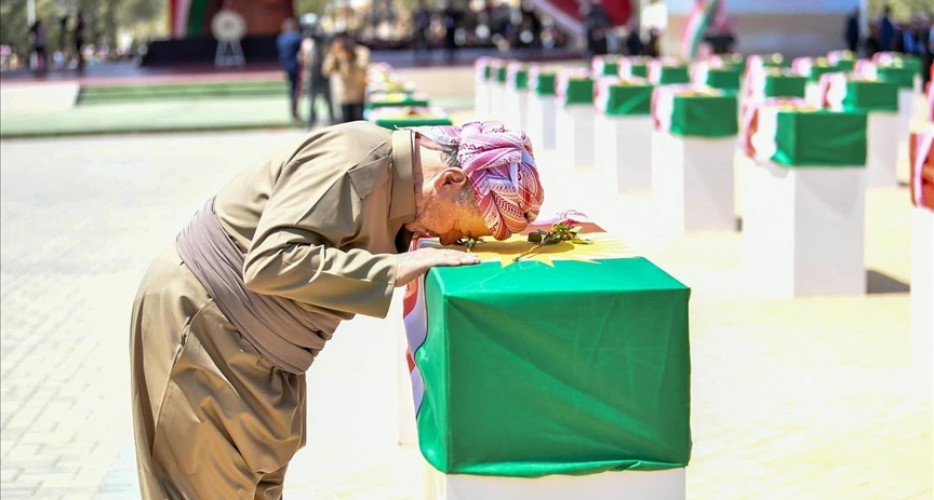
As the Kurdistan Region marks the 42nd anniversary of the Barzani genocide, top Kurdish leaders renewed calls for justice, compensation, and national remembrance, warning that the mentality behind the atrocities still lingers in parts of Iraq’s political system.
"The Anfal campaign against the Barzanis, perpetrated by the former Iraqi regime, was part of a broader series of atrocities aimed at subjugating the people of Kurdistan and erasing their existence. However, it ultimately failed due to the resilience and determination of the people of Kurdistan, leaving a grim stain on the conscience of the perpetrators," Kurdistan Region President Nechirvan Barzani said in a statement.
President Barzani reiterated his call on the Iraqi government to compensate the victims’ families and extended condolences to those who lost loved ones.
"It is imperative that the Iraqi government take all necessary steps to deliver justice and provide compensation to the victims’ families," he said.
That call was echoed by Prime Minister Masrour Barzani, who also urged Baghdad to take action.
"The patriotic people of Kurdistan will never forget these crimes, and generation after generation must know that the people of Kurdistan, with all its components, have made great sacrifices to preserve their national identity and legitimate rights," he said.
Former Kurdistan Region President and KDP leader Massoud Barzani also released a statement, warning that elements of the same chauvinist and denial-based mindset that fueled the 1983 atrocity still persist today.
"Some people have not learned lessons from history and continue to do politics with a chauvinist mentality," he said.
On July 31, 1983, the former Iraqi Ba’athist regime rounded up around 8,000 men and boys from the Barzani tribe—aged between 9 and 90—and forcibly disappeared them in the deserts of southern Iraq. The operation marked the beginning of a broader campaign of genocide against the Kurdish people, including the Anfal operations in Garmian and Badinan, the chemical attack on Halabja, and the deportation of tens of thousands of Kurds.
Barzani said the ideology behind these crimes was "a chauvinistic and denial mentality that became a source of misery and backwardness for the whole of Iraq."
"As long as this mentality remains, Iraq will never recover," he warned.
He thanked the residents of Erbil, Harir, and Soran for their support during the genocide and praised the resilience of the victims’ families, especially the Barzani mothers who endured decades of pain and loss.
"On this occasion, we send thousands of greetings to the souls of the Barzanis who were killed in the Anfal campaign, and all the martyrs of the Kurdistan freedom movement," he said.
Among the 8,000 victims were 315 children. Only 696 bodies have been returned to Kurdistan in three stages. Their remains were exhumed from five mass graves—503 bodies in 2005, 93 in 2014, and 100 in 2022—but none have been officially identified.
In 2011, the Iraqi High Criminal Court declared the Barzani genocide a case of genocide, crimes against humanity, and war crimes under decision No. 4J1. Kurdish leaders continue to urge Baghdad to recognize its responsibility and provide overdue reparations to the families.