KRG Interior Minister: Groups Behind Drone Attacks on Kurdistan Identified—Baghdad Yet to Act
Peregraf
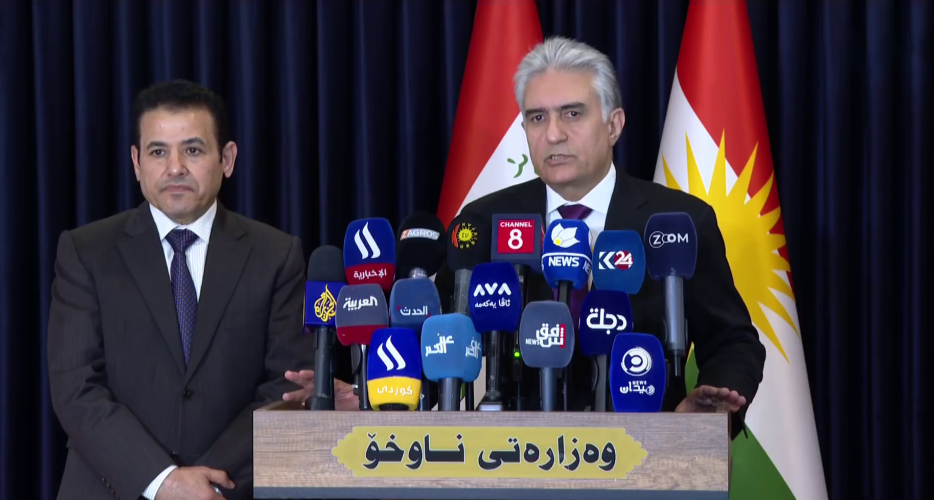
Kurdistan Region’s Interior Minister Rebar Ahmad confirmed Monday that the groups responsible for the recent wave of drone attacks on the region have been identified by both Erbil and Baghdad, but no action has yet been taken to stop them.
Speaking at a joint press conference with Iraq’s National Security Advisor Qassim al-Araaji in Erbil, Ahmad said: "The groups that carry out drone attacks on the Kurdistan Region have been exposed by us and the Iraqi government. Legal and security measures must be taken against them."
Despite several investigative committees being formed in the past, Ahmad criticized Baghdad’s inaction. "These committees have already reached conclusions, but no steps have been taken to stop these groups."
Ahmad warned that the attacks have seriously impacted Kurdistan’s oil sector, reducing production to levels below what is required under agreements with Baghdad.
The comments came after al-Araaji arrived in Erbil early Monday, just four hours after a drone bomb exploded in the Rzgari sub-district of Khabat, west of Erbil, at 5:50 a.m. No casualties were reported, according to the Directorate General of Counter Terrorism (CTD).
The visit, made on the instructions of Iraqi Prime Minister Mohammed Shia' al-Sudani, includes a high-level delegation comprising Iraq’s Deputy Commander of Joint Operations, Deputy Heads of Intelligence and National Security, Commander of Air Defense, and Directors of Military Intelligence and Counterterrorism.
Al-Araaji affirmed the government’s intent to respond: "We exchanged information with the Kurdistan Region today. The security forces have the capabilities, and the goal is to ensure stability."
"Any attack on economic interests damages both Iraq and the Kurdistan Region. The law must be enforced on everyone, including those who have been negligent." Al-Araaji said.
Since June 30, over ten drone-related incidents have been reported across Erbil, Duhok, Sulaymaniyah, and Zakho. Most attacks targeted oilfields and energy infrastructure. The Kurdistan Regional Government’s Ministry of Natural Resources reported “substantial material losses” as a result.
A Peregraf investigation found that five of the region’s eight active oil contract areas—encompassing nine fields—have been targeted. Several fields have suspended operations entirely due to the escalating threat.