Peregraf
Kurdistan Region Prime Minister Masrour Barzani has launched a sharp rebuke against the federal government in Baghdad over persistent delays in sending salaries, accusing it of using economic pressure as a tool to punish the people of Kurdistan and block the Region’s development.
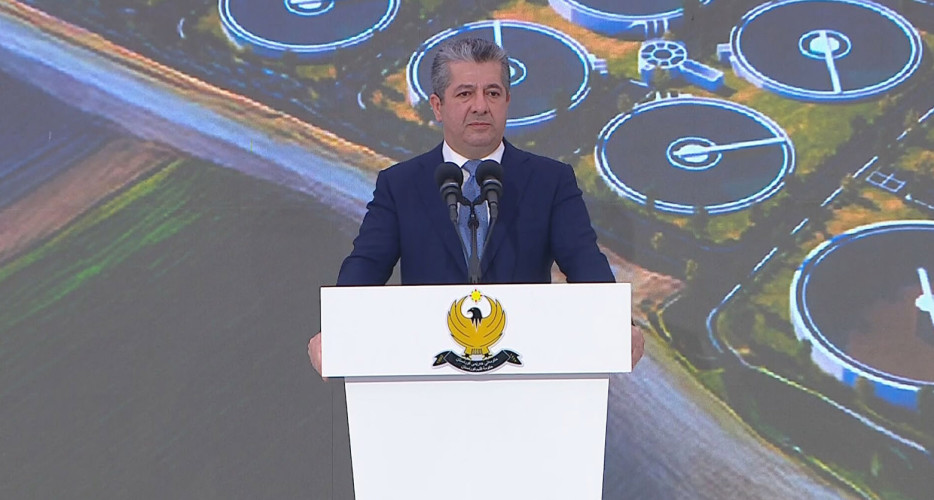
"Instead of letting us serve the citizens, they punish the citizens and cut their salaries. We are ready to put our experience at the service of Iraq so that they know how to serve the citizens," Barzani declared during the opening ceremony of Erbil’s emergency water supply project on Saturday.
The Prime Minister added that despite the Kurdistan Regional Government (KRG) agreeing to hand over 230,000 barrels of oil per day and 120 billion dinars in monthly domestic revenue, Baghdad continues to impose conditions that obstruct timely salary payments.
"They’ve added a clause saying they won’t send salaries unless they receive the full 230,000 barrels. But terrorists are attacking our oil fields with drones and stopping production—how can this be done?"
Barzani accused the federal government of unconstitutional behavior and said it was targeting the Region’s achievements.
"They want to punish our victories… Where are the voices that once said if salaries went through Baghdad, everything would be fine and paid on time? I don’t know where they are now and why they are silent."
Public employees across the Kurdistan Region have not yet received their salaries for May, despite August approaching, adding to public frustration amid increasing financial strain.
"We have shown the utmost flexibility so that people are not under wage pressure," Barzani said. "What we are doing is only for the sake of pride and serving the people of Kurdistan."
He also reaffirmed the Region’s readiness to export all its oil through Baghdad, except for domestic consumption, and called on the federal government to end its "collective punishment" and salary cuts.
"We are committed to fulfilling every constitutional duty that falls on the KRG, but we are not ready to give up our constitutional rights."
Barzani’s remarks came during the inauguration of the first phase of Erbil’s emergency water supply project, which aims to provide clean drinking water to 1.5 million people in the capital in accordance with international standards.
The project sources water from the Great Zab River with a capacity of 20,000 cubic meters per hour. The water undergoes treatment and is stored in 20 large reservoirs before being distributed across several neighborhoods.
The remaining phases are scheduled to be completed by the end of this year.
The Content of the Agreement Between the KRG and Iraqi Government Regarding the Oil and Non-Oil Revenue Files
In the matter of oil and non-oil revenues and the agreement with the Kurdistan Regional Government (KRG) of Iraq concerning them, the Prime Minister commended the efforts of the President of the Patriotic Union of Kurdistan (PUK), Mr. Bafel Talabani, and the relevant ministers for their substantial contributions that facilitated the agreement. Based on the presentation by the ministerial committee formed under the directive of the Prime Minister during the 27th regular session of the Council of Ministers on July 8, 2025, and its recommendations regarding the content of KRG Council of Ministers Resolution No. 285 dated July 16, 2025, the Council of Ministers has decided the following:
First: Oil Delivery File
1. The KRG shall immediately commence the full delivery of all oil produced from the region’s oil fields to the Oil Marketing Company (SOMO) for export purposes. The Federal Ministry of Finance shall commit to advancing the KRG a sum of $16 (in kind or cash) per barrel received, in accordance with the amended budget law, provided that the quantity received is no less than the current daily minimum of 230,000 barrels. Any increase in production shall be added based on the assessment of the Joint Measurement and Calibration Committee. In the event of export suspension for any reason, the full aforementioned quantity shall be delivered to the Federal Ministry of Oil.
(Clarification: The total current production stands at 280,000 barrels per day, according to regional reports. Of this, 50,000 barrels per day are allocated for local consumption in the region, while the remaining 230,000 barrels per day—along with any future production increases—shall be delivered to SOMO for export purposes.)
2. A quantity of 50,000 barrels per day shall be allocated for local consumption in the region, provided that the KRG bears the production and transportation costs for this quantity. The revenue from the sale of petroleum products shall be transferred to the federal treasury after deducting production, transportation, and refining costs. Should the region require additional quantities, the Federal Ministry of Oil shall, in principle, supply the region with refined products not exceeding the equivalent of 15,000 barrels of crude oil per day. A joint committee from the Federal Ministry of Oil and the KRG’s Ministry of Natural Resources shall assess the region’s actual need for petroleum products for allocation purposes and submit its report within two weeks to the Federal Council of Ministers for approval.
Second: Non-Oil Revenue File
1. The KRG shall submit an initial estimated payment of 120 billion dinars as the federal treasury’s share of non-oil revenues for May to the Federal Ministry of Finance. This amount shall be reconciled upon completion of the audit as per paragraph (2) below.
2. A task force comprising the Federal Ministry of Finance and the Federal Board of Supreme Audit, in coordination with the KRG’s Ministry of Finance and Board of Audit, shall be formed to classify, audit, and determine the federal government’s share of non-oil revenues, starting from May 2025. This shall be based on the revenue benchmarks outlined in the joint reports between the Federal Board of Supreme Audit and the KRG’s Board of Audit since the enactment of the federal budget law. The task force shall submit its report within two weeks to the Federal Council of Ministers for approval.
3. A joint committee between the federal government and the KRG shall be formed to complete the *Tawteen* (localization) of salaries in the region in accordance with the Federal Court’s ruling. The committee shall finalize its task within a period not exceeding three months, with funding allocated exclusively to localized salaries by the end of this period.
4. A team from the Federal Ministry of Finance and the Federal Board of Supreme Audit, in coordination with the KRG’s Ministry of Finance and Board of Audit, shall be formed to determine the extent of the region’s excess share in actual expenditures and how to address it under the federal budget law for the years (2023, 2024, and 2025). The team shall submit its report within a maximum of two weeks to the Federal Council of Ministers.
5. The Ministry of Finance shall proceed with disbursing the salaries of KRG employees for May as the initial step in implementing the agreement, following confirmation by the Federal Ministry of Oil/SOMO of the full receipt of the aforementioned oil quantity (currently 230,000 barrels per day) at Ceyhan Port, in accordance with the law.
6. The timelines specified in this resolution shall commence from the date of its approval by the Council of Ministers.