Peregraf
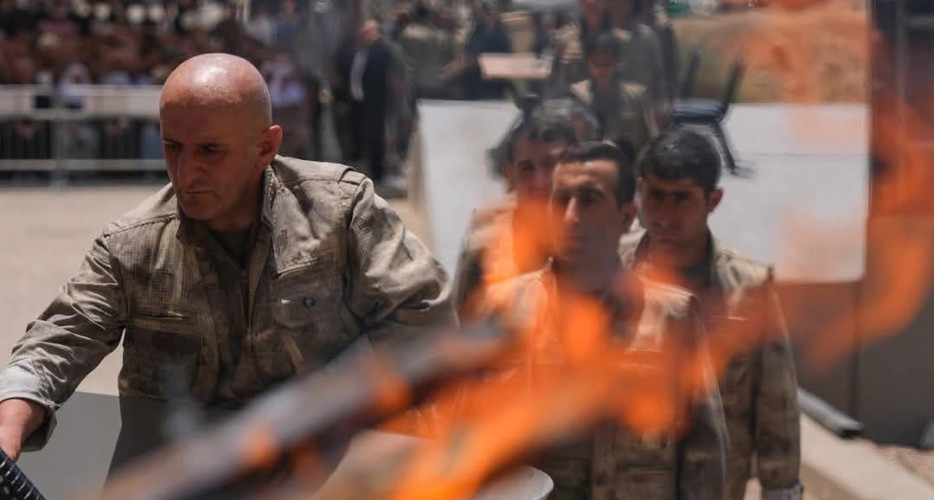
Today July 11, 2025, marked a historic turning point in the Kurdish armed struggle in Turkey, as the first group of Kurdistan Workers’ Party (PKK) guerrillas officially laid down their weapons in the historic Jasana Cave, located in the Dukan district west of Sulaymaniyah.
The disarmament ceremony, witnessed by local officials and observers, saw 30 PKK fighters surrender rifles, including Kalashnikovs and sniper weapons, as part of a broader peace process aiming to end decades of armed conflict. The step follows a landmark announcement by PKK leader Abdullah Öcalan calling for a shift from military confrontation to democratic and political engagement.
Two delegations from Turkey and North Kurdistan, led by DEM Party co-chairs Tuncer Bakırhan and Ahmet Türk, attended the disarmament ceremony, alongside representatives from the Kurdistan Regional Government, the Iraqi government, and various political parties.
In a statement issued during the ceremony, the guerrillas reiterated their demand for the physical release of Öcalan and called for a comprehensive political solution to the Kurdish issue.
“The struggle will continue through political and legal means,” the statement said.
Öcalan, imprisoned on İmralı Island since 1999, made his first video appearance in 26 years on July 9, declaring the end of the PKK’s armed campaign and renouncing its nation-statist objectives.
“The details of the laying down of the arms will be specified and expeditiously implemented,” he said.
The ceremony follows the PKK’s 12th Congress, held from May 5–7 in the Medya Defense Areas within the Kurdistan Region, where the group officially announced its dissolution as an armed organization on May 12. The congress described the move as a “historic shift” in the Kurdish freedom movement.
The decision to dissolve the PKK and embrace democratic politics was influenced by a message from Öcalan, delivered by a delegation of the pro-Kurdish DEM Party on February 27.
“The time has come to open a new chapter based on democratic unity and political engagement,” Öcalan said in the message.
Analysts view the transition as a defining moment in the Kurdish political landscape, ending decades of armed insurgency and opening new prospects for peaceful dialogue.