Peregraf
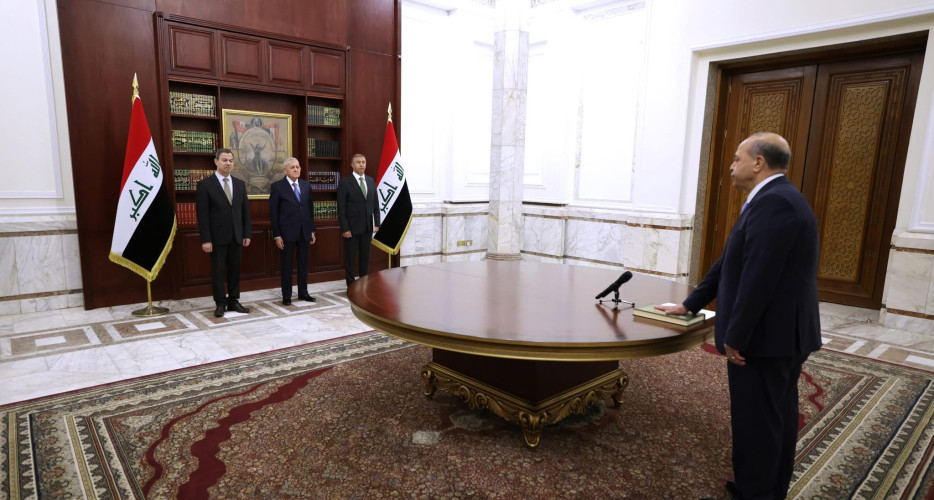
In a momentous shift at the pinnacle of Iraq’s judiciary, Judge Munzir Ibrahim was officially sworn in today as the new president of the Federal Supreme Court before Iraqi President Abdul Latif Rashid. His appointment comes at a time of heightened legal and political tensions, with one of the court’s most urgent pending cases concerning unpaid salaries in the Kurdistan Region.
The court is now expected to issue a sovereign ruling on whether the federal government is constitutionally obligated to resume sending salaries to public employees in the Kurdistan Region. Some of Kurdish salary earners have filed a formal complaint, seeking a legal mandate to compel Baghdad to disburse overdue payments. The Kurdistan Regional Government (KRG) has yet to pay May salaries, citing a lack of funds from the federal treasury.
Judge Ibrahim’s swearing-in follows a dramatic and unprecedented reshuffling of Iraq’s top judicial institution. On June 29, the Supreme Judicial Council (SJC), led by Faiq Zidan, accepted the retirement request of the previous Federal Court president, Jassim Mohammed Aboud, under the official reason of “health concerns.” While other judges had also requested retirement, their applications were later withdrawn, allowing them to resume work—leaving Aboud as the sole judge removed.
This maneuver has sparked widespread concerns about the independence of Iraq’s judiciary. Legal experts and insiders say Zidan, who now chairs both the Supreme Judicial Council and holds de facto control over the Federal Court, has blurred the separation between Iraq’s two highest judicial institutions.
A judicial source told Peregraf: “Faiq Zidan imposed his hegemony on the Federal Court. Judge Jassim believed in the court’s independence and viewed Zidan’s interference as a constitutional overreach.”
The origins of this crisis date back to June 19, when six of the nine Federal Court judges and three reserves submitted coordinated resignations to protest Aboud’s leadership. While these were soon converted into retirement requests citing health reasons, the real pressure came from political forces dissatisfied with ongoing institutional dysfunction. According to a senior political source, Iraq’s dominant Shiite parties ultimately sided with Zidan over Aboud, forcing the latter out to restore alignment between the judiciary and political leadership ahead of national elections.
Judge Ibrahim’s installation was symbolically sealed on July 1, when Zidan chaired a meeting of the reconstituted Federal Court with Ibrahim and all remaining judges in attendance—a clear display of Zidan’s consolidation of power.
Critics argue this judicial crisis has exposed Iraq’s fragile constitutional framework and threatens the court’s credibility ahead of crucial general elections scheduled for November 11, 2025. The Federal Supreme Court plays a pivotal role in certifying election results, settling parliamentary disputes, and overseeing government legality—functions that demand institutional neutrality.
Legal uncertainty also looms over several controversial past rulings by the Federal Court, including the invalidation of the Kurdistan Oil and Gas Law and decisions altering Iraq’s electoral system. Tensions have also intensified since a 2021 amendment to Law No. 30 of 2005, which stripped the Kurdistan Region of its ability to appoint judges to the court—raising fears that the FSC has lost its federal character.
As Judge Munzir Ibrahim assumes office, his first major test will be deciding whether the Iraqi government must resume salary payments to the Kurdistan Region—an issue with legal, economic, and political stakes for millions of Iraqis.
The ruling will signal whether the restructured court under Zidan’s influence can still uphold constitutional integrity—or whether Iraq’s judiciary has become a tool in an increasingly centralized system of power.