Peregraf
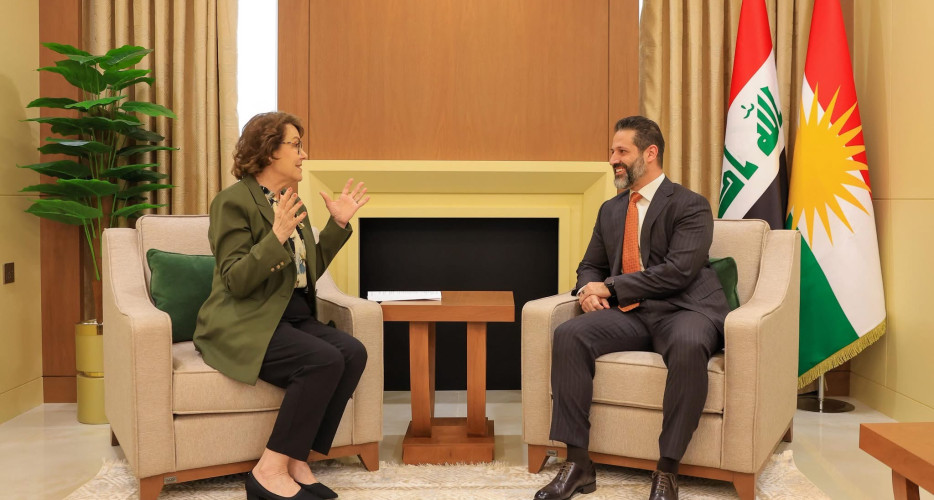
Deputy Prime Minister of the Kurdistan Regional Government (KRG), Qubad Talabani, announced today that the Patriotic Union of Kurdistan (PUK) and the Kurdistan Democratic Party (KDP) have reached an agreement on a roadmap for governance. The announcement came during a meeting with U.S. Senator Jacky Rosen in Erbil.
Senator Rosen, currently on a visit to the Kurdistan Region, urged Kurdish parties to accelerate efforts to form a strong and unified government. Responding to her call, Talabani expressed optimism that a final agreement between the two major parties would be reached soon, ending months of political gridlock.
A statement from Talabani’s office indicated that the meeting also addressed ongoing issues between the Kurdistan Region and Baghdad, including the budget and public sector salaries. Talabani stressed that resolving these challenges requires constructive dialogue and stronger unity among Kurdish factions.
“The PUK and KDP have agreed on a roadmap for governance,” Talabani said, emphasizing that cooperation and solidarity are key to overcoming current obstacles and moving forward.
Regarding the importance of the relationship and alliance between the United States and the Kurdistan Region, Talabani said: “We explained that this alliance is important not only for the fight against terrorism, but also for the development and stability of Kurdistan and the region.”
The Kurdistan Region has faced a prolonged political impasse since the first session of the new parliament on December 2, 2024. Formation of the new KRG cabinet remains stalled, particularly regarding the distribution of key ministerial and administrative posts.
In the latest regional parliamentary elections, the KDP emerged as the largest party with 39 seats in the 100-seat legislature. The PUK secured 23 seats, while minority representatives and smaller parties collectively hold 38 seats. With 51 seats required to form a governing majority, coalition-building remains crucial.
The KDP maintains political dominance in Erbil and Duhok, while the PUK holds sway in Sulaymaniyah and Halabja. Historically, cooperation between the two parties has been essential to maintaining political stability and advancing regional governance.
As negotiations continue, the outcome will be pivotal in shaping the structure and policy direction of the next KRG cabinet, as well as the broader political and administrative trajectory of the Kurdistan Region.