Kurdish Parties Condemn Baghdad’s Budget Cuts, Call for Dialogue but Warn 'All Options Are Open'
Peregraf
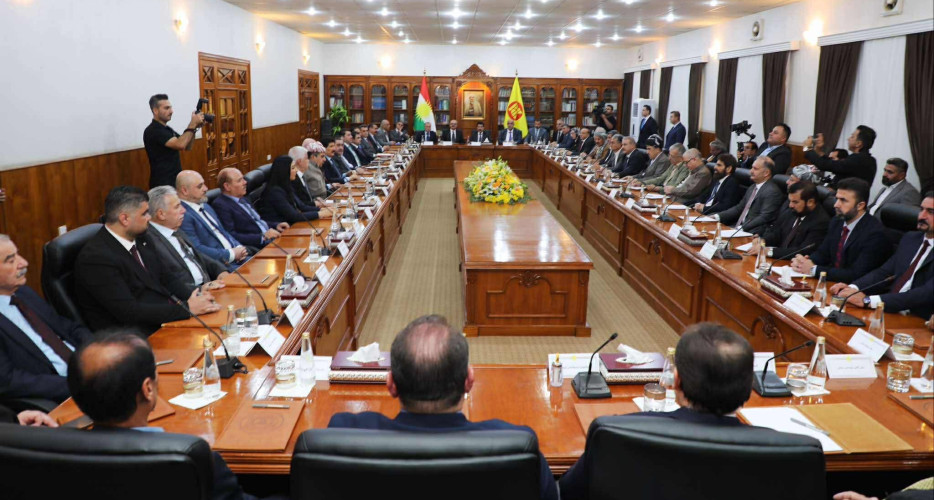
Forty-three Kurdish political parties—excluding major opposition groups—issued a unified statement on Saturday asserting that dialogue with Baghdad remains the preferred path forward, but warned that “all options are open” if the federal government continues to withhold public sector salaries.
The joint declaration, made following a high-level meeting convened by the Kurdistan Democratic Party (KDP) in Pirmam, condemned the recent decision by Iraq’s Ministry of Finance to freeze salary payments to the Kurdistan Region, calling it unconstitutional and politically motivated.
“This decision is a clear violation of the Iraqi Constitution, the Federal Court’s rulings, employee laws, and the agreements between the Kurdistan Regional Government (KRG) and the federal government,” the statement read. “Withholding salaries is an act of political pressure against the will of the Kurdish people and undermines regional stability.”
The meeting brought together senior figures from the Patriotic Union of Kurdistan (PUK), the Kurdistan Socialist Democratic Party, the Kurdistan Communist Party, and part of the Gorran Movement. However, it was boycotted by major opposition blocs including the New Generation Movement, Kurdistan Islamic Union (KIU), the National Stance Movement (Halwest), the People’s Front (Baray Gal), Kurdistan Justice Group (Komal) and the Zargata wing of Gorran, who accused the KDP of sidelining democratic institutions.
Gorran spokesperson Dilêr Abdulkhaliq, whose party sent limited representation, criticized the final statement, arguing that negotiations with Baghdad should be led by the Kurdistan Parliament, not partisan coalitions. “People care about their salaries and livelihood. We urged the meeting to focus on transparency in oil and non-oil revenues,” he said.
The emergency summit came in response to Baghdad’s claim that the Kurdistan Region exceeded its 12.67% share of the national budget. Iraq’s Finance Minister, Taif Sami, announced this week that the KRG had received excess transfers over the past three years and must now adopt the federal “Tawtin” electronic payment system to continue receiving funds.
As public outrage grows—with nearly 1.2 million civil servants still awaiting their May salaries—Kurdish officials have accused Baghdad of using financial tools as political weapons. The KDP hinted at the possibility of dramatic political responses if payments are not resumed before Eid al-Adha. “We are being punished economically for political reasons. This is unacceptable,” the party said in a separate statement.
Tensions between Erbil and Baghdad have been further inflamed by recent multibillion-dollar oil agreements between the KRG and U.S.-based companies. Iraqi militia leader Qais al-Khazali has accused the KRG of separatism, alleging illicit oil exports and defiance of federal authority.
Meanwhile, KDP leader and Iraqi Parliament Deputy Speaker Shakhawan Abdullah warned that a Kurdish withdrawal from Baghdad’s political institutions is on the table. “If the decision is made, I will execute it within an hour,” he said.
The opposition parties, however, cautioned against bypassing the Kurdistan Parliament. “Partisan crisis management will only deepen mistrust,” they said in a joint statement. “The Parliament is the only legitimate place to resolve financial and political disputes.”
As Eid al-Adha approaches, the standoff between Erbil and Baghdad shows no signs of easing—raising fears of deeper political fragmentation and long-term economic hardship for the Kurdish people.