KDP Hosts Kurdish Party Talks Amid Growing Tensions with Baghdad, Key Opposition Parties Boycott
Peregraf
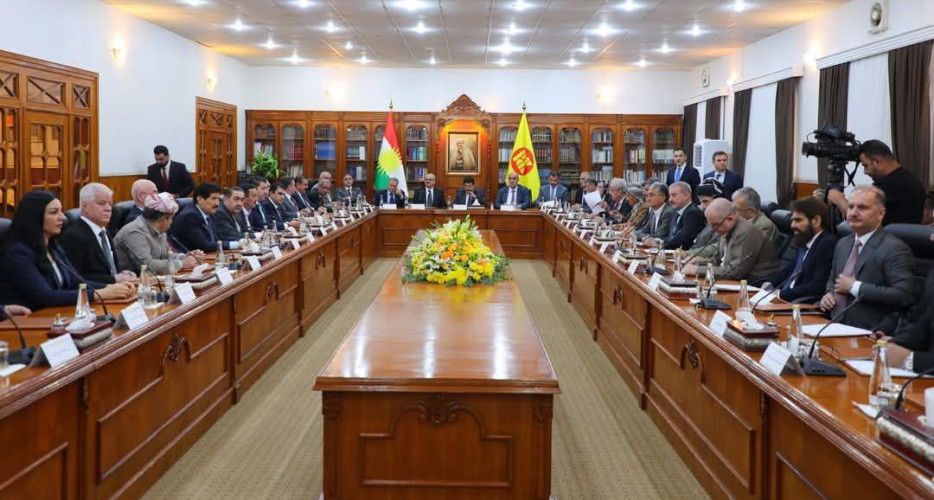
The Kurdistan Democratic Party (KDP) convened a meeting on Saturday with several Kurdish political parties to address escalating tensions with Baghdad over withheld public sector salaries and disputed energy policies. However, major opposition parties boycotted the gathering, denouncing it as an attempt to sideline democratic institutions.
The meeting, held in the KDP’s stronghold of Pirmam in Erbil province, included representatives from the Patriotic Union of Kurdistan (PUK), the Kurdistan Socialist Democratic Party (KSDP), the Kurdistan Communist Party, and the Kurdsat wing of the Change Movement (Gorran).
Absent, however, were the Region’s main opposition forces. The New Generation Movement—the largest opposition bloc in the Kurdistan Parliament—along with the Kurdistan Islamic Union (KIU), Kurdistan Justice Group (Komal), the National Stance Movement (Halwest), the People’s Front (Baray Gal), and the Zargata wing of Gorran refused to participate.
The opposition parties warned against what they called “partisan crisis management,” arguing that the Kurdistan Parliament must serve as the legitimate forum for resolving urgent political and financial issues. “Bypassing the Parliament only weakens public trust and erodes transparency,” the statement read.
Baghdad Freezes KRG Funds, Citing Budget Law
The emergency summit comes just days after Iraq’s Finance Minister, Taif Sami, announced on May 28 that the Kurdistan Region had surpassed its 12.67% allocation of the federal budget for 2025. In an official letter, Sami claimed the Region had received excess transfers over the past three years and warned that any continued payments would violate both the federal budget law and recent rulings by the Federal Supreme Court.
Sami also reiterated Baghdad’s demand for the Kurdistan Regional Government (KRG) to implement the nationwide “Tawtin” electronic salary payment system, which aims to reduce corruption and promote transparency in public sector disbursements.
Public Anger Mounts Over Withheld Salaries
The federal decision has sparked widespread public anger across the Kurdistan Region. Nearly 1.2 million public employees are still waiting for their May salaries, and fears are growing that payments for the remainder of the year may also be delayed. The economic strain is palpable as citizens face mounting living costs and uncertainty just weeks before the Eid al-Adha holiday.
Kurdish leaders have slammed Baghdad’s move as politically driven, pointing to recent billion-dollar energy agreements signed by Prime Minister Masrour Barzani in Washington as a possible trigger. The deals, signed with U.S.-based firms including HKN/Onex Group and Western Zagros, have stirred suspicions in Baghdad that Erbil is charting a more autonomous energy path.
Kurdish Leaders Float Political Withdrawal
Tensions have reached a boiling point, with some senior Kurdish officials openly discussing the possibility of withdrawing from Iraq’s political system entirely. Shakhawan Abdullah, Deputy Speaker of the Iraqi Parliament and a top KDP official, declared: “It is time to withdraw. If a decision is made, I will implement it within an hour.”
The KDP has issued a stark ultimatum: if salary transfers are not resumed before Eid al-Adha, the party will respond with what it called a “serious political action.”
“We are being punished economically for political reasons,” the KDP said in a statement. “This is unacceptable.”
Disputed Figures and Accusations of Separatism
The financial tug-of-war continues, with Baghdad asserting it has already transferred more than 13.5 trillion Iraqi dinars to the KRG, while Erbil maintains that it is still owed over 9.11 trillion dinars for 2025 alone. Kurdish lawmakers have accused the federal government of implementing a “policy of starvation” to weaken the Region politically and economically.
Fueling the fire, Qais al-Khazali, head of the Iran-backed Asaib Ahl al-Haq militia, accused the KRG of pushing a separatist agenda. In a televised speech, Khazali claimed that the KRG’s recent energy diplomacy with the U.S. undermines Iraqi sovereignty and stability.
He further alleged that the KRG has smuggled oil to countries like Afghanistan and Pakistan, costing Iraq an estimated $2 billion annually. “The KRG’s refusal to export oil through SOMO is a blatant challenge to federal authority,” he added.