Peregraf
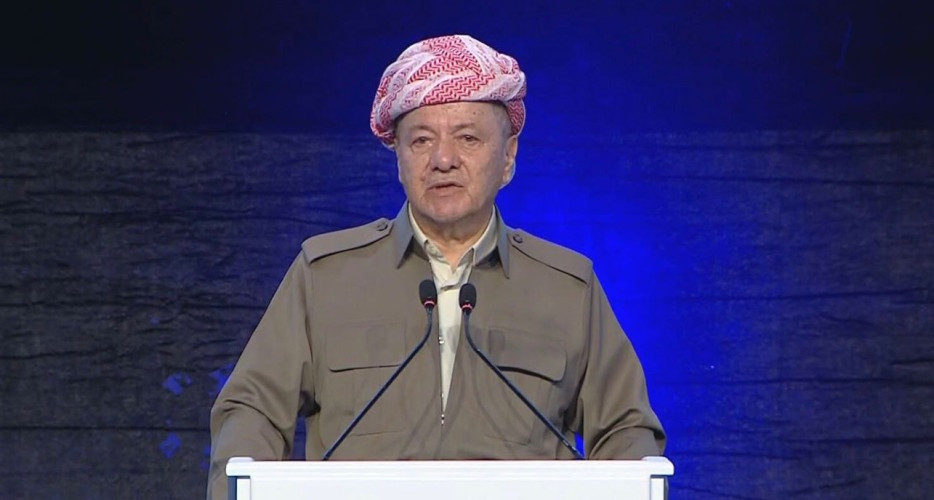
Amid mounting financial tensions between Erbil and Baghdad, Masoud Barzani, the leader of the Kurdistan Democratic Party (KDP), has called for a meeting with all Kurdish political parties to forge a unified response to what Kurdish officials are calling a “deliberate financial blockade” by the federal government.
The high-level meeting, set for Saturday in Pirmam, follows the federal government’s decision to suspend public salary payments for May 2025 and the foreseeable future. Barzani’s initiative seeks to consolidate internal solidarity among Kurdish parties as the standoff with Baghdad enters a dangerous new phase.
However, the call for unity has not been widely welcomed. The New Generation Movement (NGM) and the National Stance Movement (Halwest) have both declined to attend the Pirmam gathering. In a joint statement, the opposition parties asserted that the Kurdistan Parliament—not partisan meetings—should be the forum for addressing crises that affect the public. They warned that bypassing democratic institutions undermines transparency and legitimacy.
The Kurdistan Justice Group (Komal) stated in a release that they will not participate in the Pirmam meeting to which the KDP has invited them. Similarly, the People's Front (Bereyî Gel) in Lahur Sheikh Jangi's leadership is boycotting the tomorrow's meeting called by KDP and said in a statement: "We oppose any attempt to undermine the Kurdistan Parliament, which we consider the legitimate representative of the Kurdish people's will and the appropriate platform for meetings and decision-making on fate-determining issues. Therefore, regarding the salary issue and other accumulated problems, we will hold a decisive position in the coming days."
Baghdad Freezes Funds, Citing Budget Law
On May 28, Baghdad’s Finance Minister Taif Sami announced that the Kurdistan Region had exhausted its 12.67% share of the federal budget for 2025. In an official letter sent to the KRG, Sami stated that over the past three years, the Region had received more than its legal allocation in budget transfers and revenues. She added that continuing such payments would breach the federal budget law and violate rulings by Iraq’s Federal Supreme Court.
Sami also criticized the KRG’s continued failure to implement the “Tawtin” electronic banking system for public sector salary disbursements—a key demand from Baghdad aimed at promoting transparency and limiting corruption.
Public Outrage as Salaries Withheld
The decision has triggered widespread public anger across the Kurdistan Region, where approximately 1.2 million public sector employees are still awaiting their May salaries. Uncertainty looms over payments for the remaining months of 2025, deepening public frustration and exacerbating existing economic pressures.
Kurdish leaders have denounced Baghdad’s move as a politically motivated punishment, particularly in the wake of high-profile energy agreements recently signed in Washington. Prime Minister Masrour Barzani’s U.S. visit saw the Region seal energy deals worth $110 billion with firms such as HKN/Onex Group and Western Zagros—agreements that some in Baghdad interpret as a move toward greater Kurdish autonomy.
Kurdish Retaliation: Withdrawal on the Table
In response to the federal government’s actions, senior Kurdish leaders are now openly discussing the possibility of withdrawing from Iraq’s political process altogether. Shakhawan Abdullah, Deputy Speaker of the Iraqi Parliament and a leading KDP figure, issued a blunt warning: “It is time to withdraw. If a decision is made, I will implement it within an hour.”
The KDP has issued an ultimatum to Baghdad: release the Region’s salaries before Eid al-Adha or face a “serious political response.”
“We are being punished economically for political reasons,” the party said in a statement. “This is unacceptable.”
Competing Claims: Billions in Dispute
While Baghdad claims it has already transferred more than 13.5 trillion dinars to the Region, Erbil maintains it is still owed more than 9.11 trillion dinars for 2025 alone. Kurdish MPs have labeled the federal government’s actions as a “policy of starvation” aimed at weakening the Region politically and economically.
Khazali Accuses KRG of ‘Separatist Agenda’
Tensions have further escalated following remarks by Qais al-Khazali, the leader of Asaib Ahl al-Haq, a powerful Iran-aligned Shiite militia. In a televised address, Khazali accused the KRG of pursuing a separatist agenda, citing the Region’s recent energy diplomacy in Washington as evidence of Kurdish efforts to distance themselves from Baghdad.
“This separatist approach has not changed,” Khazali said. “It threatens the stability of the Kurdistan Region and undermines Iraq’s sovereignty.”
He also accused the KRG of smuggling oil to countries like Afghanistan and Pakistan, alleging that such activities have cost Iraq over $2 billion annually.
“Everyone knows about this—OPEC, the Iraqi government, and the major powers,” he claimed, adding that the KRG’s refusal to export oil through Iraq’s state-run SOMO company constitutes a direct challenge to federal authority.
As the salary crisis intensifies and political rhetoric hardens, the already fragile relationship between Erbil and Baghdad faces its most severe test in years. With Eid approaching and public discontent growing, the next few days may determine not just the future of Kurdistan’s public finances—but its place in Iraq’s federal structure.