Kurdistan Region President, U.S. Secretary Rubio Discuss Regional Developments Amid Deepening Disputes with Baghdad
Peregraf
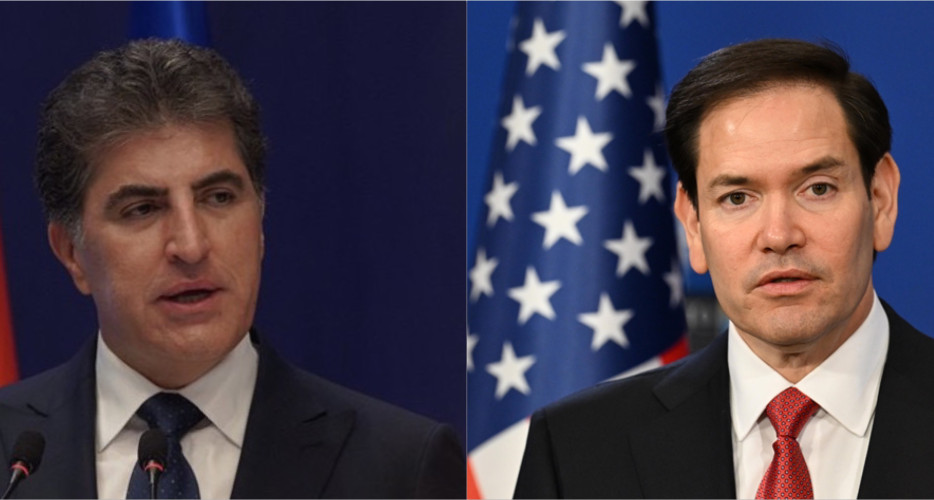
Kurdistan Region President Nechirvan Barzani held a phone conversation Tuesday evening with U.S. Secretary Rubio, focusing on the latest political and security developments in the Kurdistan Region, Iraq, and the broader Middle East.
In a statement posted on his official X account, President Barzani expressed appreciation for the call, highlighting the importance of sustained dialogue and coordination.
“I appreciate tonight’s call from Secretary Rubio, during which we discussed developments in the Kurdistan Region, Iraq, and the wider region,” Barzani wrote.
He reaffirmed the shared commitment to peace, stability, and the enduring partnership between the Kurdistan Region, Iraq, and the United States, while expressing gratitude for Washington’s steadfast support over the years.
Budget Dispute Threatens Public Salaries
The call comes as tensions mount between Erbil and Baghdad over oil, gas, and budget allocations. The Iraqi Federal Government has notified the Kurdistan Regional Government (KRG) that it has fulfilled its 12.67% financial allocation for KRG salaries as stipulated in the federal budget law covering 2023–2025. Despite this, the KRG has yet to distribute salaries for May, raising fears about future payments.
According to Iraqi MP Soran Omar, letter No. 14502 from the Ministry of Finance, issued Tuesday, confirms Baghdad has delivered its financial obligations to the KRG. Omar noted that the ministry accounted for all oil and non-oil revenues generated by the Kurdistan Region, adding: “In 2024, this situation occurred in October, but this year it has come earlier—in May.”
The letter has triggered alarm, as it suggests Baghdad may not provide any additional funds to the Region for the rest of 2025—leaving the salaries of hundreds of thousands of public servants in limbo unless alternative funding is found.
MP Omar also criticized the KRG’s financial transparency, claiming oil revenues are “unknown and unaccounted for.” He accused the KRG of transferring only a fraction of its domestic revenues to the federal government, in violation of the budget law.
“The irresponsibility in handling oil revenues and the failure to ensure transparency has put the livelihoods of public employees at serious risk,” he said.
So far, KRG officials have not responded publicly to the delayed salary payments or outlined a plan to address the funding shortfall.
Federal Court Lawsuit Challenges $110 Billion Oil Deals
Further intensifying the standoff, two Iraqi lawmakers—MPs Raid al-Maliki and Bassem Ghribawi—have filed a lawsuit at the Federal Supreme Court seeking to nullify recently signed oil and gas contracts between the KRG and American energy companies. The MPs claim the $110 billion in production-sharing contracts violate Iraq’s constitution.
“We have asked the court to declare the Kurdistan Regional Government’s contracts invalid,” MP Maliki said at a press conference.
On May 19, 2025, the KRG signed two massive energy deals in Washington with U.S.-based HKN/Onex Group (under Miran Energy) and Western Zagros. The contracts, signed under the supervision of KRG Prime Minister Masrour Barzani, bypass the Iraqi federal government and focus on developing the Miran and Topkhana oil and gas fields.
“These billion-dollar agreements prove the Kurdistan Region’s commitment to peace and economic development,” Prime Minister Barzani said at the signing ceremony, promising that the projects would provide 24-hour electricity for the Region and allow the export of surplus power to other Iraqi provinces.
The fields are estimated to hold 13 trillion cubic feet of natural gas and 9 million barrels of oil. KRG officials project production of 50 to 70 million cubic feet of gas per day within 18–20 months—potentially bridging a significant gap in power generation. Despite an installed capacity of 8,189 megawatts, the Region currently produces only around 4,500 MW.
Baghdad Deems Contracts Illegal, but May Need the Energy
Acting KRG Minister of Natural Resources Kamal Mohammed emphasized the Region’s independent course of action: “We have not consulted the Iraqi Oil Ministry, and we are not waiting for Baghdad’s approval.”
The Iraqi Oil Ministry, however, has strongly condemned the deals, citing the 2022 Federal Supreme Court ruling that declared the KRG’s 2007 Oil and Gas Law unconstitutional and demanded all energy operations be placed under federal control.
Efforts to pass a unified federal oil and gas law remain stalled. Speaking at the Delphi Forum in Sulaymaniyah on the same day the contracts were signed, Iraqi President Abdul Latif Rashid admitted the deadlock: “My priority is to resolve the oil and gas law dispute so that Iraq’s revenues can benefit all citizens.”
Despite legal objections, the federal government may soon find itself relying on Kurdish energy. The KRG has pledged to supply over 1,000 MW of surplus electricity to Baghdad—potentially offering relief to a nation gripped by chronic power shortages.
This presents a political dilemma for Baghdad: accepting the electricity could signal implicit recognition of Kurdish autonomy in energy affairs, while rejecting it could exacerbate Iraq’s energy crisis and public discontent.
Meanwhile, the U.S. State Department has welcomed the KRG’s initiative.
“We are pleased to announce the signing of contracts with U.S. companies and the expansion of trade relations between the United States and the Kurdistan Region,” the Department’s Middle East Office stated on X.
As legal battles and budgetary strains deepen, the standoff between Erbil and Baghdad is shaping the future of Iraq’s energy landscape—and testing the limits of federalism in the country’s post-conflict governance.