Peregraf
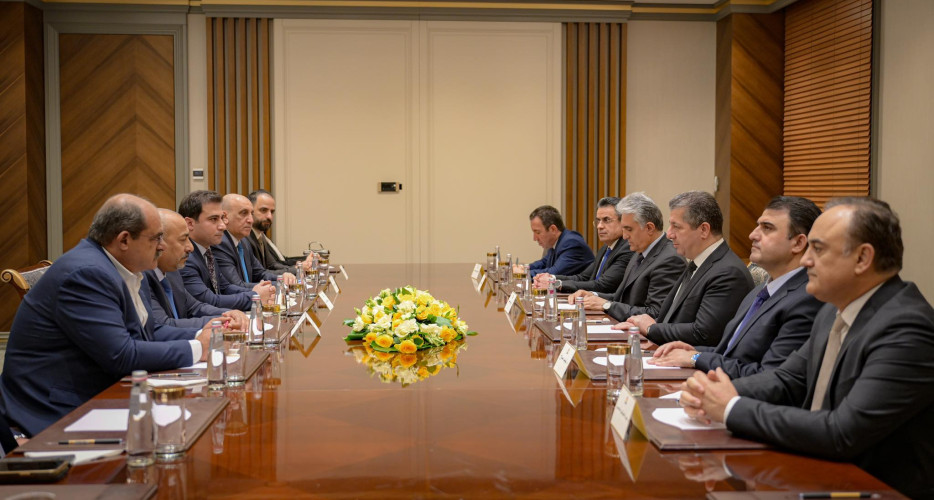
Kurdistan Region Prime Minister Masrour Barzani has reaffirmed the importance of ensuring the Region’s full participation in Iraq’s strategic Development Road Project, during a meeting with a delegation from the Iraqi Council of Representatives.
The visiting delegation included members of the Parliamentary Committee on Economy, Industry, and Trade. Discussions focused on enhancing coordination between the Kurdistan Regional Government (KRG), the federal government, and the Iraqi Parliament to support legislation serving all Iraqi communities.
"The Development Road is a vital national project," PM Barzani said, "linking the Gulf states, Iraq, the Kurdistan Region, Turkey, and Europe through an integrated railway network. It is essential that all regions, including the Kurdistan Region, are actively involved and equitably benefit."
Barzani also underscored the need to ensure the free movement of goods across all Iraqi territories, calling for the removal of administrative and logistical barriers that hinder trade. He stressed that any national project must be implemented in line with Iraq’s Constitution and federal system, which outline the rights and responsibilities of all parties.
"Iraq is rich in natural resources and human potential, and it occupies a pivotal geopolitical location," he noted. "What we need is responsible and just governance that respects the rights of all its constituents."
The meeting comes amid growing concerns in the Kurdistan Region over exclusion from the Development Road Project—a $17 billion infrastructure initiative that aims to transform Iraq into a regional trade hub connecting the Gulf to Europe via Turkey.
Disputed Claims and Project Delays
On March 28, 2023, the KRG’s Ministry of Transportation and Communications publicly refuted claims made by federal officials that a final agreement had been reached regarding the Development Road’s route through the Kurdistan Region.
In an official statement, the Ministry clarified that the last formal communication between Baghdad and Erbil occurred on May 23, 2024, when both sides approved a joint protocol to define the project’s route. This agreement was intended to be submitted to both prime ministers for final endorsement.
However, the KRG expressed concern over Baghdad’s actions shortly thereafter. The Federal Ministry of Transport failed to attend a scheduled field visit the day after the protocol was signed, and on May 26, 2024, the agreement was abruptly revoked in an official letter signed by Iraqi Transport Minister Razzaq Muhaibas Ajimi Al-Saadawi—without explanation.
The KRG argued that its proposed route was 32 kilometers shorter, more cost-effective, and safer, serving diverse communities along a path from Mosul through the Nineveh Plains to Duhok and then to the Iraqi-Turkish border near Zakho. In contrast, the federal government's alternative route runs through remote desert areas, bypassing communities heavily impacted by ISIS.
"The claims of a finalized agreement are completely false," the KRG stated, emphasizing that no final decision has been made and reiterating its demand for professional and inclusive dialogue. "The constitutional rights of the people of Kurdistan will not be compromised."
Mounting Concerns Over Exclusion
On February 12, 2025, PM Barzani met with Turkish Finance Minister Mehmet Şimşek to discuss the Development Road Project and the Kurdistan Region’s potential role. He highlighted the importance of Kurdish participation in what he described as a project of regional significance.
"We agreed on the importance of connecting the Gulf, Iraq, and the Kurdistan Region with Turkey and Europe via railway," Barzani said, "and the need for the Kurdistan Region to be part of this critical initiative."
However, skepticism remains within the KRG. On January 18, KRG Minister of Reconstruction and Housing Dana Abdulkarim criticized the federal government’s approach, describing the project as "the most important strategic initiative since Iraq’s establishment" yet lamenting the lack of consultation with Kurdish officials.
"The Kurdistan Region will not benefit from this route," Abdulkarim warned, accusing Baghdad of continuing a centralized approach that ignores the Region’s input.
Strategic and Economic Stakes
Dubbed "Iraq’s Silk Road," the Development Road envisions a vast logistics corridor linking the Grand Faw Port in southern Iraq to Turkey and, eventually, Europe. The current federal route bypasses most of the Kurdistan Region, only brushing the edge of Duhok near the Turkish border.
KRG officials have proposed alternative routes through Kirkuk and Erbil or along the east bank of the Tigris River. These suggestions have been rejected by federal authorities.
Exclusion from the project could carry significant economic costs for the Kurdistan Region. The Development Road is projected to generate $4 billion annually, primarily through trade and transport. Minister Abdulkarim emphasized that including the Kurdistan Region would not only spur local economic growth but also strengthen national cohesion.
The project, set for completion by 2050, includes a $5 billion expansion of the Grand Faw Port and will unfold in three phases. Trains on the new railway are expected to reach speeds of 300 km/h, reducing transport times between Europe and the Gulf from 33 days to just 15.
Despite its potential to reshape Iraq’s infrastructure and economy, the project has become a new flashpoint in the strained relationship between Erbil and Baghdad. Barzani and Şimşek also discussed unresolved issues, including the suspension of oil exports from the Kurdistan Region.
As negotiations continue, the KRG maintains that its full inclusion in the Development Road Project is essential—not only for the prosperity of the Kurdistan Region but for the long-term success of Iraq as a whole.