Peregraf
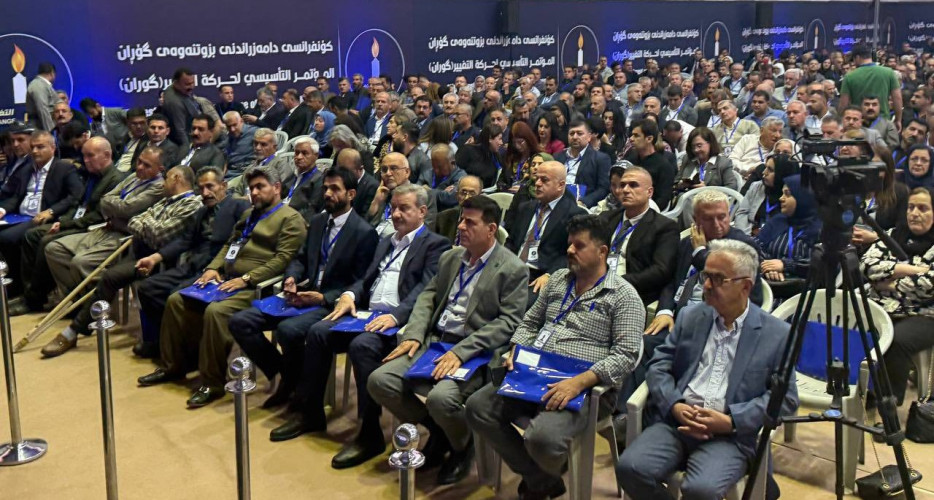
The Gorran (Change) Movement's Kurdsat faction failed to meet the legal quorum for its establishment conference today, deepening the political crisis within the party. Only 435 members attended the gathering, far short of the required 1,063 founders needed to validate the conference according to Iraqi party laws.
Representatives from Iraq's Independent High Electoral Commission (IHEC) were present at the conference hall but left shortly after confirming that the legal quorum had not been reached. They are expected to submit a formal report to the Council of Commissioners regarding the failure to meet the required attendance.
Today's conference was crucial, as Gorran must complete a formal establishment process to qualify for participation in the upcoming Iraqi parliamentary elections scheduled for November 11. By law, founding members listed in Gorran's 2017 establishment records — totaling around 2,000 individuals — must be present at the conference. However, internal splits and defections over recent years have significantly weakened the movement’s base.
The division within Gorran remains sharp between two rival camps: the Zargata Hill faction, led by the sons of the party’s late founder Nawshirwan Mustafa, and the Kurdsat faction, headed by acting General Coordinator Dana Ahmed Majid.
Although members of the Zargata Hill group were permitted to attend today’s conference, only a handful participated, stating they were there merely to monitor proceedings rather than actively engage. They continue to demand that IHEC recognize the conference they held independently on April 5 at Zargata Hill, during which they elected 55 members to the National Council and ratified a political platform and internal regulations. However, the commission had not observed that event and has officially rejected its legitimacy, despite having previously approved the date.
The latest setback forced the Electoral Commission to postpone today's conference, leaving Gorran’s participation in the upcoming elections in serious doubt.
The internal deadlock threatens to marginalize one of Kurdistan’s most influential opposition parties at a critical political juncture for the region.
Gorran’s Rise, Challenges, and Decline
Gorran was founded by Nawshirwan Mustafa along with several former officials from the Patriotic Union of Kurdistan (PUK). The movement made its electoral debut in the 2009 Kurdistan parliamentary elections, winning 25 out of 100 available seats, in addition to 11 seats allocated for specific communities. This result took the two dominant parties, especially the PUK, by surprise.
Nawshirwan Mustafa's initiative tapped into widespread dissatisfaction with the PUK and the Kurdistan Democratic Party (KDP), positioning Gorran as the primary opposition force in the Kurdistan Parliament and launching a campaign of dissent. For the first four years in parliament, Gorran operated as an opposition party; however, after the 2013 parliamentary elections, where it secured 24 seats, it joined the Kurdistan Regional Government (KRG).
In October 2015, the Gorran-affiliated speaker of parliament was prevented from returning to Erbil, and Gorran ministers and officials were removed from their government positions by a decision from the KDP Political Bureau due to ongoing conflicts. Following Nawshirwan Mustafa's death, the Gorran Movement encountered numerous challenges, resulting in the departure of various leaders and factions. In 2019, during the formation of the ninth cabinet of the KRG led by Masrour Barzani, Gorran re-entered the power structure, obtaining four ministries and a vice presidency in the Kurdistan Region Presidency, which negatively impacted its public image.
In the last Kurdistan parliamentary elections, the movement won only one out of 100 seats. It currently has one MP and aligns with the Kurdsat group, led by Dana Ahmed Majid, the acting general coordinator.