Peregraf
The Kurdistan Regional Government’s (KRG) Ministry of Transportation and Communications has refuted claims that an agreement has been reached with the Iraqi Federal Government regarding the Development Road Project.
In an official statement, the Ministry addressed recent remarks attributed to federal officials suggesting that both governments had finalized plans for the project’s railway and international highway within the Kurdistan Region. The KRG strongly denied these claims, stating that they “do not reflect the truth.”
The Ministry clarified that the last official communication between the two sides took place on May 23, 2024, during meetings in Erbil. At that time, both ministries approved a joint protocol as a working framework for determining the project’s route. This agreement was supposed to be presented to the prime ministers of both governments for final approval.
However, the KRG expressed concern over Baghdad’s subsequent actions. Just hours after the protocol was signed, the Federal Ministry of Transport failed to attend a scheduled field visit. Three days later, on May 26, 2024, the federal government abruptly revoked the protocol via an official letter signed by Iraqi Transport Minister Razzaq Muhaibas Ajimi Al-Saadawi, without any explanation.
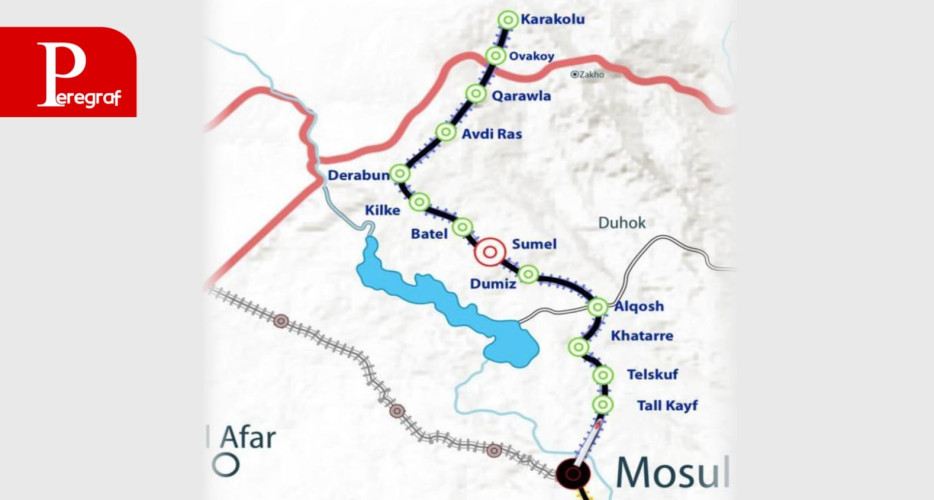
The KRG emphasized that its proposed railway and highway route is 32 kilometers shorter, more cost-effective, safer, and more beneficial to diverse communities. The route runs from Mosul, east of the Tigris River, through the Nineveh Plains, Hamdaniya District, and Tel Kaif District, then continues to Simele in Duhok Governorate, reaching the village of Deraboun east of the Tigris River, before finally connecting to the Iraqi-Turkish border near Qarola in the Ruzgari Subdistrict of Zakho Independent Administration, all east of the Tigris River.
The KRG also criticized the federal government’s alternative route, stating that it passes through remote desert regions while neglecting key areas severely affected by ISIS.
Reaffirming its commitment to national infrastructure projects, the KRG stated that the Development Road Project should serve all Iraqis fairly. It also warned that any final decision on the route depends on Baghdad’s willingness to engage professionally and inclusively.
“The claims of a finalized agreement are completely false,” the statement concluded. “The constitutional rights of the people of Kurdistan will not be compromised.”
Kurdistan Region's Concerns Over Exclusion
On February 12, 2025, Prime Minister Masrour Barzani met with Turkish Finance Minister Mohammed Şimşek to discuss Iraq’s ambitious $17 billion Development Road Project, which aims to connect the Gulf to Europe via Turkey. The meeting highlighted the Kurdistan Region’s concerns regarding its exclusion from the project and the broader implications for regional trade and cooperation.
"We discussed the importance of the Development Road Project and connecting the Gulf countries, Iraq, and the Kurdistan Region with Turkey and European countries by rail and agreed on the need for the Kurdistan Region's active participation in this important project," PM Barzani stated.
However, KRG Minister of Reconstruction and Housing Dana Abdulkarim has voiced skepticism about the region’s involvement. On January 18, he described the project as "the most important strategic initiative since Iraq’s establishment" but criticized the lack of consultation with Kurdish authorities. "The Kurdistan Region will certainly not benefit from this path," Abdulkarim said, calling Baghdad’s decision to bypass Kurdish territory a continuation of "centralized thinking."
Project Details and Ongoing Controversy
Dubbed "Iraq’s Silk Road," the Development Road aims to enhance trade between Asia and Europe by linking the Grand Faw Port in southern Iraq with Turkey through a network of railways and highways. The current route primarily passes through Nineveh governorate, skirting the Kurdistan Region, with only a small portion crossing into Duhok governorate near the Turkish border.
The KRG has urged Baghdad to reconsider the route to include more Kurdish territory, arguing that the region’s economic and strategic position would enhance the project’s success. However, federal authorities have rejected these proposals. The KRG’s alternative route suggestions—including one passing through Kirkuk and Erbil or another following the east side of the Tigris River—were dismissed by Baghdad.
Economic Stakes and Federal Rejection
If the Kurdistan Region remains excluded, it stands to lose significant economic benefits. The Development Road is expected to generate $4 billion annually, primarily from trade and logistics. Minister Abdulkarim emphasized that integrating the Kurdistan Region into the project would not only boost the local economy but also promote stronger social ties between Iraq and the Kurdistan Region.
The Development Road Project is set to be completed by 2050, featuring a $5 billion expansion of the Grand Faw Port and the construction of railways and highways in three phases. Trains on the new railway are expected to reach speeds of up to 300 kilometers per hour, cutting transport times between Europe and the Gulf from 33 days to just 15 days.
Despite its transformative potential, the project’s exclusion of major Kurdish cities has heightened tensions between Erbil and Baghdad. Barzani and Şimşek also discussed ongoing disputes between Erbil and Baghdad, including the urgent need to resume oil exports from the Kurdistan Region.
As discussions continue, the KRG remains committed to securing a greater role in the Development Road Project, emphasizing that economic integration is key to Iraq’s long-term success.