Peregraf
In a groundbreaking move after more than 40 years of armed conflict, Abdullah Ocalan, the imprisoned leader of the Kurdistan Workers’ Party (PKK), has called on PKK guerrillas to lay down their arms and embrace a political resolution to the Kurdish issue in Turkey.
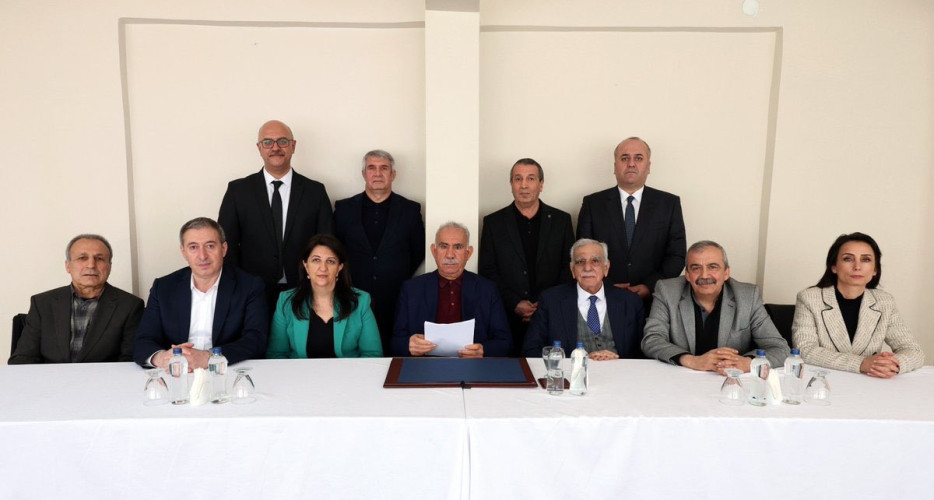
The pro-Kurdish Peoples’ Equality and Democracy Party (DEM) delegation, which met with Ocalan at Imrali Island today, announced his message in a press conference. Ocalan’s appeal calls for an end to the armed conflict and the start of a peaceful, legal, and political process to address Kurdish demands.
Ocalan’s FULL STATEMENT:
Call for Peace and Democratic Society
The PKK was born in the 20th century, in the most violent epoch of the history of humanity, amidst the two World wars, under the shadow of the experience of real socialism and the cold war around the World.
The outright denial of Kurdish reality, restrictions on basic rights and freedoms - especially freedom of expression - played a significant role in its emergence and development.
The PKK has been under the heavy realities of the century and the system of real socialism in terms of its adopted theory, program, strategy and tactics. In the 1990s, with the collapse of real socialism due to internal dynamics, the dissolution of the denial of Kurdish identity in the country, and improvements in freedom of expression, led to weakening of the PKK´s foundational meaningfulness and resulted in excessive repetition.
Throughout the history of more than 1000 years, Turkish and Kurdish relations were defined in terms of mutual cooperation and alliance, and Turks and Kurds have found it essential to remain in this voluntary alliance to maintain their existence and survive against hegemonic Powers.
The last 200 years of capitalist modernity have been marked by primarily with the aim to break this alliance. The forces involved, in line with their class-based interests, have played a key role in furthering this objective.
With monist interpretations of the Republic, this process has accelerated. Today, the main task is to restructure the historical relationship, which has become extremely fragile, without excluding consideration for beliefs with the spirit of fraternity.
The need for a democratic society is inevitable. The PKK, the longest and most extensive insurgency and armed movement in the history of the Republic, found social base and support, and was primarily inspired bythe fact that the channels of democratic politics were closed.
The inevitable outcome of the extreme nationalist deviations - such as aseparate nation-state, federation, administrative autonomy, or culturalistsolutions - fails to answer the historical sociology of the society.
Respect for identities, free self-expression, democratic self-organization of each segment of society based on their own socio-economic and political structures, are only possible through the existence of a democratic society and political space.
The second century of the Republic can achieve and assure permanentand fraternal continuity only if it is crowned with democracy. There is no alternative to democracy in the pursuit and realization of a political system. Democratic consensus is the fundamental way.
The language of the epoch of peace and democratic society needs to be developed in accordance with this reality.
The call made by Mr. Devlet Bahceli, along with the will expressed by Mr. President, and the positive responses from the other political parties towards the known call, has created an environment in which I am making a call for the laying down of arms, and I take on the historical responsibility of this call.
As in the case with any modern community and party whose existence has not been abolished by force, would voluntarily do, convene your congress and make a decision; all groups must lay their arms and the PKK must dissolve itself.
I convey my greetings to all those who believe in co-existence and who look forward to my call.
February 25, 2025
Abdullah Öcalan
A Renewed Peace Process
The revelation follows Ocalan’s first direct meeting with pro-Kurdish lawmakers since the collapse of the 2014 peace process. According to DEM officials Pervin Buldan and Ozturk Turkdogan, Ocalan emphasized the need for Turkish-Kurdish unity, democratic reforms, and an inclusive approach involving all Turkish political parties.
He warned that ongoing conflicts in the Middle East, particularly in Gaza and Syria, were exacerbating the Kurdish issue and urged immediate steps toward peace. Ocalan also suggested that President Recep Tayyip Erdogan and Nationalist Movement Party (MHP) leader Devlet Bahceli could play decisive roles in shaping a new peace framework.
“The strengthening of Turkish-Kurdish brotherhood is not only a historical responsibility but a decisive need for all nations,” Ocalan stated.
On January 22, 2025, DEM lawmakers held a second meeting with Ocalan, relaying responses from Turkish political parties regarding the potential for negotiations. His latest communication with PKK leadership in Qandil has sparked renewed optimism for dialogue.
Government’s Response and Political Shift
In a surprising political shift, the Turkish government appears to be easing its stance on Ocalan. MHP leader Devlet Bahceli recently proposed allowing Ocalan to address the Turkish parliament to formally declare the PKK’s dissolution—an unprecedented move that some analysts see as a turning point in Turkish-PKK relations.
Founded in 1978 with aspirations for Kurdish independence, the PKK has since revised its goals toward autonomy within Turkey. However, it remains designated as a terrorist organization by Turkey, the United States, and the European Union.
The DEM Party, which succeeded the Peoples’ Democratic Party (HDP), has long played a role in peace efforts. As Ocalan’s message reaches PKK leadership and Turkish political figures, it remains to be seen whether this moment will lead to a lasting resolution or another stalled attempt at peace.