Teachers and Public Sector Workers in Sulaymaniyah Block Oil Tankers in Protest Over Salary Crisis
Peregraf
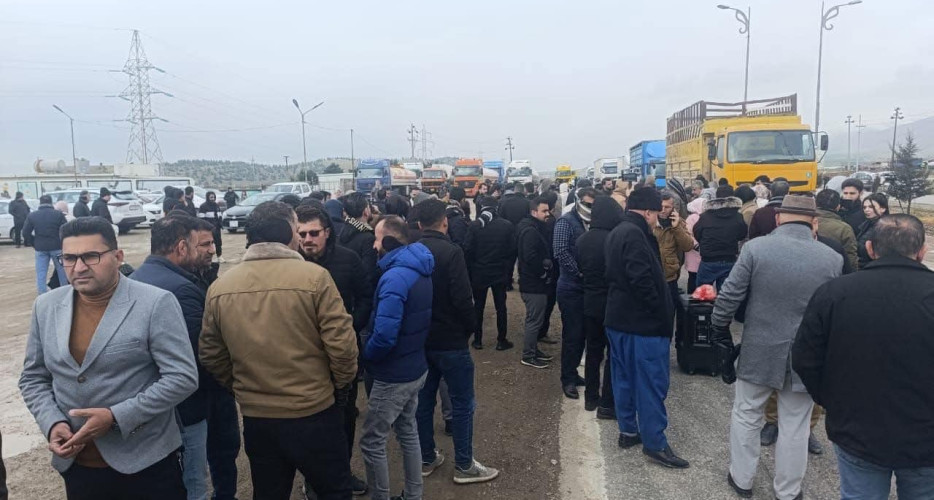
Teachers and public sector employees have blocked oil tankers on the Arbat-Sulaymaniyah road in protest against the ongoing salary crisis and the Kurdistan Regional Government’s (KRG) failure to implement the federal Iraqi salary distribution program, known as Tawteen.
Tensions escalated on the Arbat - Sulaymaniyah Road as confrontations arose between protesting teachers, public employees, and the driver of an oil tanker. The tanker sought to navigate the road; however, the protesters obstructed its passage. A considerable number of tankers have been prevented from proceeding by the demonstrators, resulting in their diversion from the roadway.
The protesters argue that while they struggle with delayed salaries, oil revenues— which should be allocated to public services— are instead benefiting ruling party officials and private companies.
Teachers and public sector workers established two tents along the #Sulaymaniyah - Arbat road to persist in obstructing the passage of #oil tankers heading to Iran in response to the ongoing salary crisis.
— Peregraf (@PeregrafNews) February 23, 2025
Read more on: https://t.co/MvHyIGJNc4 pic.twitter.com/cIPtY06pFk
Osman Gulpi, a teacher participating in protests in Arbat, asserts that the obstruction of oil transportation by tanker, which generates income for the ruling party and its affiliated companies, has commenced. He emphasizes that this marks a new phase in the civil struggle that warrants societal support. Gulpi states, "Individuals are preventing the flow of oil that rightfully belongs to them, while officials are profiting from its sale for their personal gain and that of their families."
Tensions escalated on the Arbat - Sulaymaniyah Road as confrontations arose between protesting teachers, public employees, and the driver of an oil tanker. The tanker sought to navigate the road; however, the protesters obstructed its passage. A considerable number of tankers… pic.twitter.com/6jYXnKjxMQ
— Peregraf (@PeregrafNews) February 23, 2025
Since 2023, oil smuggling from the Kurdistan Region to Iran has become widespread, further straining the region’s finances. The illicit trade undermines Kurdistan’s legal oil exports and diverts substantial revenues away from the KRG’s public treasury. Smuggling operations reportedly generate significant profits for ruling party figures, while public employees face delayed and reduced salaries.
A teacher ascends to the front section of an oil tanker on the Sulaymaniyah-Arbat road, preventing it from proceeding along the route.
— Peregraf (@PeregrafNews) February 23, 2025
More👉 https://t.co/MvHyIGJNc4 pic.twitter.com/W68GGMPtVs
KRG and Baghdad Deadlocked Over Oil Revenues
Amid the protests, the KRG insists that an agreement with the Iraqi federal government is necessary before resuming oil exports from the Kurdistan Region. The KRG’s Negotiating Delegation, following a meeting with Iraqi oil officials on February 18 in Erbil, emphasized the need to allocate a portion of Kurdistan’s oil for domestic use before exports can proceed.
“We reaffirm the KRG’s commitment to implementing the Federal Budget Law’s first amendment, which allows for the re-export of Kurdistan Region oil through Iraq’s State Oil Marketing Organization (SOMO). However, this implementation depends on finalizing the volume required for domestic consumption,” the KRG stated.
Iraq Announces Readiness for Oil Export Resumption
On the other hand, the Iraqi Ministry of Oil announced previously that it had completed the necessary procedures to restart Kurdistan Region oil exports via Turkey’s Ceyhan Port. The ministry urged the KRG to deliver the agreed oil volumes to SOMO for export, in accordance with Iraq’s OPEC production quota.
Barzani and Sudani Discuss the Oil Crisis
As the dispute continues, Kurdistan Region President Nechirvan Barzani met with Iraqi Prime Minister Mohammed Shia’ al-Sudani in Baghdad. According to the Iraqi Prime Minister’s office, Sudani stressed the urgency of restarting oil exports through Ceyhan and addressing financial disputes between Erbil and Baghdad.
U.S. Pushes for Oil Export Resumption Amid Smuggling Concerns
Meanwhile, the United States is pressuring Iraq to restart Kurdistan Region oil exports, citing concerns over smuggling. Reuters sources report that Washington sees this as part of its broader “maximum pressure” campaign against Iran, as Kurdistan’s smuggled oil is allegedly generating over $1 billion annually for Iran and its regional proxies.
Since the closure of the Ceyhan pipeline in March 2023, an estimated 200,000 barrels per day of discounted crude have reportedly been smuggled from Kurdistan to Iran and Turkey. U.S. officials are pushing Baghdad to ensure Kurdistan oil reaches global markets rather than being sold at discounted rates through illegal channels.
New Budget Amendment Paves the Way for Oil Exports
A recent budget amendment passed by Iraq’s parliament on February 2, 2025, and signed into law, sets the production and transportation costs for Kurdistan’s oil at $16 per barrel, with the federal government covering these expenses. Kurdish MP Dilan Ghafoor told Peregraf that this rate is temporary and will be reassessed within 60 days by an independent company.
The amendment is seen as a crucial step toward resuming Kurdistan Region’s oil exports. However, experts warn that financial and logistical hurdles remain, and swift action is needed to prevent further economic deterioration in the region.
With both Erbil and Baghdad relying on oil revenues for public services and salary payments, resolving the dispute is critical. As Iraq moves closer to resuming full oil exports, global markets are closely monitoring the developments, especially amid ongoing fluctuations in oil prices.