Mazloum Abdi and Barzani Representative Discuss Strengthening Kurdish Unity in Syria
Peregraf
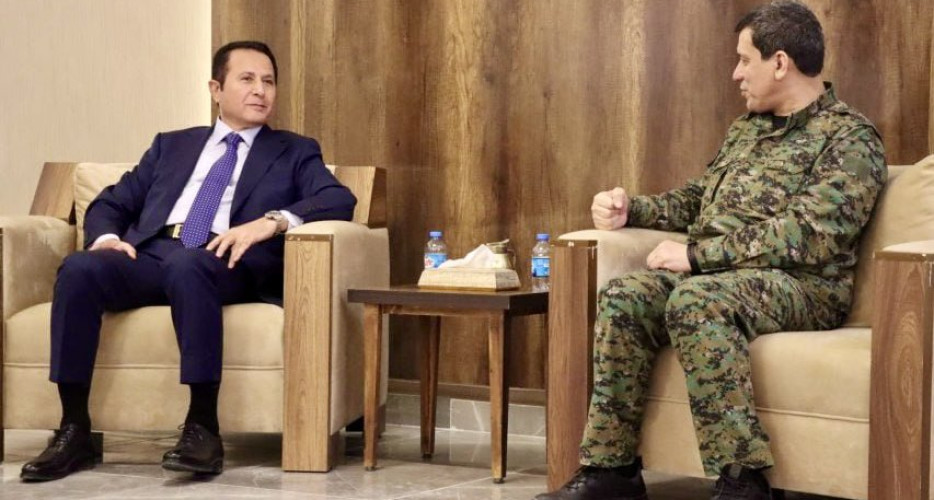
Today, Mazloum Abdi, the General Commander of the Kurdish-led Syrian Democratic Forces (SDF), met with Hamid Darbandi, the representative of Kurdistan Democratic Party (KDP) President Masoud Barzani, to discuss efforts to strengthen Kurdish unity. This meeting comes as the Kurdish political landscape faces mounting challenges and calls for solidarity.
Barzani, has sent a representative to northeast Syria (Rojava) to meet with the SDF chief Mazloum Abdi and the region’s opposition coalition, Kurdish National Council ENKS, on Monday.
On January 8, 2025, Masoud Barzani hosted a delegation from the leadership of the ENKS in Pirmam. During the meeting, Barzani emphasized the importance of unity and solidarity among Kurdish parties in Syria and advocated for resolving disputes through dialogue.
“The discussions addressed the situation in Syria and the stance of Kurdish parties on current developments,” read a statement from Barzani’s headquarters. The statement highlighted Barzani’s call for respect for the interests of the Kurdish people in Syria and reliance on peaceful measures to achieve their goals.
The push for Kurdish unity comes as regional and international efforts continue to seek a resolution to the Syrian crisis, with Kurdish factions facing criticism for their fragmented approach. This disunity is often cited as a barrier to effectively advocating for Kurdish rights in Syria.
In a statement on December 14, 2024, SDF Commander Mazloum Abdi described Kurdish national unity as a “historical necessity” given the region’s ongoing challenges.
The Syrian Crisis and Its Aftermath
Since the onset of the Syrian civil war in 2011, the country has undergone massive transformations. The fall of the Assad regime, which many believe is inevitable given the ongoing conflict and international isolation, is expected to usher in a new political era. However, this transition also poses significant challenges for the diverse communities in Syria, including the Kurds, Arabs, and other ethnic and religious groups.
For the Kurds, the post-Assad era could represent both an opportunity and a risk. While the vacuum left by the regime’s collapse may allow for greater autonomy in Kurdish-majority regions, it could also exacerbate internal divisions and external pressures. Kurdish areas, which have enjoyed a de facto autonomous administration under the Syrian Democratic Forces (SDF) since 2013, will need to navigate complex negotiations with other Syrian opposition factions, regional powers like Turkey, and international actors.
Kurdish Divisions and the Role of Unity
Kurdish unity has long been a contentious issue, with major factions like the SDF and ENKS often at odds over ideology, governance, and alliances. The Syrian Kurdish National Council (ENKS), closely aligned with the Kurdistan Democratic Party (KDP) and Turkey, often clashes with the Democratic Union Party (PYD), the dominant force within the SDF, which has ties to the Kurdistan Workers’ Party (PKK).
These divisions have weakened the Kurdish position on the national stage and undermined their ability to secure recognition for their autonomous administration in northeastern Syria. Calls for unity, like those from Mazloum Abdi and Masoud Barzani, reflect growing awareness of the need to present a cohesive front in the face of future political negotiations.
As Syria transitions into a post-Assad era, the ability of Kurdish factions to overcome their differences and work together will likely determine their role in shaping the country’s future. A united Kurdish bloc could advocate more effectively for federalism, minority rights, and the preservation of self-governance structures. However, continued disunity risks sidelining Kurdish aspirations in the broader struggle for Syria’s political reconstruction.
International Stakes
The Kurdish issue in Syria remains a focal point for regional and global powers. Turkey, which views Kurdish autonomy as a threat to its national security, continues its military operations in northern Syria, aiming to dismantle the SDF’s control. Meanwhile, the U.S. and European nations have backed the SDF as a key ally in the fight against ISIS, complicating the dynamics.
With the Syrian crisis at a turning point, the future of Kurdish-majority regions will depend not only on internal cohesion but also on navigating the intricate web of international interests. The coming years will test whether the Kurds can seize this critical moment to secure a sustainable and equitable role in a redefined Syria.