Peregraf
Massoud Barzani, the leader of the Kurdistan Democratic Party (KDP), stated that following the successful conduct of elections, the process of forming a government and engaging in negotiations among the parties will be completed effectively. He emphasized, "We aspire to establish a broad-based government grounded in electoral merit."
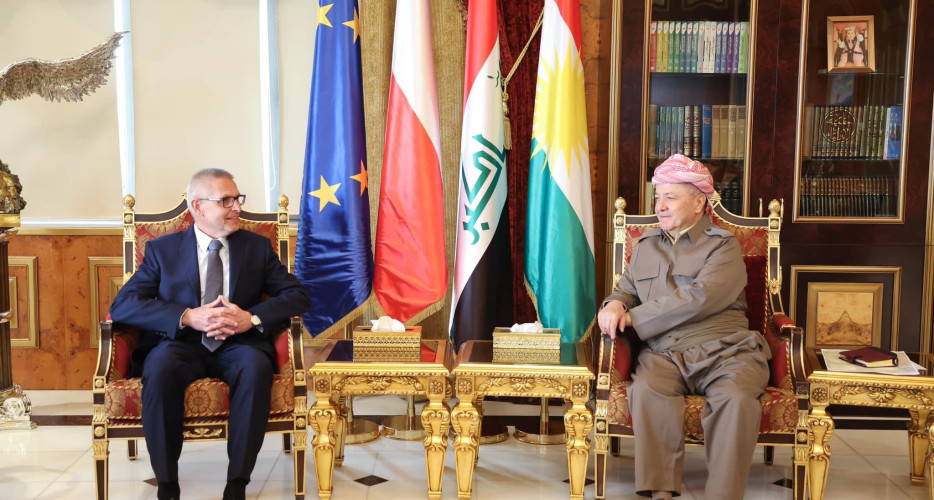
Barzani made these comments during a meeting with Marcin Kubiak, the Polish Ambassador to Iraq. He remarked, "The participation of the Kurdish populace in the elections within a peaceful environment has elevated our spirits."
Barzani's statement reflects the understanding that elections in the Kurdistan Region are not the sole means of obtaining legitimacy for government formation. The ruling parties in the region, namely the Patriotic Union of Kurdistan (PUK) and the KDP, maintain their own armed forces that operate independently of government oversight. This situation, coupled with their parliamentary seats, contributes to their legitimacy and influences the discussions surrounding the formation of the Kurdistan Regional Government.
Approximately one month after the sixth round of elections for the Kurdistan Parliament, the inaugural session has yet to convene, and negotiations for the establishment of the tenth cabinet have not commenced. This delay is attributed to the pending decisions from the Iraqi High Independent Election Commission (IHEC) and the IHEC Judiciary Council regarding the appeals submitted by various parties.
The primary discussions regarding government formation will involve the three leading parties from the elections: the KDP, the PUK, and the New Generation Movement (NGM), with the KDP securing 39 seats, the PUK obtaining 23 seats, and the NGM winning 15 seats.
NGM has emerged as the third-place winner in the recent elections, prompting both PUK and KDP to engage with NGM regarding the formation of the new cabinet for the Kurdistan Regional Government (KRG). NGM has expressed its willingness to join the government; however, it has set forth conditions that are deemed unreasonable. The movement intends to present two proposals for government formation, although the likelihood of their acceptance appears slim. Consequently, it is anticipated that the new KRG cabinet will primarily be established by PUK and KDP, the first and second-place winners in the Kurdistan parliamentary elections.
In its initial proposal, NGM is requesting the position of KRG Prime Minister, asserting that it desires this role while allowing other positions within the Kurdistan region, such as the Speaker of Parliament and the President of the Kurdistan Region, to be allocated to different parties.
Should NGM not be granted the Prime Minister position, its alternative proposal stipulates that all other roles, including the President of the Kurdistan Region, the Speaker of Parliament, and the 23 ministries of the KRG, should be assigned to NGM, with the Prime Minister's position reserved for another party.
NGM's demands are primarily directed towards the KDP, which is tasked with the responsibility of forming the government.
NGM has indicated that it is unwilling to participate in the government if it is only offered a few ministerial positions without substantial authority, as it believes this would not facilitate a "radical change in the governance of the Kurdistan Region." This sentiment has been reiterated by NGM's president, Shaswar Abdulwahid, who emphasizes “the movement's commitment to significant reform”.
The fourth-place winner in the Kurdistan parliamentary elections is the Kurdistan Islamic Union (KIU), also known as Yakgirtu, which secured seven seats in Parliament and has declared its intention not to participate in the upcoming KRG cabinet.