Peregraf
Bafel Talabani has articulated the strategy of the Patriotic Union of Kurdistan (PUK) regarding the formation of a new cabinet for the Kurdistan Regional Government (KRG), asserting, "The era of dictatorship has ended, and it is imperative to establish a responsible national government."
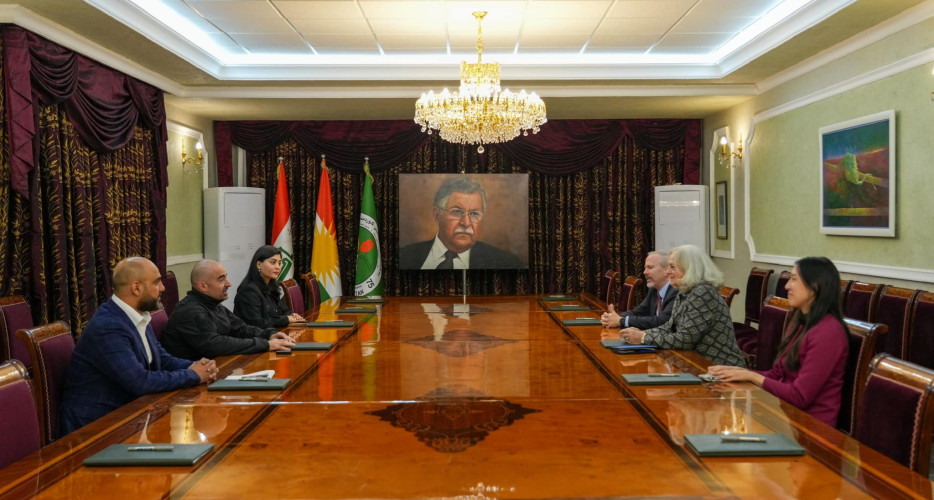
During a meeting with the US Ambassador to Iraq, Alina Romanowski, at his residence in Dabashan, Talabani emphasized that "the PUK is advancing towards the establishment of a government guided by a new strategy, aiming to avoid the pitfalls of past dictatorial governance."
He further stated, "Our objective is to create a national government that is accountable to its citizens, one that is equitable and serves all cities without discrimination."
Talabani noted that this new chapter for the Kurdistan Region "will not tolerate dictatorship or self-serving governance," underscoring that "the previous misuse of government institutions for party and personal gain is a thing of the past. The government must no longer function solely to benefit a specific political party."
He concluded by asserting that "the forthcoming KRG cabinet is intended for the people and must prioritize their needs. Any deviation from this principle will be met with resistance, and the PUK will not permit it."
The president of the PUK addressed the relationship between Erbil and Baghdad, as well as the ongoing conflicts in the Middle East, stating, "We stress the importance of adhering to the constitution and fostering a true partnership in the governance of the nation, ensuring the rights of all stakeholders are upheld. It is imperative that all parties act with responsibility regarding the regional conflicts and prevent the nation from turning into a battleground for the resolution of disputes."
The formation of the Kurdistan Regional Government (KRG) cabinet has always been a complex and often contentious process, primarily involving the two major political parties: the PUK and the Kurdistan Democratic Party (KDP).
The PUK and KDP have been the dominant political forces in the Kurdistan Region of Iraq since its establishment. Historically, these parties have had a power-sharing arrangement, often leading to coalition governments. However, their relationship has been marked by periods of cooperation and rivalry, influenced by their differing political ideologies and regional support bases.
Key Issues and Challenges
One of the main issues in the cabinet formation process is the allocation of key ministerial positions. Both PUK and PDK seek to secure influential posts to advance their political agendas and ensure representation for their constituencies. This has often leads to delays and gridlock in the formation process. Masrour Barzani, the current Prime Minister of the KRG, has been a central figure in the KDP and has played a significant role in shaping the political landscape of the Kurdistan Region. Since his appointment as Prime Minister in 2019, Barzani, he has faced harsh criticism from PUK. Critics argue that Barzani's leadership has led to the monopolization of power within the KRG, primarily benefiting the KDP. This concentration of power has raised concerns about the marginalization of other political parties, particularly the PUK, and the potential erosion of democratic principles in the region.
The Barzani family's influence in Kurdish politics is deeply rooted, with Masrour Barzani's father, Masoud Barzani, having led the KDP for decades. This dynastic leadership has contributed to the perception of a power monopoly, as key positions within the KRG are often held by members of the Barzani family or their close allies. This has led to accusations of nepotism and a lack of political diversity within the government.
In the Kurdistan Region, the "Green Zone" often refers to areas controlled by the PUK, while the "Yellow Zone" refers to areas controlled by the (KDP. Masrour Barzani, as the Prime Minister of the Kurdistan Regional Government (KRG), has been involved in various projects across the region. Additionally, he has laid the foundation for infrastructure projects, including a national museum and green spaces. However, there have been tensions between the PUK and KDP regarding the allocation of resources and development projects. The PUK has accused the KRG of favoring Erbil and providing fewer funds for Sulaymaniyah, which is under PUK control. This has led to criticisms that Barzani's administration may be neglecting projects in the "Green Zone" or areas controlled by the PUK.