Peregraf
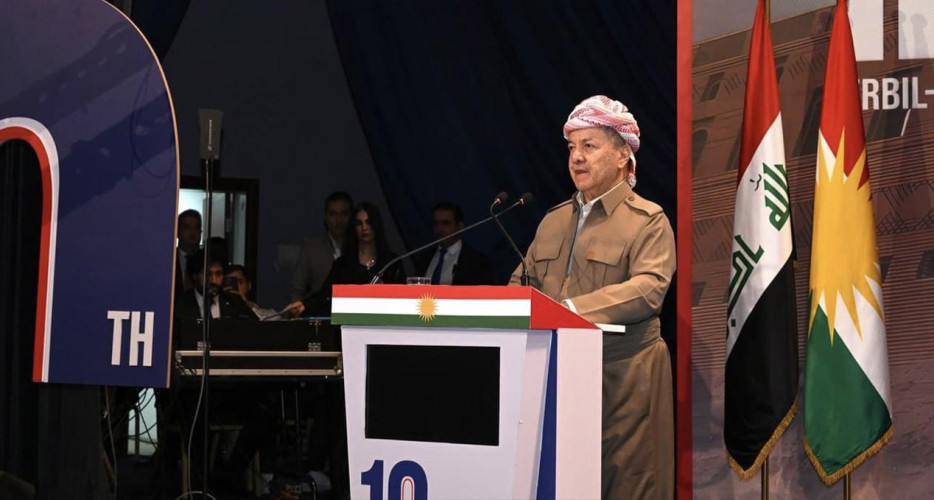
The President of the Kurdistan Democratic Party (KDP), Massoud Barzani, stated that the new cabinet of Kurdistan Regional Government (KRG) will be formed under the framework of one Kurdistan Region, a one government, one parliament, and one Peshmerga force.
During his address at the Mesopotamian Medical Congress in Erbil today, Barzani remarked, "On the 20th of this month, a significant election took place in Kurdistan. We take pride in the fact that the elections were conducted in a remarkably peaceful environment, contrary to the concerns many had."
He further emphasized, "Following the elections, it is essential to engage in dialogue among all parties, with the criteria for discussion being the merit and performance levels demonstrated by the parties during the elections."
The KDP leader, whose party secured the highest number of seats in the new parliament with 39, asserted that the upcoming government must take decisive action to combat illegal activities, including the establishment of drug manufacturing facilities, drug trafficking, terrorism, and any deviations from the law. He stressed the necessity for the rule of law to be upheld.
The Kurdistan Region in Iraq has two ruling zones due to a power-sharing agreement between the two main political parties: the Kurdistan Democratic Party (KDP) and the Patriotic Union of Kurdistan (PUK). This arrangement, known as the "50-50 system," was established to manage the political landscape and ensure balanced governance. Under this system, the KDP controls the Erbil and Duhok Governorates, while the PUK governs the Sulaymaniyah Governorate. This division was supposed to help maintain a relative balance of power between the two parties, although it has also led to some political tensions and challenges over the years.
In recent years, the balance of power has indeed been leaning more towards the KDP. The KDP has become more dominant, while the PUK has faced challenges and a decline in influence. This shift has led to increased tensions and a breakdown of the traditional power-sharing agreement between the two parties. The KDP's growing influence has also caused the PUK to seek support from Baghdad to counterbalance the KDP's dominance.
In the recent Kurdistan parliamentary elections held on October 20, 2024, PUK secured 23 seats in the 100-seat parliament. This placed them second behind the Kurdistan Democratic Party (KDP), which won 39 seats. The PUK's performance reflects its continued influence, although it remains behind the KDP in terms of parliamentary representation.
The elections saw a voter turnout of 72%, a significant increase from the 59% recorded in the previous elections in 2018. Despite the challenges and allegations of fraud from some parties, the PUK and PDK managed to maintain a substantial presence in the parliament.
Both the KDP and the PUK have their own armed forces, which are part of the Peshmerga. The KDP controls Unit 80, while the PUK controls Unit 70. These units are loyal to their respective political parties and have historically been used to maintain control over specific territories and to exert political influence.
The Peshmerga forces have played a crucial role in the security and defense of the Kurdistan Region, especially during conflicts such as the fight against ISIS. However, the division of the Peshmerga along party lines has also led to challenges in unifying and modernizing the force.
Efforts have been made to integrate these forces under the Ministry of Peshmerga Affairs to create a more unified and professional military, but progress has been slow due to political tensions and mistrust between the KDP and PUK. It's a complex situation with deep historical roots, and the use of armed forces by political parties continues to shape the political landscape in the Kurdistan Region.