Peregraf
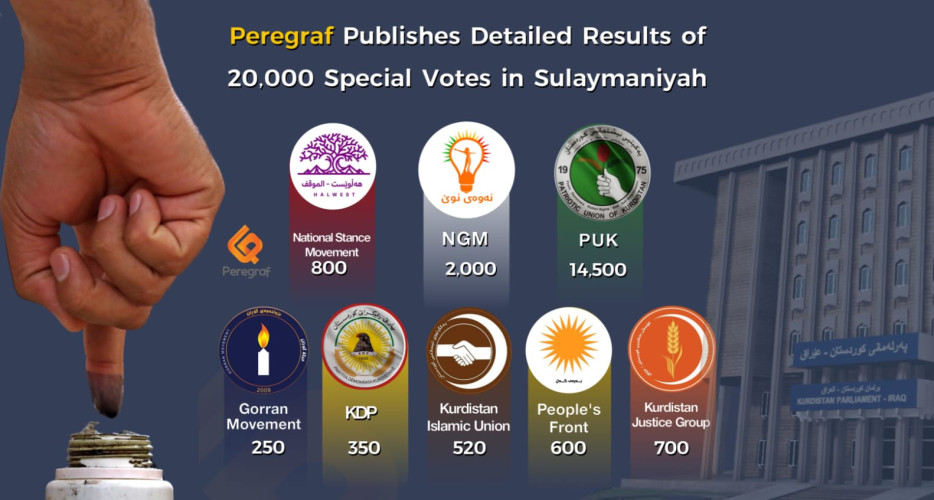
Peregraf has obtained detailed results from approximately 20,000 special votes cast in the Sulaymaniyah, including Sulaymaniyah, Garmian, and Raparin. These results come partly from official sources within political parties, while others have been independently gathered. According to the data, the Patriotic Union of Kurdistan (PUK) leads the race, securing over 14,000 votes.
In second place is the New Generation Movement, followed by the National Stance Movement in third. The PUK received around 14,500 votes, while the New Generation garnered roughly 2,000 votes.
The National Stance Movement, led by Ali Hama Salih and participating in the elections for the first time, placed third. The movement edged ahead of the People's Front, led by Lahur Sheikh Jangi, and several Islamic parties by approximately 800 votes. The Kurdistan Justice Group (Komal) followed in fourth place, obtaining about 700 votes. The People's Front, also making its electoral debut, ranked fifth with around 600 votes.
The Kurdistan Islamic Union (Yakgrtu) and the Kurdistan Democratic Party (KDP) each received about 520 votes, while the Gorran Movement collected around 250 votes. Other parties and independent candidates received significantly fewer votes.
Jumana Ghalai, spokeswoman for the Iraqi High Election Commission (IHEC), announced that voter turnout for the special voting process in the Kurdistan Parliament elections reached an impressive 97%. In a statement to Peregraf, Ghalai confirmed that 208,521 voters cast their ballots out of 215,960 registered, reflecting strong participation.
Special voting for the Kurdistan Regional parliamentary elections concluded successfully, with polling starting at 7:00 AM and voting machines automatically shutting down at 6:00 PM. The majority of special voters were located in Erbil (89,791), followed by Sulaymaniyah (78,661), Dohuk (40,956), and Halabja (952). Additionally, 5,600 voters from Iraqi provinces were eligible to vote.
In a bid to prevent double voting in the general election scheduled for October 20, authorities temporarily collected voter cards. Receipts were issued to voters, allowing them to retrieve their cards at a later date.
Several issues were reported at polling stations. Some voters experienced difficulties with fingerprint recognition, while the most significant violation involved the use of mobile phones. Despite IHEC’s ban, Peregraf reporters in Sulaymaniyah, Erbil, Halabja, and Dohuk observed security forces using mobile phones while casting their votes.