Peregraf
Kurdistan Region President Nechirvan Barzani, on Thursday, acknowledged that the process of reforming and unifying the Peshmerga forces is progressing slower than desired, both by the Kurdistan Regional Government (KRG) and the U.S.-led coalition.
"There are problems, and it is a slow process," Barzani stated. "We must all work seriously to make this process a success and not disappoint our friends and allies who are supporting the unification of the Peshmerga forces."
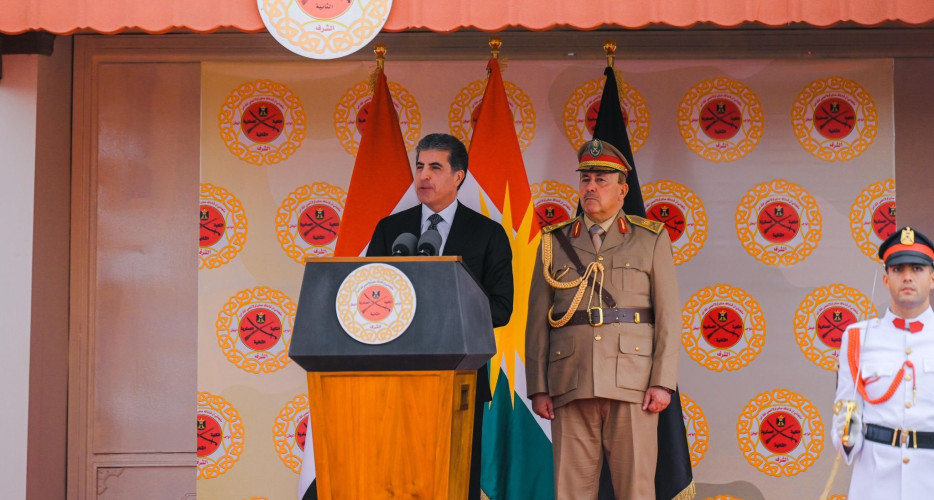
Barzani attended the graduation ceremony of 792 Peshmerga officers at Zakho Military College today, where he delivered a speech expressing gratitude to the United States and coalition forces for their continued support of the Peshmerga Ministry's reform efforts. He added, "My message to the Coalition is that while the process is slow, there is strong will to unite the forces and establish a single national force under the command and control of the Kurdistan Regional Government and the Ministry of Peshmerga Affairs."
The President emphasized the importance of continued cooperation between the Iraqi army and the Peshmerga forces, particularly in light of the ongoing threat posed by ISIS. "We believe that ISIS remains a serious threat to the security of Iraq and the region, making cooperation between the Iraqi army and Peshmerga essential," Barzani said.
With the sustained assistance from the US and coalition partners to the Peshmerga Ministry, there have been ongoing concerns regarding the slow advancement of the reform process and the unification of the Peshmerga forces, as well as the persistent political discord between the PUK and KDP within the ministry.
For seven years, an international coalition led by the United States, along with Britain, Germany, and the Netherlands, has aimed to establish a national army for the Kurdistan Region. This initiative involves the provision of financial resources, strategic advice, military supplies, and other forms of coordination, with the intent of integrating forces associated with the Patriotic Union of Kurdistan (PUK) and the Kurdistan Democratic Party (KDP) under the auspices of the Ministry of Peshmerga.
In the latter months of 2022, Peshmerga Minister Shorsh Ismail resigned due to challenges posed by the PUK and KDP that hindered the "organization and unification" of the Peshmerga forces, raising concerns among the United States and its allies. Subsequently, the PUK and KDP struggled to reach a consensus on a suitable candidate for the ministerial position.
The coalition forces subsequently cautioned the Peshmerga Ministry that failure to advance the reform process in a cohesive manner, along with the continued interference and disputes between the PUK and KDP, would result in the suspension of all assistance.
Ultimately, under pressure from the United States and the threat of halting aid to the Peshmerga, as well as the cessation of the reform process within the Ministry, the PUK and KDP persuaded the Peshmerga minister to resume his duties after nearly a year, assuring the removal of existing obstacles. The United States expressed its approval of Shorsh Ismail's return, stating, "We have high hopes for you to continue the reform process within the Peshmerga forces and create a national force."
The formal agreement between the US Department of Defense and the Peshmerga was established in 2016 and renewed in September 2020, primarily aimed at providing assistance, addressing the needs of the Peshmerga, and supporting the successful reform process within the Ministry of Peshmerga, as well as the reunification of Peshmerga units and forces.