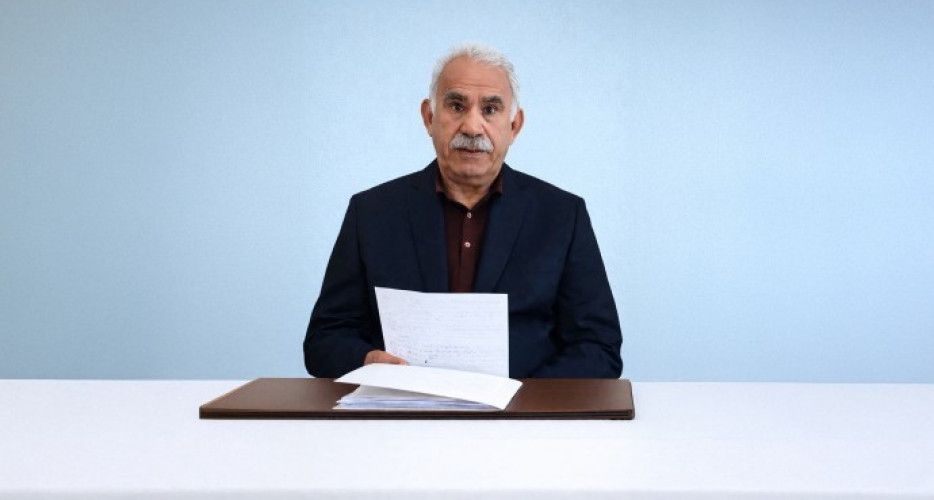
Peregraf – In a new message, imprisoned PKK leader Abdullah Öcalan has stated that "the era of armed struggle has ended," signaling what could mark a shift in the decades-long conflict between the PKK and the Turkish state.
The statement, delivered through the pro-Kurdish Peoples' Equality and Democracy Party (DEM Party) following a March 27 meeting on Imrali Island, underscores a renewed push toward a political resolution.
"This process has reached a significant threshold," the delegation said, stating that dialog, democratic will, and historical responsibility must guide the next phase.
A Strategic Pivot
Öcalan's statement that "there is no turning back now" from abandoning armed struggle represents one of his clearest endorsements yet of a transition away from armed action. The PKK, which Turkey, the United States, and the European Union have designated as a terrorist organization, has waged an insurgency since 1984.
His latest message frames the Kurdish issue not as a military confrontation but as a political challenge requiring systemic democratic reform.
"We have no problem with the Republic," Öcalan said. "The real issue is that the Republic is not democratic. Democracy is the only solution that will ensure the strengthening of the Republic."
Call for Democratic Integration
Central to Öcalan's vision is what he describes as a "Democratic Republic" rooted in pluralism, civil rights, and societal integration. He called for guarantees of identity, freedom of expression, organization, and women's rights – not only for Kurds but for all citizens of Turkey.
The statement also urged Turkish institutions, particularly the Grand National Assembly of Turkey, to assume a role by establishing a comprehensive legal framework to support the peace process.
According to the DEM Party delegation, there is a view that "historical opportunities must not be missed," and that strengthening democratic politics is necessary to achieving a resolution.
Regional Context and Geopolitical Warning
Öcalan placed his message within a broader regional context, referring to escalating tensions across the Middle East. He pointed to ongoing instability in Syria and the US-Israel War on Iran, now on Day 32, describing competing geopolitical "lines" led by the United States and Israel; the United Kingdom and status quo powers; and a third path centered on democratic societal development.
"Developments in Iran have once again demonstrated the validity and importance of the process being carried out in Turkey," he said.
He also invoked the ancient Treaty of Kadesh as a symbolic precedent, arguing that the historical ties between Anatolia and Mesopotamia necessitate a cooperative and integrated future.
A Long and Uncertain Road Ahead
Despite the strong rhetoric, uncertainties remain. Previous peace efforts between Ankara and Kurdish representatives – notably the 2013–2015 process – ultimately collapsed, leading to renewed violence.
Whether Öcalan's latest message will translate into policy shifts or reciprocal steps by the Turkish government remains unclear. Ankara has not publicly responded to the statement.
Analysts suggest that the clarity of Öcalan's position – explicitly renouncing armed struggle and emphasizing democratic engagement – could create a new opening, depending on political will from involved parties.
A Defining Moment?
For many Kurds in Turkey and across the region, Öcalan's message may represent a moment to redefine a decades-long conflict through political means.
"The process we are living through is a transition to peace," Öcalan said. "When it succeeds, the Republic will become twice as strong."
Whether this statement marks the beginning of a durable peace or another missed opportunity will depend on how state institutions and Kurdish political actors respond.