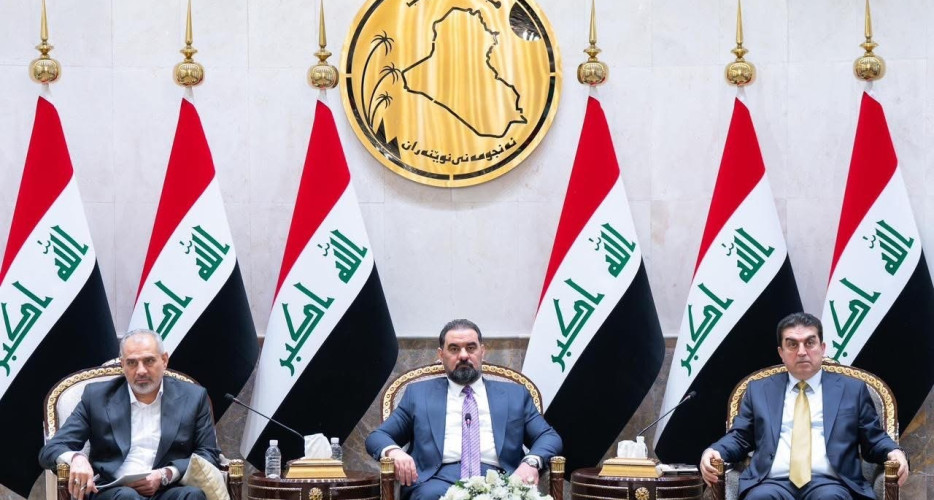
Peregraf — Iraq’s parliament has scheduled April 11 for a decisive session to elect a new president, in a renewed attempt to break months of political paralysis, even as deep divisions among key factions threaten to derail the process.
In an official statement, the Presidency of the Council of Representatives said it held an expanded meeting with leaders of parliamentary blocs to review legislative priorities and finalize committee appointments. Central to the discussions was the long-delayed election of the President of the Republic, described as a constitutional obligation necessary to restore momentum to governance amid mounting security and economic challenges.
The announcement comes alongside mounting pressure from Shiite political forces, which have set April 8 as a final deadline for the Kurdistan Democratic Party (KDP) and the Patriotic Union of Kurdistan (PUK) to agree on a single candidate for the presidency.
Bahaa al-Araji, head of the Reconstruction and Development Coalition aligned with Prime Minister Mohammed Shia’ al-Sudani, said the deadline reflects intensified efforts to end the impasse. “With firm resolve and sincere parliamentary efforts, we have today reaped the fruits of our tireless work,” he said, framing the move as a necessary step to confront Iraq’s growing political and economic challenges.
Barzani Pushes Back
However, the push toward a rapid vote has met firm resistance from KDP leader Masoud Barzani, who warned against what he described as attempts to impose a solution without Kurdish consensus.
In a letter sent to Shiite and Sunni leaders on March 28, Barzani cautioned that “haste or imposition will lead to opposite results and deeper division.” He stressed that Kurdish factions remain divided over a unified nominee and argued that the issue must first be resolved internally.
Barzani called for broader dialogue and urged political actors to prioritize what he described as principles of “partnership, balance, and national consensus,” signaling a preference for a slower, negotiated process over a rushed parliamentary vote.
Rising Pressure Inside Parliament
Despite Barzani’s objections, pressure within parliament is intensifying. More than 220 lawmakers—the minimum quorum required to elect a president—have signed a petition demanding that the vote proceed, reflecting growing frustration over the prolonged stalemate.
Speaker Haibat al-Halbousi has backed the effort, warning that continued delays are undermining state stability. “We face a clear national responsibility to conclude this milestone and choose a figure who represents everyone,” he said.
Yet divisions remain sharp, particularly within the Kurdish bloc. According to Kurdish MP Dilan Ghafour, all Kurdish factions except the KDP have supported the parliamentary push, underscoring the lack of unity that has repeatedly stalled progress.
A Familiar Constitutional Impasse
Under Iraq’s constitution, electing a president requires a two-thirds majority—220 out of 329 lawmakers—a threshold that has proven difficult to secure amid political fragmentation.
The presidency, traditionally held by a Kurdish figure, has become the focal point of intra-Kurdish rivalry. Incumbent Abdul Latif Rashid is seeking a second term, while the PUK has nominated Nizar Amedi and the KDP has put forward Fuad Hussein.
Failure to fill the post has effectively frozen the broader political process, as the president is responsible for formally designating a prime minister to form a government.
Regional Tensions Add Urgency
The political deadlock is unfolding against a backdrop of heightened regional tensions and internal divisions, including disagreements among Shiite factions over the premiership and ongoing security concerns linked to regional conflict dynamics.
Shiite blocs have warned they may boycott future sessions if Kurdish factions continue to abstain, raising the specter of a deeper institutional crisis.
As the April deadlines approach, Iraq faces a stark choice: proceed with a high-stakes parliamentary vote that risks further division, or delay once again in pursuit of a fragile political consensus—an option that may prolong uncertainty at a critical moment for the country.