'Death to America' Chanted Inside Iraqi Parliament as Tensions Spill Into Heated Session
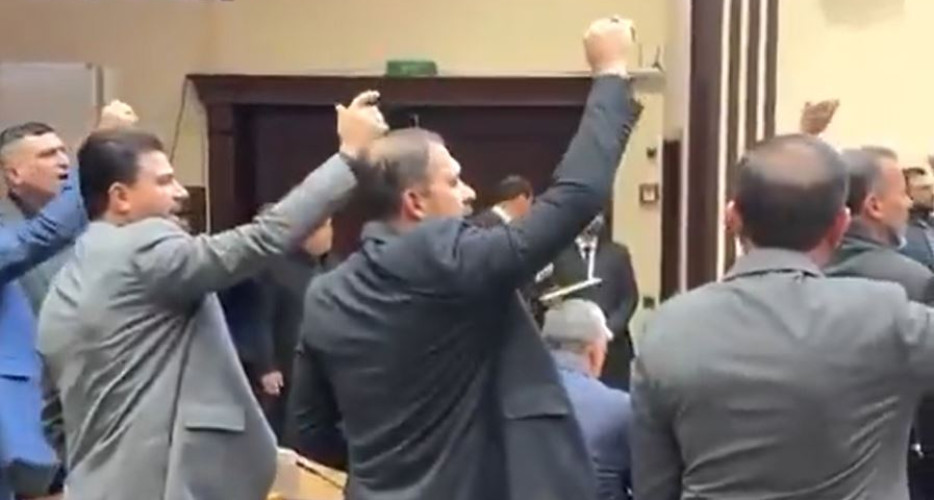
Peregraf — Iraq’s parliament descended into chaos late Saturday night as lawmakers linked to Iran-aligned armed factions chanted anti-American and anti-Israeli slogans during a high-level session convened to discuss the country’s security situation and escalating regional tensions.
The meeting, attended by senior Iraqi military and security commanders, was intended to review Iraq’s defense posture amid the intensifying conflict in the region and a wave of drone attacks targeting the Kurdistan Region and other locations in Iraq over the past week.
According to lawmakers present, the atmosphere quickly turned confrontational after briefings from security officials. Members of parliament closely aligned with factions within the Popular Mobilization Forces (PMF), known in Arabic as Hashd al-Shaabi, began chanting slogans condemning the United States and Israel while praising groups describing themselves as part of a "Resistance Front."
Witnesses said the chants echoed through the parliament chamber.
"Death to America! America is the Great Satan! Death to Israel! Yes to the Resistance!" several lawmakers shouted.
A Kurdish member of parliament, speaking to Peregraf on condition of anonymity, said that many lawmakers chose not to respond.
"While the chanting and praising were happening, Sunni, Kurdish, and even some Shiite MPs remained silent," the lawmaker said.
The slogans were voiced as Iraq faces a tense security environment. Over the past week, armed groups claiming affiliation with the so-called "Islamic Resistance in Iraq" have launched a series of drone attacks targeting the Kurdistan Region and other sites, raising fears of a wider escalation linked to the regional confrontation involving Iran, Israel, and the United States.
The parliamentary session was meant to focus on Iraq’s preparedness amid those developments. Senior commanders, including the chief of staff of the Iraqi Army, attended the meeting and briefed lawmakers on the country’s defense capabilities and the status of its air defense systems.
But the discussion soon shifted into a political confrontation.
Lawmakers from the Al-Sadiquon bloc, the parliamentary wing of Asa'ib Ahl al-Haq led by Qais al-Khazali, demanded that the Iraqi government take a clearer position on the unfolding regional crisis. The bloc holds 27 seats in parliament, and the deputy speaker of the chamber is affiliated with the faction.
Members of the group called on the government to adopt what they described as a "firm stance" in response to regional developments and the presence of U.S. forces in Iraq.
The tensions inside the chamber escalated further when a physical altercation broke out between two members of parliament.
Mustafa Sanad, a lawmaker from the "Abshir ya Iraq" bloc, which is politically close to factions within the PMF, confronted Bahaa al-Nouri of the Reconstruction and Development bloc associated with Prime Minister Mohammed Shia al-Sudani.
According to witnesses, the dispute began after Sanad sharply criticized Sudani’s government for what he described as failing to take a clear position on the regional conflict and the attacks being carried out by armed groups.
During the argument, Sanad slapped al-Nouri, prompting an immediate intervention by parliamentary officials and other lawmakers.
The presiding official of the session ordered Sanad barred from attending parliamentary meetings until he issues a formal apology to the parliament’s leadership and to the head of Sudani’s bloc.
The incident drew attention beyond Iraq after Zalmay Khalilzad, who served as the United States ambassador to Iraq from 2005 to 2007, posted a video of the chanting lawmakers on X. In the post, Khalilzad criticized the scene, writing: "A scene in Iraqi Parliament where some members were shouting death to America. Where would they be without 2003 US overthrow of Saddam."
The events underscored the deep divisions within Iraq’s political establishment at a moment when the country finds itself increasingly exposed to regional tensions.
Iraq’s government has repeatedly sought to avoid being drawn into the broader confrontation between Iran, Israel and the United States, while at the same time struggling to manage powerful armed factions that operate within or alongside the state security apparatus.
For many observers, the chants and the scuffle on the parliamentary floor illustrated the fragility of Iraq’s political balance as tensions continue to rise across the Middle East.