Al-Sudani and Nechirvan Barzani Discuss Regional Escalation as Iran Warns Kurdistan Region
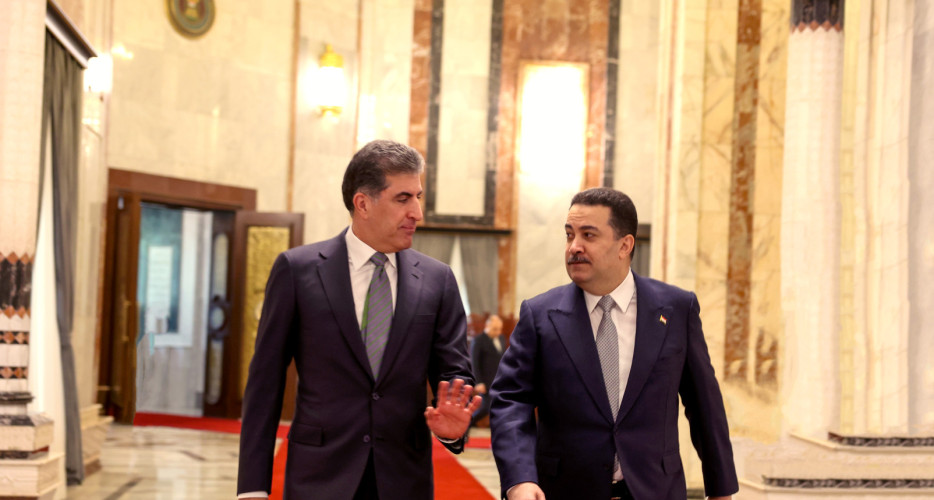
Peregraf — Iraqi Prime Minister Mohammed Shia' al-Sudani held a phone call on Friday with Nechirvan Barzani, President of the Kurdistan Region, to discuss the latest security developments amid intensifying regional tensions and their potential consequences for Iraq.
According to the Iraqi Prime Minister's Media Office, the two leaders addressed the ongoing military operations in the region and their impact on Iraq, emphasising the need to preserve stability and national sovereignty.
During the call, both sides stated their rejection of attacks targeting Iraqi cities, including those in the Kurdistan Region of Iraq, and stressed that Iraqi territory must not be used as a launching point for attacks against neighbouring countries.
They also affirmed support for measures aimed at strengthening security and stability, highlighting the importance of unified positions and coordinated statements among national political forces to confront current challenges.
"The country's stability and sovereignty must be preserved through coordinated national efforts," the statement said, noting that the two sides discussed ways to reinforce Iraq's security posture during a period of heightened regional uncertainty.
Escalating Regional Tensions
The phone call comes as the war involving the United States and Israel against Iran enters its seventh day, raising concerns that the Kurdistan Region could be drawn into the expanding regional confrontation.
Earlier on Friday, Iran's Defence Council issued a stark warning to the Kurdistan Region, saying that its infrastructure could become a target if militant groups are allowed to enter Iranian territory from areas under Kurdish control.
Ali Akbar Ahmadian, a member of Iran's Defence Council appointed by the Supreme Leader, said Iran's armed forces have established what he described as a new deterrence equation across the region.
"Commanders of all ranks of the Armed Forces, in implementing diverse, asymmetric and intelligent defence strategies, have crushed the positions of hostile American-Zionist enemies in complex operations and now hold mastery over the entire region and the Persian Gulf," Ahmadian said.
He warned that while recent strikes had targeted American and Israeli bases and what he described as separatist groups in the Kurdistan Region, Iran could broaden its response if attacks against its territory continue.
"It is reminded to friends and brothers in the Kurdistan Region of Iraq that, until now, only American and Israeli bases and separatist groups in the Region have been targeted," Ahmadian said.
"However, if these groups continue to operate, plot, or enter the borders of the Islamic Republic through the Region, all facilities of the Kurdistan Region of Iraq — as the rear guard of these groups — will be extensively targeted."
He also warned that such a scenario would end Tehran's political support for the Kurdistan Region.
"The friendly relations and unwavering support of the Islamic Republic for the Kurdistan Region during difficult days, such as the ISIS attack, will cease," he said.
Iranian Leaders Warn Kurdish Opposition
The warning comes amid growing pressure from Tehran over Kurdish opposition groups operating from bases in the Kurdistan Region.
Late Thursday, Iranian President Masoud Pezeshkian said authorities would deal "decisively" with separatist movements, remarks widely interpreted as directed at Iranian Kurdish opposition parties based in the Kurdistan Region of Iraq.
In a message posted on X, Pezeshkian thanked residents of Iran's Kurdish-populated areas for their support during what he described as "historic days," while reiterating the government's security stance.
"I express my gratitude to the brave and honourable people of Kurdistan who have stood by Iran during these historic days," he wrote.
"I share the grief of the families of the martyrs and those wounded in these incidents. The governor and the security-providing armed forces are duty-bound to deal decisively with any separatist movements."
Wave of Drone and Missile Attacks
In recent days, the Kurdistan Region has experienced a wave of drone and missile attacks targeting multiple locations.
Security sources say more than 100 drones and missiles have struck areas across the region in attacks attributed to Iran and armed factions linked to the so-called "Islamic Resistance," a network of Iran-aligned groups operating in Iraq.
The repeated strikes have heightened concerns among Kurdish officials that the Kurdistan Region could become entangled in a broader regional confrontation.
Earlier on Thursday, Iraqi Deputy Prime Minister and Foreign Minister Fuad Hussein reiterated that the Kurdistan Region does not allow any party to use its territory to launch attacks against neighbouring countries, including Iran.
Kurdish officials have repeatedly stated that the region is not a party to the conflict and intends to remain neutral despite escalating tensions.
Security authorities in the Kurdistan Region have also stepped up coordination with Baghdad and increased monitoring along border areas with Iran, where several Iranian Kurdish opposition groups maintain bases.
Caught between competing regional pressures, Kurdish leaders are relying on diplomatic engagement, security coordination with the Iraqi federal government, and repeated assurances that the Kurdistan Region will not serve as a platform for attacks against neighbouring states.
With both Washington and Tehran closely monitoring developments, the Kurdistan Region faces mounting pressure to maintain stability while avoiding deeper involvement in the expanding regional conflict.