Iraq's Top Leadership Rejects Attacks on Kurdistan Region, Warns Against Dragging Country Into Regional War
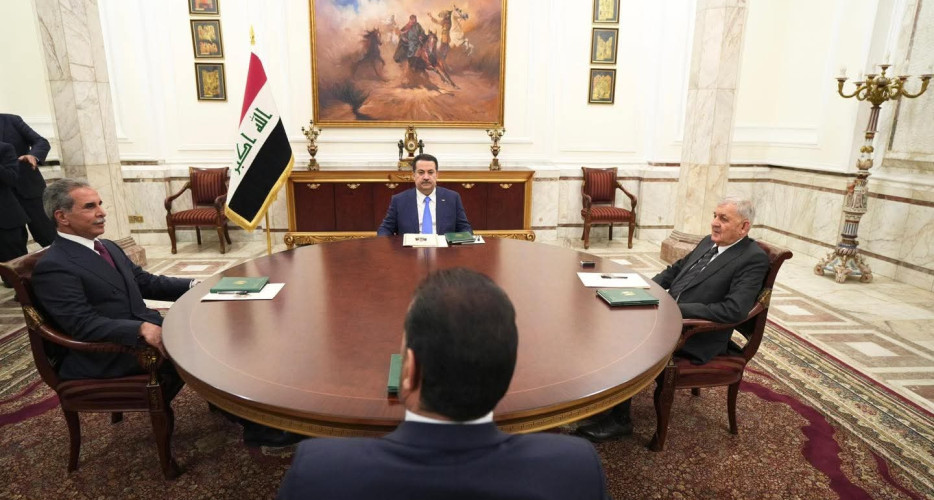
Peregraf — Iraq's top political and judicial leaders met at Baghdad Palace on Thursday to discuss escalating regional tensions and their potential consequences for the country, stressing the need to safeguard national sovereignty and prevent Iraq from becoming entangled in external conflicts.
The meeting brought together Abdul Latif Rashid, President of Iraq; Mohammed Shia' al-Sudani, Prime Minister and Commander-in-Chief of the Armed Forces; Mohammed al-Halbousi, Speaker of the Council of Representatives; and Faiq Zeidan, Chairman of the Supreme Judicial Council.
According to an official statement, the leaders conducted an extensive review of the latest security and political developments at both the regional and international levels, as tensions continue to rise across the Middle East. The discussions focused on the potential impact of these developments on Iraq's internal stability and security.
The meeting underscored the government's stated efforts to ensure the country is not drawn into regional conflicts. The leaders reviewed mechanisms adopted by the Iraqi government to prevent Iraq from becoming a battlefield for external disputes and reaffirmed their support for measures aimed at preserving security and stability.
Participants emphasised the importance of protecting Iraq's sovereignty and maintaining security across the country, including safeguarding diplomatic missions operating within Iraqi territory.
The leaders reiterated the country's stated policy of balance in regional affairs, stressing the need for Iraq to maintain a constructive role in promoting stability across the region.
"The presidencies stressed the necessity of maintaining Iraq's pivotal and balanced role in strengthening regional security and stability," the statement said.
The leaders also reaffirmed Iraq's stated position against the use of its territory as a base for attacks on neighbouring countries, warning that such actions would threaten regional security and undermine Iraq's sovereignty.
At the same time, they rejected attacks targeting Iraqi territory, including cities, provinces, and the Kurdistan Region, describing such attacks as a violation of Iraq's national sovereignty.
The stance comes amid heightened tensions and recent security incidents across Iraq and the Kurdistan Region, raising concerns that regional rivalries could spill over into Iraqi territory.
By emphasising both positions — opposing attacks launched from Iraqi soil and rejecting attacks on Iraq — the meeting sought to reinforce Baghdad's stated position that the country should not serve as a battleground for regional powers.
Officials also reiterated the importance of supporting government institutions and security forces in maintaining internal stability during a period of heightened regional uncertainty.
The high-level meeting conveyed a unified message from Iraq's executive, legislative, and judicial leadership that the country intends to avoid being drawn into escalating regional confrontations while defending its sovereignty and territorial integrity.