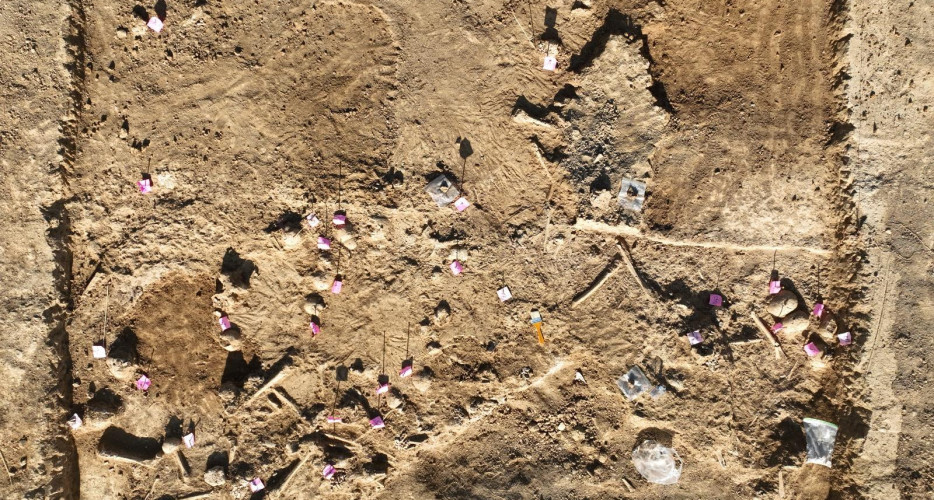
Peregraf — Archaeologists in Erbil have uncovered a mass burial site dating back approximately 2,000 years. The discovery is expected to provide significant insights into one of the region’s least understood ancient states, the Kingdom of Adiabene.
The site, located in the Baghlumunara district, was identified by a local excavation team working with the Directorate of Antiquities. Officials report that the trench contains the remains of at least 100 individuals, buried together under circumstances that have yet to be determined.
Alongside the skeletal remains, researchers recovered several artifacts, including ancient coins, two bronze anklets, two beads, and an iron bracelet. Notably, only four pieces of pottery were found—an unusually low number for a burial of this size—leading researchers to question the specific conditions surrounding the deaths and subsequent burials.
Archaeologists involved in the project described the find as a significant historical discovery that may clarify a largely undocumented period in the history of Adiabene. This ancient kingdom once ruled parts of the Kurdistan Region and northern Mesopotamia.
Investigating the Cause of Death
The discovery has led to several competing hypotheses. One theory suggests the trench may be evidence of conflict during the reign of Queen Helena of Adiabene, who is historically noted for her conversion to Judaism. Other possibilities include a massacre during the expansion of the Sasanian Empire or the aftermath of a localized epidemic, such as the plague.
Each theory reflects a different period of Adiabene’s complex history, characterized by shifting political alliances and religious transitions.
To provide clarity, officials have sent DNA samples from the remains to laboratories affiliated with the Ministry of Interior. Researchers hope the results will offer data regarding the geographic origins of the deceased, their general health, and the potential cause of death.
A Kingdom at the Crossroads
Adiabene, referred to in ancient Syriac sources as *Hadyab*, occupied a strategic position between the major empires of antiquity. Centered on Arbela—modern-day Erbil—the kingdom emerged several centuries before the Common Era and expanded under rulers such as Monobazus I, who extended his influence toward Nineveh.
The kingdom reached its peak under Izates II, whose alliance with the Parthian Empire secured political stability and territorial growth. Its borders eventually reached from the Great and Little Zab rivers to the foothills of the Zagros Mountains, placing it at a vital intersection of trade and culture.
Despite its importance, much of Adiabene's history remains fragmentary, preserved only in scattered classical and religious texts. Archaeological finds like the Baghlumunara site are rare and often provide crucial data to fill these historical gaps.
Unanswered Questions
For now, the site offers more questions than answers. The high concentration of remains suggests a sudden, large-scale event, though the lack of traditional funerary goods makes interpretation difficult. It remains uncertain whether the individuals were victims of conflict, disease, or social upheaval.
Archaeologists emphasize that further excavation and laboratory analysis are required before definitive conclusions can be reached. Nonetheless, the find highlights the historical depth of Erbil—one of the world’s oldest continuously inhabited cities—as a site of significant archaeological importance.