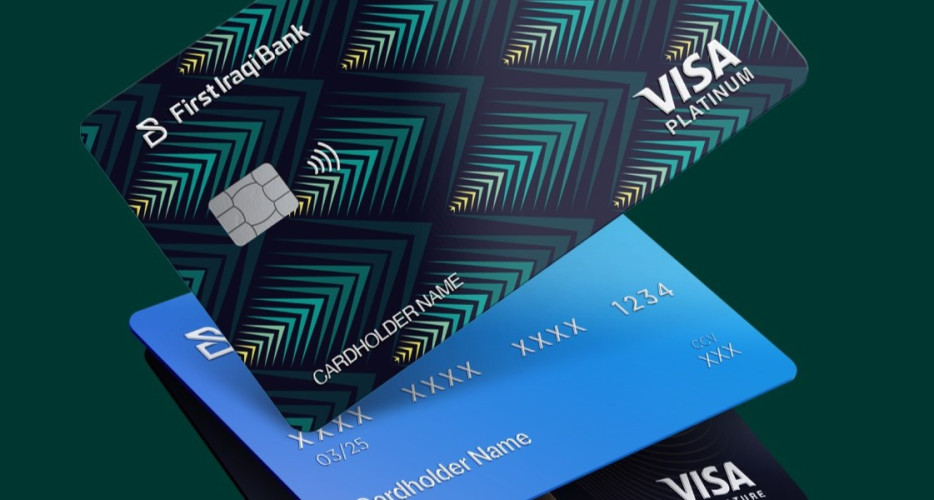
Peregraf — The sudden suspension of card services by First Iraqi Bank (FIB) is raising serious concerns about the bank’s operational stability, with analysts warning the disruption could signal a deeper institutional crisis that risks eroding already fragile public trust in Iraq’s emerging digital banking sector.
Over recent weeks, FIB customers have reported that their cards have become entirely non-functional. Initially, transactions abroad were blocked, followed by a halt in online purchases. Now, even basic domestic digital services—such as buying mobile credit or topping up internet balances—have ceased to work.
International and Domestic Card Payments Suspended
FIB customers have faced a stepwise shutdown of card services. International payments using FIB Visa cards—meaning purchases outside Iraq—have been blocked since June 1, 2025. In recent weeks, Visa card payments for domestic purchases within Iraq have also stopped working.
Some digital transactions remain functional: transfers between FIB accounts and payments via apps using direct FIB account transfers are still possible. In other words, if a customer buys a service or voucher through an app and pays directly from their FIB account instead of using the Visa card, the transaction will succeed. However, any payment specifically using the Visa card is currently suspended.
This distinction highlights that while the bank’s digital infrastructure is partially operational, the core card network—which is vital for international commerce and everyday payments—has effectively been disabled.
FIB’s customer service confirmed that card-based purchases are currently disabled, stating that technical teams are working to resolve the issue. However, sources familiar with the matter suggest the problem extends beyond routine technical failure.
An informed source told Peregraf that the bank is facing "serious issues," including internal operational challenges as well as complications involving external partners. "Even if these problems are addressed, restoring full card functionality will take time," the source said, pointing to structural—not temporary—obstacles.
Silence from Key Institutions
In an effort to clarify the situation, Peregraf submitted formal inquiries to First Iraqi Bank, the Central Bank of Iraq, and Visa Inc., whose network is used for FIB-issued cards.
The questions focused on the cause of the disruption, potential regulatory or compliance issues, and whether any restrictions have been imposed on the bank’s access to international payment systems.
None of the three institutions responded within 24 hours, deepening uncertainty and fueling speculation about the scale of the crisis.
While no official declaration has been made, banking observers warn that prolonged suspension of core services—particularly card operations—can be a critical indicator of systemic distress within a financial institution.
Digital banking experts note that if a bank loses access to international payment networks like Visa, or faces compliance-related restrictions, it can effectively become isolated from the global financial system. This, in turn, disrupts customer transactions, liquidity flows, and ultimately the bank’s ability to operate normally.
"If these issues are tied to compliance, or correspondent banking relationships, the consequences could be severe," one financial analyst told Peregraf. "In worst-case scenarios, such disruptions can escalate into a loss of confidence that triggers a broader institutional collapse."
A Fragile Banking Environment
The crisis comes at a sensitive time for Iraq’s financial sector. Authorities, led by the Central Bank, have been actively promoting financial inclusion and digital banking as part of broader economic reforms.
However, despite this push, no digital bank licenses have been officially granted yet in Iraq. All currently operating banks remain licensed as traditional institutions, even if some offer digital services. This includes First Iraqi Bank, which—despite its app-based model—is not licensed as a "digital bank" under Iraqi law.
FIB has been one of the most prominent private banks driving digital-style services, particularly by enabling account opening and financial access through mobile applications.
Yet the current disruption highlights a fundamental challenge: public trust.
The situation at FIB may have implications beyond a single institution. If the disruption is linked to compliance or external financial relationships, it could signal broader vulnerabilities within Iraq’s private banking sector.
Banks in Iraq rely heavily on international partnerships for card services, cross-border transactions, and access to global financial systems. Any disruption in these relationships can quickly cascade into operational paralysis.
At the same time, the Central Bank faces a delicate balancing act: enforcing stricter financial regulations while ensuring that banks remain functional and public confidence is maintained.
Waiting for Clarity
For now, customers remain unable to use their cards, and uncertainty continues to grow.
Without official explanations from FIB, the Central Bank, or Visa, key questions remain unanswered: Is this a temporary technical issue, a regulatory intervention, or a sign of deeper financial instability?
Until clarity emerges, the incident stands as a critical test—not only for FIB’s survival, but for the credibility of Iraq’s broader push toward a modern, digital banking system.