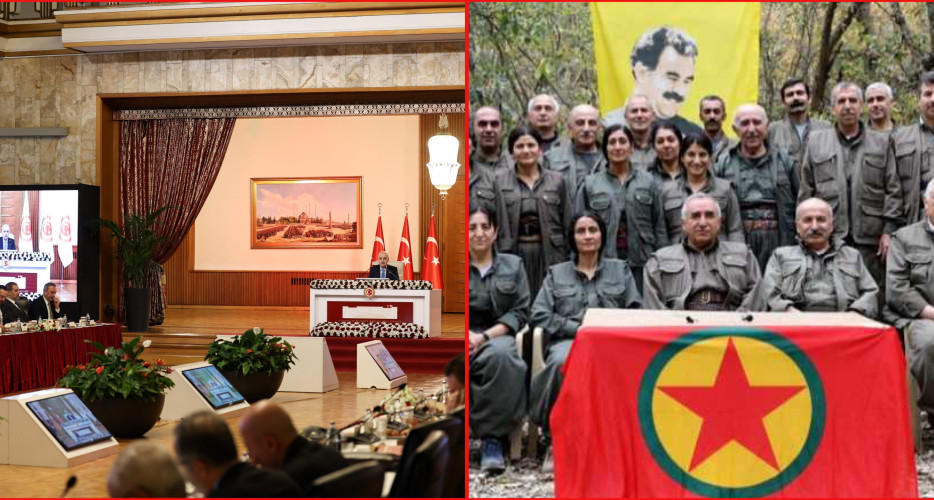
Peregraf —The Executive Council Co-Presidency of the Kurdistan Communities Union (KCK) has issued a sharp critique of a report recently approved by a Turkish parliamentary committee regarding the Kurdish issue, characterizing the document as fundamentally flawed and politically hollow.
In an official statement, the KCK asserted that the report contains "fundamental errors and deficiencies that strip it of political significance," specifically pointing to the committee's avoidance of the term "Kurdish issue."
"A primary concern is the deliberate avoidance of the explicit term ‘Kurdish issue.’ Despite the committee being formed to address the consequences of this conflict, a problem that remains unnamed cannot be solved," the statement read. The KCK argued that the document reflects a continued reliance on a security-centric approach rather than recognizing the situation as a historical political struggle involving the rights of the Kurdish people.
The KCK further criticized the report for framing the conflict primarily through the lens of "terrorism," arguing that such language prevents engagement with the root causes of the decades-long issue. The organization also reiterated that Abdullah Öcalan must play an active political role in any viable solution.
Details of the Parliamentary Report
On February 18, 2026, the Turkish Parliament’s special commission—tasked with addressing the Kurdish question—finalized and approved its report. Compiled over 88 working hours and spanning 4,199 pages, the document is intended to serve as a foundation for future policy discussions.
Numan Kurtulmuş, Speaker of the Turkish Parliament, described the matter primarily as a "terrorism issue" and clarified, "This report does not constitute an amnesty." He emphasized that while a constitutional amendment was outside the commission’s specific mandate, such a step remains essential for a lasting resolution.
The commission, formally known as the National Solidarity, Brotherhood, and Democracy Commission, structured its report into seven sections:
1. Commission Research: Documentation of the work process.
2. Objectives: Outline of primary goals.
3. Historical Context: Examination of Turk-Kurd relations.
4. Consensus Areas: Summary of findings from experts, officials, and civil society.
5. Disarmament: Proposed measures for the dissolution of the PKK and related security steps.
6. Legal Framework: Suggestions for legislative changes.
7. Democratization: Promotion of political inclusion and minority rights.
The report includes five appendices detailing membership, working principles, submissions by political parties, summaries of 20 separate meetings, and lists of contributing institutions.
Calls for Constitutional Reform
Despite the report’s focus on legislation, many analysts warn that a resolution will ultimately require constitutional reform. Kurtulmuş acknowledged this reality, stating, "Although drafting a new constitution is not within the scope of this commission’s duties, it stands before us as a shared responsibility that cannot be delayed."
Kurdish Lawmakers Express Reservations
MPs from the Peoples' Equality and Democracy Party (DEM Party) criticized the report's terminology, specifically the use of the phrase "Terror-Free Turkey Process" and the repeated labeling of the PKK as a "terrorist organization." They argued that these terms fail to acknowledge Turkey’s multiethnic reality.
The DEM Party urged for:
* Recognition of the process as the "Peace and Democratic Society Process," in line with Abdullah Öcalan’s February 27 statement.
* The adoption of consensus-building language, such as "Democracy, Brotherhood, and National Unity."
* Official acknowledgment of Abdullah Öcalan as a central actor in the peace process.
* Guarantees for mother-tongue education and the formal recognition of multilingualism, including Kurdish.
While the approval of the report marks a procedural milestone, ongoing debates over terminology, constitutional reform, and political recognition highlight the significant challenges remaining in the pursuit of a durable resolution.