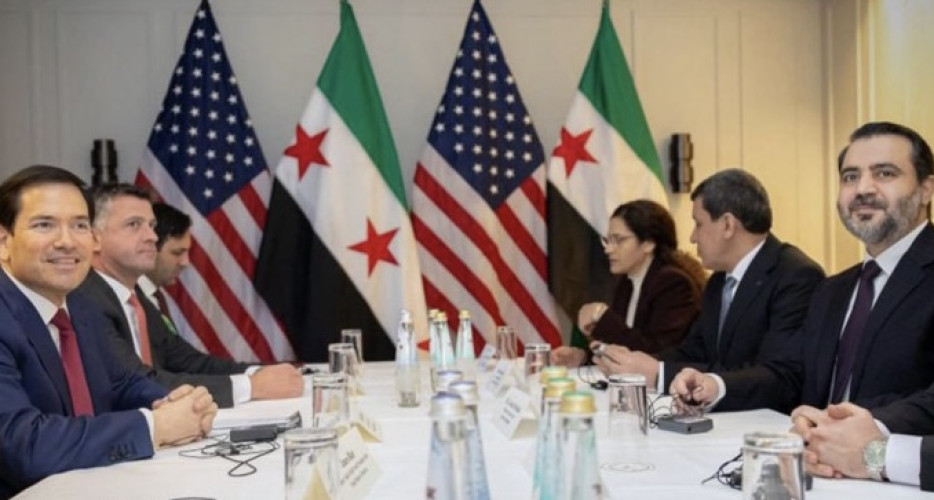
Peregraf- U.S. Secretary of State Marco Rubio said the United States held what he described as a historic joint meeting bringing together Kurdish representatives and Syrian officials, marking a rare moment of direct engagement aimed at stabilizing northeast Syria and preventing a resurgence of ISIS.
Speaking at a press conference, Rubio explained that Washington was unable to attend a scheduled Ukraine-related meeting because of the urgency of talks involving Syria and the Kurds. “We could not be in two places at the same time,” he said. “So we met with the Syrian foreign minister and General Mazloum on behalf of the Kurds—together in the same meeting. It was a historic meeting.”
According to Rubio, the meeting brought together key figures from both sides. The Syrian delegation included SDF Commander-in-Chief Mazloum Abdi, Syrian Foreign Minister Asaad al-Shaibani, and Ilham Ahmed. The talks took place on the sidelines of the Munich Security Conference in Germany on February 13.
Rubio said the talks followed a dangerous escalation in northeast Syria, prompting then-President Donald Trump to personally intervene—on two occasions—to halt the fighting. Trump, Rubio said, urged Syrian leaders to stop hostilities to allow for the secure transfer of ISIS detainees and to create time for political arrangements involving the Kurds.
“At stake were thousands of ISIS prisoners who could have broken out and created havoc and chaos,” Rubio said. He noted that the ceasefire made it possible to move the detainees safely into Iraq, preventing what he described as a potentially catastrophic mass jailbreak.
The pause in fighting, Rubio added, also created space for an agreement between Kurdish forces and Syrian authorities in Syria, based in Damascus, on the integration of Kurdish forces into the national Syrian military structure. While acknowledging that implementation will be difficult, he said all parties have committed to the process.
Rubio stressed that broader reconciliation is still required, with additional agreements needed among Syria’s diverse communities, including the Druze, Bedouins, and Alawites. However, he said the current path remains preferable to fragmentation.
“We believe this outcome, as difficult as it has been, is far better than a Syria broken into multiple pieces, with endless fighting and mass migration,” Rubio said. “That’s why we’re very positive about this.”
The remarks underscore the central role of the Kurds in U.S. diplomacy on Syria and highlight Washington’s effort to translate security coordination into a long-term political framework—anchored by what Rubio called a historic, first-of-its-kind joint meeting.