Nechirvan Barzani Meets U.S. Senators Behind 'Save the Kurds Act' at Munich Security Conference
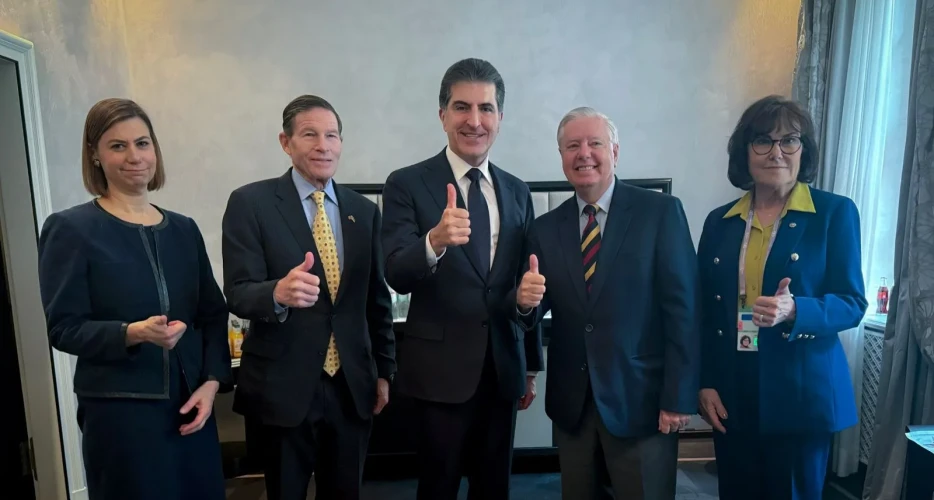
Peregraf — Kurdistan Region President Nechirvan Barzani met on Saturday with U.S. Senators Lindsey Graham and Richard Blumenthal, the two lawmakers who recently introduced the Save the Kurds Act to the U.S. Congress, on the sidelines of the Munich Security Conference in Germany.
Following the meeting, Barzani welcomed the engagement with U.S. lawmakers, emphasizing Washington’s continued role in promoting stability in the Middle East.
"I am pleased to meet my friend, Senator Lindsey Graham and his congressional delegation," Barzani said. "I’m grateful for the role of the U.S. Congress in supporting peace and stability in our region."
The meeting comes as the U.S. Congress intensifies its focus on the situation in northeastern Syria and the security of Kurdish forces there. Late last month, Graham, a Republican from South Carolina, and Blumenthal, a Democrat from Connecticut, jointly introduced the Save the Kurds Act in response to what they described as repeated attacks by Syrian government forces on the Kurdish-led Syrian Democratic Forces (SDF).
The proposed legislation aims to impose sanctions on Syrian government officials, financial institutions, and foreign individuals involved in military or financial dealings with Damascus. It also seeks to formally recognize the SDF for its role alongside U.S. forces in the fight against the Islamic State (ISIS), while redesignating Hay’at Tahrir al-Sham (HTS) as a Foreign Terrorist Organization.
During the U.S.-led campaign to dismantle ISIS’ self-declared caliphate, the SDF played a central role in ground operations, suffering thousands of casualties while securing vast areas of northeastern Syria. Although ISIS has lost territorial control, U.S. officials and lawmakers continue to warn that the group remains a serious threat.
According to Graham and Blumenthal, continued attacks on the SDF not only undermine regional stability but also endanger U.S. personnel on the ground and increase the risk of an ISIS resurgence. They argue that protecting Kurdish partners is essential to safeguarding hard-won gains made during years of counterterrorism operations.
The senators have also warned that the ongoing violence could damage Washington’s relationship with Syria’s new leadership under President Ahmed al-Sharaa. Since the ouster of the Assad government, al-Sharaa has portrayed military operations against the SDF as part of a broader effort to reunify the country after more than a decade of civil war. However, U.S. lawmakers say there is evidence suggesting that some of the attacks on the SDF are being coordinated with and supported by Turkey.
"I believe that there is strong bipartisan support for the idea of protecting the Kurds in Syria and beyond because they have been such a reliable ally to the United States," Graham said in a statement. "The SDF — with a large Kurdish element — took the brunt of the fight to defeat ISIS in President Trump’s first term. Attacking the Kurds greatly diminishes the United States’ standing and will hinder Syria’s ability to grow as a country."
Graham added that any actors who believe there will be no consequences for targeting Kurdish forces in Syria are "sadly mistaken."
Blumenthal echoed those concerns, stressing the need for concrete action. "I believe we need to protect the Kurds in Syria and take action to ensure they are protected from any retribution or revenge by the Syrian government," he said.
The Save the Kurds Act includes several key provisions, among them imposing sanctions on Syrian officials and entities that support military actions against the SDF, formally recognizing the SDF’s partnership with the United States against ISIS, and requiring congressional approval before Syria can be removed from the U.S. list of state sponsors of terrorism. The bill would also grant the U.S. president authority to suspend sanctions if Syria certifies that it has halted all attacks on the SDF and its partners, while introducing a "snapback" mechanism to immediately reimpose sanctions if attacks resume.
Supporters of the legislation argue that the bill is critical to U.S. national security, warning that abandoning allies on the ground would create a vacuum that extremist groups could exploit. They stress that maintaining stability in post-war Syria depends on protecting partners who played a decisive role in defeating ISIS and continue to shoulder the burden of securing the region.