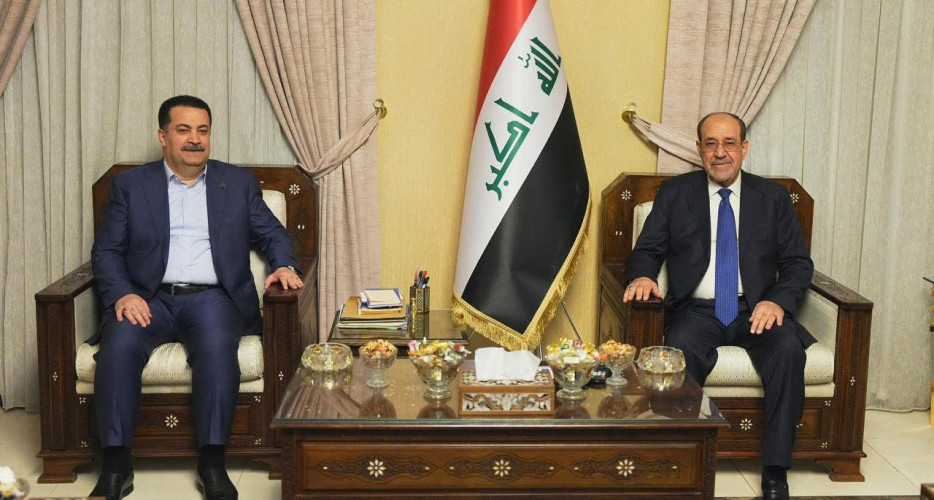
Peregraf — Prime Minister Mohammed Shia al-Sudani met on Wednesday with former Prime Minister Nouri Kamil al-Maliki, head of the State of Law Coalition, to discuss Iraq’s mounting political stalemate and ongoing efforts to fulfill outstanding constitutional obligations, according to a statement from the Prime Minister’s Media Office.
The meeting reviewed the overall political situation and the status of dialogues among national forces aimed at completing unresolved constitutional commitments, most notably the election of a president. The two leaders also discussed the positions of major political blocs and attempts to reach a broader political agreement that would allow the Council of Representatives to finalize the presidential vote and move forward with remaining entitlements.
According to the statement, the talks also touched on the government’s efforts to continue delivering services, advance development projects, and strengthen the national economy despite prolonged political uncertainty.
The meeting comes as negotiations continue between the Kurdistan Democratic Party (KDP) and the Patriotic Union of Kurdistan (PUK) to resolve longstanding differences and coordinate positions at both the federal level and in the Kurdistan Region, particularly over a joint Kurdish candidate for the presidency — a post traditionally allocated to the Kurds under Iraq’s power-sharing system.
On Wednesday, the PUK rejected media reports claiming that an agreement had been reached between PUK President Bafel Talabani and KDP leader Masoud Barzani during their meeting in Pirmam, near Erbil.
In a statement, PUK spokesman Karwan Gaznayi said the meeting was “positive and held in a very calm atmosphere,” focusing on issues related to the Kurdistan Region, Iraq, and the wider region. However, he categorically denied claims circulating on some media outlets and social media that an agreement had been reached on government positions.
“We officially and categorically deny these rumors,” Gaznayi said, stressing that any agreement between the two sides would be announced through official channels.
Sources familiar with the talks said discussions included ongoing negotiations over a joint Kurdish candidate for the Iraqi presidency and efforts to form a new Kurdistan Regional Government (KRG) cabinet, but confirmed that no final decisions were announced.
While the unresolved Kurdish position has been cited publicly as a key reason for the delay in forming a new federal government, multiple political sources say the deeper deadlock lies within Iraq’s Shiite political camp.
As post-election negotiations stall, al-Maliki — the official nominee of the Shiite Coordination Framework to form a new cabinet — has proposed a plan that would significantly alter Iraq’s political timeline: extending the tenure of al-Sudani’s caretaker government for two years in order to pave the way for early parliamentary elections.
According to three senior Kurdish and Arab political sources in Baghdad, al-Maliki is pushing for the extension as a way to break the impasse following U.S. President Donald Trump’s public opposition to his return to the premiership. The sources said al-Maliki believes early elections could reset the political balance in his favor while avoiding an immediate confrontation over naming a new prime minister.
“He wants early parliamentary elections, and for that, he is asking that the current al-Sudani cabinet continue for another two years,” one high-ranking source told Peregraf. The same source said the proposal faces resistance from within the Shiite coalition itself, where many factions fear the risks of returning to the polls.
Those fears are both political and practical. Several parties worry they would fail to repeat their gains from the November 2025 elections. Among them, according to a senior informed source, is Asa’ib Ahl al-Haq, led by Qais al-Khazali. Others fear that early elections could facilitate a political comeback by cleric Muqtada al-Sadr, whose withdrawal from parliament reshaped Iraq’s political landscape but whose support base remains highly mobilized.
There are also constitutional and administrative hurdles. Eight ministers from al-Sudani’s cabinet have since been elected to parliament, taken their oaths, and vacated their ministerial posts. Extending the life of a cabinet that has already been partially depleted would raise complex constitutional questions.
Publicly, Shiite leaders have often framed the crisis as a consequence of the failure to elect a president — an impasse blamed on Kurdish divisions. However, reporting by Peregraf suggests this explanation masks a more fundamental problem.
Under Iraq’s constitution, once a president is elected, they must immediately task the nominee of the largest parliamentary bloc — the Shiite Coordination Framework — with forming a government. Several sources said the real delay stems from the Shiite camp’s inability to agree on whether al-Maliki should be that nominee.
Trump’s rejection of al-Maliki has forced Shiite leaders into what one political insider described as “two bitter options.” Replacing al-Maliki would be seen by his supporters as a humiliating retreat under foreign pressure, while insisting on his nomination risks a direct rupture with Washington — a scenario many fear could push Iraq toward economic and diplomatic isolation.
The warning from Washington has been unusually blunt. On January 27, Trump said he was hearing that Iraq “might make a very bad choice by reinstalling Nouri al-Maliki as Prime Minister,” arguing that during al-Maliki’s previous tenure the country “descended into poverty and total chaos.” He warned that a return by al-Maliki would lead the United States to withdraw its support, leaving Iraq with “ZERO chance of success, prosperity, or freedom.”
The remarks came days after the Coordination Framework formally announced al-Maliki as its candidate during a meeting at the office of Hadi al-Amiri on January 24, citing a majority vote and his political experience. Al-Maliki responded by stressing respect for Iraq’s national will and rejecting what his party described as foreign interference.
Al-Maliki’s record remains deeply divisive. He served as prime minister from 2006 to 2014, a period marked by sectarian tensions, mass protests, and security failures that culminated in the rise of ISIS and the collapse of large parts of the Iraqi security forces.
The stakes are heightened by Iraq’s economic vulnerability. Nearly all of the country’s oil revenues are held in U.S. dollars under American oversight, giving Washington significant leverage. Finance Minister Taif Sami has publicly reassured state employees that salaries will be paid on time, but privately warned lawmakers that deteriorating relations with the Trump administration could have severe consequences.
According to MP Ahmed Haji Rashid, Sami told a meeting on February 8 that Iraq’s economy remains highly exposed to shifts in U.S. policy. “If our relationship with Trump breaks down, our economic situation will become very dire,” she said.
As Baghdad weighs al-Maliki’s proposal and Kurdish talks remain inconclusive, Iraq faces a critical moment. Whether its political leaders can reach a compromise before internal divisions and external pressure collide may determine not only the shape of the next government, but the country’s economic and diplomatic future.