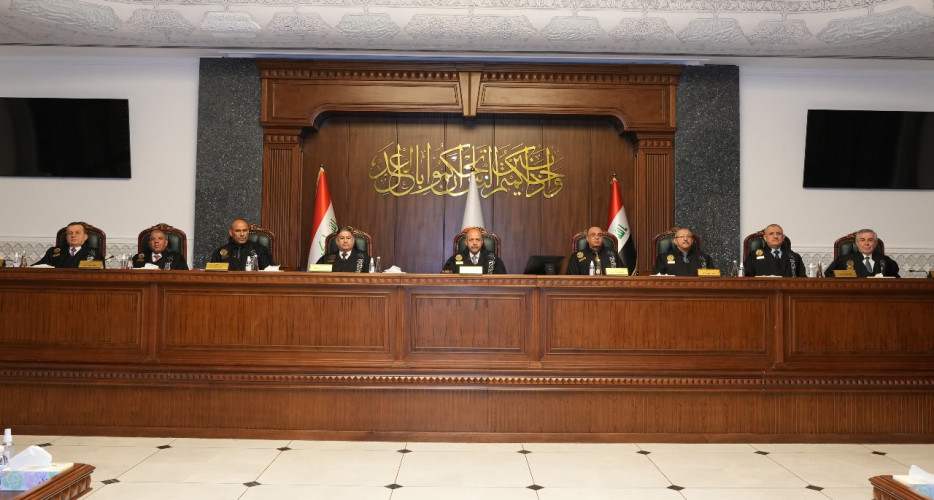
Peregraf — Iraq’s Federal Supreme Court has dismissed a lawsuit seeking to overturn the government’s new customs tariff, ruling that the plaintiff lacked the legal standing required to pursue the case, despite mounting political opposition and widespread protests by merchants in the capital.
The lawsuit was filed by Mohammed Jassim al-Khafaji, a Shiite member of parliament, against Prime Minister Mohammed Shia’ al-Sudani. Al-Khafaji challenged Cabinet Resolution No. 957 of 2025, which introduced higher customs duties, arguing that the measure was unconstitutional and should be annulled. He also requested an urgent court order to suspend implementation of the decision. The court rejected the case, citing the absence of a direct legal interest.
The ruling comes amid growing backlash from traders and political factions who say the tariff hike has deepened economic pressure on consumers and businesses. The Sudani government, however, has defended the move as a necessary step to regulate foreign trade, standardize procedures at border crossings, and address long-standing distortions in Iraq’s customs system. Officials say the reforms align with recommendations from the United States and international organizations aimed at stabilizing Iraq’s economy and boosting state revenues.
Tensions escalated on February 8, when large swathes of Baghdad’s commercial districts shut down as merchants launched a strike against the higher duties. Major markets in Al-Shorja, Al-Rashid Street, Al-Rubaie, and Al-Sina’a closed, along with key shopping areas in Karrada and Al-Nasr Square. Dozens of shop owners gathered in Al-Shorja market to protest what they described as punitive taxes imposed during an already sluggish economic period.
Organizers said the shutdown began the previous evening and was intended to pressure the government into reversing the decision. Traders argue that higher customs duties have driven up prices, reduced consumer purchasing power, and led to a sharp decline in sales, threatening the survival of small and medium-sized businesses. Protesters warned the strike would continue unless authorities reconsidered the policy and adopted a mechanism more responsive to current market conditions.
Political pressure has also intensified. Days before the strike, Speaker of Parliament Haebat al-Halbousi formally urged Prime Minister al-Sudani to suspend the tariff increase. In a letter dated February 1, 2026, al-Halbousi called for a 90-day halt to the implementation of Resolution No. 957 of 2025 and a comprehensive review of the customs tariff structure.
The request followed a parliamentary session held on January 10–11, attended by senior officials from the Border Ports Authority, the Customs Authority, and the Tax Authority. According to the speaker’s letter, lawmakers proposed adopting a unified customs rate of 5 percent on affected goods and reducing duties on hybrid vehicles from 15 percent to 5 percent, citing environmental protection and fuel efficiency. Al-Halbousi said the proposed measures were aimed at easing pressure on citizens and stabilizing the market.
Despite the court’s dismissal of the legal challenge, the controversy surrounding the customs tariff shows little sign of abating, as economic grievances, political divisions, and street-level protests continue to converge.