Iran at Its 'Weakest', Iraqi Militias on Alert: Inside the Growing U.S.–Iran Confrontation
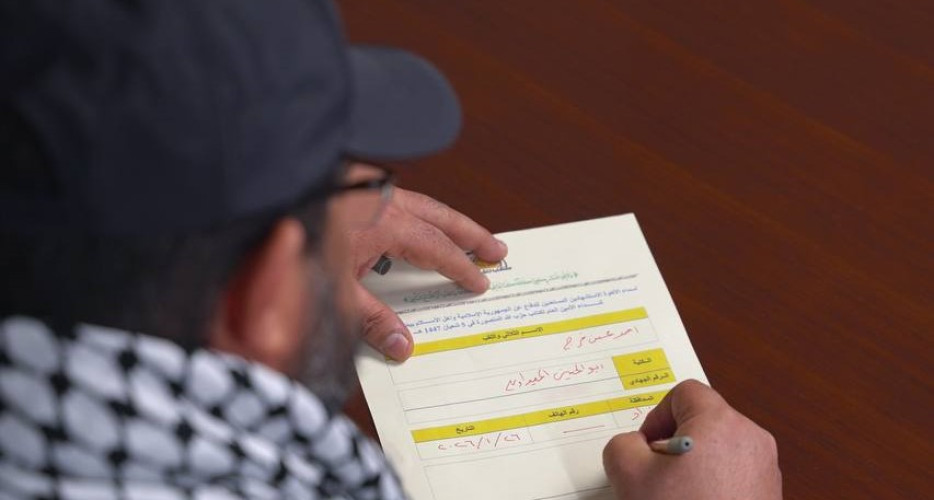
Peregraf - As regional tensions intensify and speculation grows over a potential U.S. military strike on Iran, Iraqi Shiite armed groups aligned with Tehran are escalating their rhetoric and preparations. The latest sign of this escalation came with the distribution of so-called "sacrifice forms" by Kata'ib Hezbollah (KH), one of Iraq’s most powerful Iran-backed militias, calling on members and supporters to pledge themselves for what the group describes as the defense of the Islamic Republic of Iran.
According to multiple reports, hundreds of individuals have reportedly registered their names on the forms, signaling their willingness to sacrifice themselves should Iran come under direct military attack. The move coincides with the arrival of U.S. warships in the Middle East and heightened American military deployments across the region.
At the same time, the New York Times reported that U.S. officials have delivered a blunt warning to the Iraqi government. The message to Baghdad was clear: if Shiite militias in Iraq launch attacks on U.S. bases or personnel in the event of increased tensions with Iran, the United States will respond militarily.
"Martyrdom for the Defense of the Islamic Republic"
Since Sunday, January 25, 2026, Kata'ib Hezbollah has circulated special forms titled "Martyrdom for the Defense of the Islamic Republic." The documents require those signing up to provide their full name, alias, place of residence, mobile phone number, a written "statement of stance," and a signature.
Abu Hussein al-Hamidawi, the Secretary-General of Kata'ib Hezbollah, was reportedly the first to complete the form. In his written statement, he declared: "Our weapons are legitimate and will remain in the hands of our Mujahideen."
On the same day, al-Hamidawi issued a public call urging KH members and supporters to prepare for what he described as an imminent confrontation. In his statement, he portrayed Iran as the "40-year-old shield protecting Islam," framing any potential conflict as an existential religious and ideological battle.
Founded in 2007 to confront U.S. forces following the American invasion of Iraq, Kata'ib Hezbollah has since emerged as one of the most influential Shiite armed factions in the country. It is a core component of Iraq’s Popular Mobilization Forces (PMF), operating primarily within Brigades 45, 46, and 47, and maintains close political, military, and ideological ties with Tehran.
The group adheres to the doctrine of Wilayat al-Faqih (Guardianship of the Jurist), the ideological foundation of Iran’s Islamic Republic. Since 2009, Kata'ib Hezbollah has been designated a terrorist organization by the United States and has been blamed for dozens of rocket and drone attacks targeting U.S. military installations in Iraq and Syria.
KH is not alone in its stance. Other factions within Iraq’s so-called "Resistance Front" have also announced their readiness to fight if Iran is attacked. Among them is the Badr Organization, led by Hadi al-Amiri, which issued a statement declaring that there would be "no room for neutrality" in what it described as a decisive war in defense of Tehran.
U.S. Intelligence: Iran at Its Weakest Point
The New York Times reported that U.S. President Donald Trump has recently received several intelligence briefings suggesting that the Iranian government is currently in its weakest position in decades. According to informed sources, the reports indicate that Tehran’s authority is at its lowest point since the fall of the Shah during the 1979 Islamic Revolution.
These assessments come in the aftermath of widespread protests that erupted in Iran late last year. While the demonstrations have since subsided, intelligence officials believe they have left lasting damage, particularly as unrest reached regions long considered strongholds of Supreme Leader Ali Khamenei.
Beyond political instability, Iran’s economic situation remains dire. Reports point to severe financial pressures on Iranian families, compounded by sanctions and internal mismanagement. The government has relied heavily on repression to maintain control, further deepening domestic discontent.
Trump’s Position and Internal Debate
The White House has confirmed that President Trump is closely monitoring developments. White House spokesperson Karoline Leavitt stated that the president "continuously receives intelligence updates on the world and is closely monitoring the situation regarding Iran."
According to the New York Times, Trump had previously considered striking Iran in response to the violent suppression of protesters. That option was reportedly shelved after Tehran halted executions linked to the demonstrations. A senior U.S. official also revealed that Israeli Prime Minister Benjamin Netanyahu requested that Trump delay any immediate military action.
However, divisions remain within Trump’s inner circle. Some hardline advisors reportedly see the current moment as an opportunity to push for regime change in Iran. Republican Senator Lindsey Graham was quoted as saying: "The goal is to end the regime."
The U.S. military has significantly expanded its footprint across the region. A U.S. defense official confirmed that the aircraft carrier USS Abraham Lincoln, along with three warships armed with Tomahawk cruise missiles, has entered the U.S. Central Command (CENTCOM) area of responsibility in the western Indian Ocean.
In addition, the Pentagon has deployed 12 F-15E strike aircraft, reinforced Patriot and THAAD missile defense systems, and placed long-range bombers on high alert to counter any potential Iranian missile attacks.
As diplomatic warnings, military deployments, and militia mobilizations converge, the region appears to be entering one of its most volatile periods in years—raising concerns that a single spark could trigger a wider conflict stretching far beyond Iran’s borders.