Öcalan–Parliamentary Commission Meeting Reveals New Pressure on Syrian Kurds and SDF Disarmament
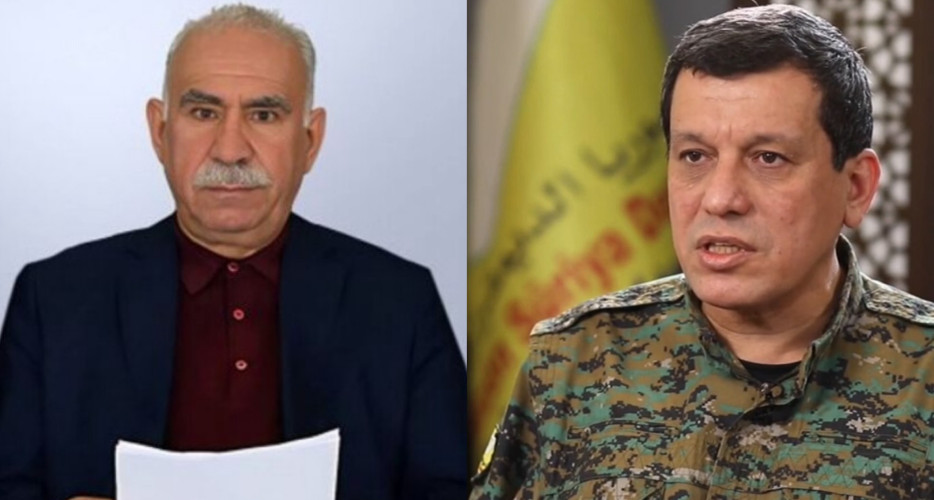
Peregraf — Newly published minutes from a high-level meeting between Abdullah Öcalan and members of Turkey’s National Solidarity, Brotherhood and Democracy Commission offer the clearest indication yet that Ankara is seeking to extend its renewed peace framework beyond Turkey’s borders—placing Syrian Kurds and the Syrian Democratic Forces (SDF) at the center of a potential regional reconfiguration.
The meeting, held on November 24, 2025, at İmralı High-Security Prison and made public today, spans 16 pages and outlines Öcalan’s most explicit position to date on Syria: a call for the disarmament, political integration, and mental demilitarization of Kurdish forces, including the SDF, within a Turkey-centered regional order.
Syria Moves to the Foreground
While much of the discussion revisited Turkey’s long and failed peace efforts with the PKK, Syria emerged as a decisive fault line. Öcalan repeatedly emphasized that any durable solution in Turkey would collapse unless it is mirrored in Syria, warning that the organizational center of gravity has shifted from Kandil to northeastern Syria.
“There is something going on in Syria right now,” Öcalan told the commission, describing the Syrian file as equal in importance to Turkey’s internal Kurdish question. He acknowledged that the SDF—backed by the United States and Israel—commands an armed force of at least 100,000 fighters, but argued that continued militarization would ultimately undermine Kurdish gains.
Disarmament Beyond Turkey
Crucially, Öcalan clarified that his February 2025 call for the PKK to dissolve and lay down arms was not limited to Turkey, but applies to all components of the movement across Syria, Iraq, and Iran.
“Ending the PKK requires not only laying down weapons, but mental disarmament,” he said, signaling a push to dismantle hostility as well as armed structures. He openly criticized the transfer of PKK fighters from Iraq to Syria, describing it as a contradiction that must be corrected.
Commission members echoed this urgency. Hüseyin Yayman, representing the ruling AK Party, stressed that public expectations are now focused squarely on practical steps in Syria, including disarmament and the return of children allegedly recruited by armed groups.
“The nation asks: will weapons be laid down in Syria?” Yayman said, underscoring the political pressure on the process.
SDF, Statehood, and External Powers
Öcalan drew a sharp distinction between his own vision and what he described as emerging projects for Kurdish statehood in Syria. He referenced recent meetings in Erbil and Europe—some held under German patronage—which he claimed aimed at the “full establishment of a Kurdish state.”
In unusually blunt language, Öcalan positioned himself as an obstacle to such ambitions, arguing that Kurdish statehood in Syria would serve Israeli regional interests rather than Kurdish stability. He described Turkey as a “proto-state” and a potential anchor for regional integration, while labeling a future Kurdish state as a “post-Israel” project that would deepen regional fragmentation.
Instead, Öcalan promoted his long-standing concept of “Democratic Society”—a model based on local democracy, communes, and civil society rather than autonomy or federalism. He insisted this model could be applied in Syria and claimed he could open dialogue with SDF leadership, including Mazloum Abdi (Ferhat Abdi Şahin), whom he described as one of his closest former associates.
Integration, Not Autonomy
According to the minutes, Öcalan endorsed the March 10 agreement reportedly signed by the SDF, calling it a basis for future steps, but emphasized that armed forces in Syria must eventually be integrated into a unified defense structure, rather than remain independent militias.
He warned that without local democracy and civil society, Syria risks producing “a new Hafez al-Assad,” regardless of who controls territory. At the same time, he rejected a unitary authoritarian state, arguing that Syria needs decentralization without fragmentation.
“Local democracy is as necessary as a state center,” Öcalan said, framing this as a balance rather than a challenge to territorial integrity.
Ankara’s Expectations and the Coup Warning
Throughout the meeting, both Öcalan and commission members repeatedly warned of a “coup mechanism”—a reference to entrenched forces within and beyond the state that have historically sabotaged peace initiatives.
Commission representatives stressed that the window for progress is narrow. Feti Yıldız of the MHP underlined that speculative or maximalist claims—particularly regarding borders or statehood—could derail the process. The emphasis, he said, must remain on a “terror-free Turkey”, with Syria now inseparable from that goal.
Öcalan acknowledged resistance within the organization, particularly among factions entrenched in Syria, and conceded that his previous calls were not fully implemented. Nevertheless, he insisted that his influence remains decisive and that he is prepared to act “theoretically and practically” if legal and political conditions allow.
A Regional Test Case
The publication of these minutes signals a significant escalation in Ankara’s expectations toward Syrian Kurdish actors. For the first time, disarmament of the SDF is being openly discussed within an official parliamentary framework, albeit indirectly through Öcalan’s mediation.
Whether the SDF—deeply embedded in U.S. regional strategy and facing Turkish military pressure—will respond to such calls remains uncertain. What is clear, however, is that Turkey’s renewed peace initiative is no longer confined to its own borders.
As one commission member put it, failure to translate these discussions into concrete steps—particularly in Syria—could once again trigger a cycle of escalation. For now, the meeting marks a pivotal moment: Syria has moved from the margins of Turkey’s Kurdish question to its very center.