Macron and Erdoğan Hold Talks with al-Sharaa on Attacks Against Kurdish Neighborhoods in Aleppo
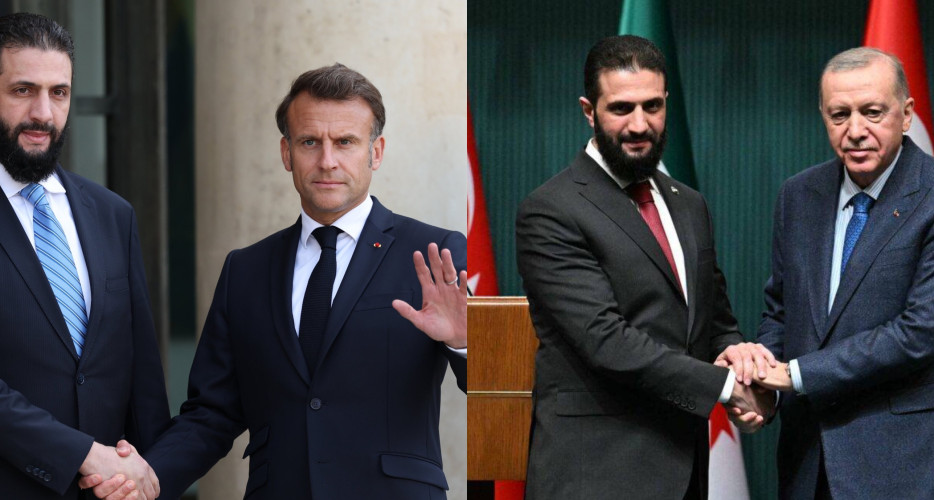
Peregraf — Syrian President Ahmad al-Sharaa has held separate phone calls with Turkish President Recep Tayyip Erdoğan and French President Emmanuel Macron to discuss escalating security developments in Aleppo, including attacks on the Kurdish-majority neighborhoods of Sheikh Maqsoud and Ashrafiyeh, amid growing international calls for de-escalation and civilian protection.
According to official statements, President al-Sharaa’s conversation with Erdoğan focused on the latest developments on the Syrian scene and ongoing efforts to consolidate stability in the region. Al-Sharaa emphasized Syria’s national principles, foremost among them the extension of state sovereignty over all Syrian territory. He outlined key priorities for the government at this stage, including protecting civilians, securing the surroundings of Aleppo, and ending what he described as illegal armed presence that obstructs reconstruction and the return of normal life.
Erdoğan, for his part, expressed Turkey’s support for efforts aimed at enhancing security and stability, stressing the importance of joint coordination to confront shared challenges and threats. Both leaders agreed to maintain close coordination between relevant institutions in their countries to implement mutual understandings, serve the interests of their peoples, and promote sustainable peace in the region.
In a separate call with French President Emmanuel Macron, al-Sharaa discussed prospects for bilateral cooperation and broader regional developments, in what Syrian officials described as part of Damascus’s diplomatic outreach to strengthen its international engagement. The Syrian president thanked France for its role in supporting stability and highlighted Paris’s positions in favor of national integration, the extension of state sovereignty, and efforts to alleviate humanitarian suffering and support early recovery.
Addressing the situation in Aleppo, al-Sharaa briefed Macron on what he said were state efforts to secure the city and protect civilians, reiterating that safeguarding residents and stabilizing the city’s perimeter are top priorities. He also underscored the government’s responsibility to protect all components of Syrian society, singling out the Kurdish community as an integral part of the national fabric and a key partner in shaping Syria’s future.
Macron reaffirmed France’s support for Syria’s unity and sovereignty, emphasizing the importance of continued consultation and backing efforts aimed at restoring stability and the rule of law.
The diplomatic engagements come as the situation in Sheikh Maqsoud and Ashrafiyeh continues to draw international attention. The United States has expressed alarm over reports of shelling, drone strikes, and clashes affecting densely populated residential areas in northern Aleppo.
In a statement posted on X, Ambassador Tom Barrack, the U.S. Special Envoy to Syria, said Washington is following developments in the two Kurdish neighborhoods “with grave concern,” urging all parties to exercise maximum restraint and prioritize the protection of civilian lives and property. His comments come amid reports of civilian casualties, damage to homes, and severe disruptions to daily life.
Barrack warned that the escalation threatens what he described as significant progress made by Syria over the past thirteen months toward stability, national reconciliation, and reconstruction after years of devastating conflict. He pointed to recent high-level regional discussions, including talks involving Israel, as part of broader efforts to break cycles of violence and move toward lasting peace.
The U.S. envoy reiterated Washington’s support for a future Syria based on inclusion and equal rights for all communities, including Sunnis, Kurds, Druze, Christians, Alawites, and others. He also disclosed that efforts were close to finalizing the March 10, 2025 integration agreement between the Syrian Democratic Forces (SDF) and the Syrian government, an accord aimed at enhancing security coordination, shared governance, and national unity.
Despite the current escalation, Barrack said the agreement remains achievable and called on the Syrian government, the SDF, local authorities, and all armed actors to pause hostilities and commit to immediate de-escalation. He also cautioned against external forces and their proxies whom he said seek to undermine recent progress and plunge the country back into instability.
As fighting and diplomatic activity unfold in parallel, the future of Aleppo—and the fragile political and security balance in Syria—appears increasingly tied to whether competing actors choose dialogue and restraint over further military escalation.