Iraqi President Voice Alarm Over Aleppo Violence as Fighting Escalates in Kurdish Neighborhoods
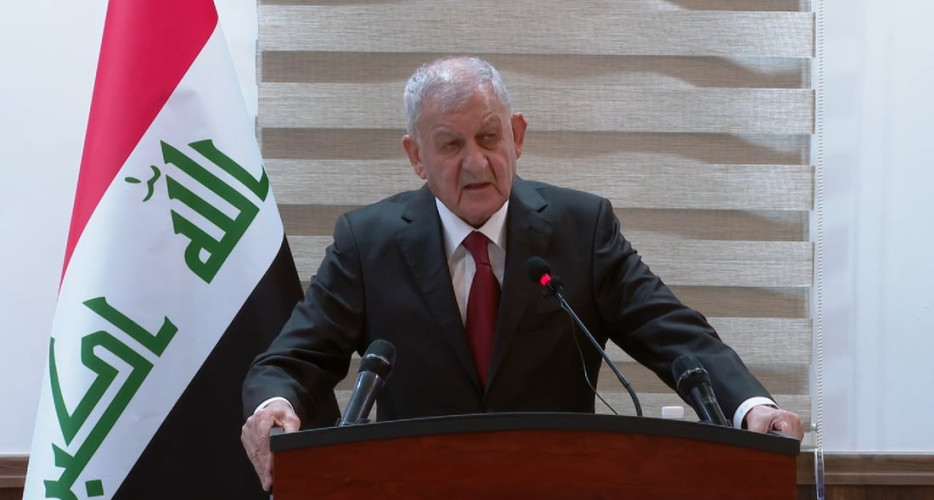
Peregraf — Iraqi President Dr. Latif Rashid on Thursday expressed deep concern over the escalating tensions and violence in the Syrian city of Aleppo, calling on all parties to immediately halt hostilities and pursue dialogue as the only viable path to resolving the crisis.
In an official statement, President Rashid said Iraq is “following with deep concern the tensions and acts of violence taking place in the neighboring Syrian city of Aleppo,” urging all sides to exercise restraint, abandon violence, and return to the negotiating table. He emphasized that continued clashes serve no one’s interests and risk further civilian casualties, particularly among women and children.
The Iraqi president reaffirmed his country’s support for peaceful solutions that uphold coexistence and mutual acceptance among Syria’s diverse communities, stressing that “all components of the Syrian people complement one another.” He warned that the alternative to dialogue would only deepen humanitarian suffering and instability, while reiterating Iraq’s backing for all efforts aimed at de-escalation and achieving lasting peace and stability in the region.
The presidential statement came amid intensified diplomatic activity by Baghdad, as Iraqi Deputy Prime Minister and Minister of Foreign Affairs Fuad Hussein held a telephone conversation on Thursday, January 8, with Saudi Foreign Minister Prince Faisal bin Farhan Al Saud. According to the Iraqi Foreign Ministry, the two sides exchanged views on regional developments, with a particular focus on the deteriorating situation in Syria and the ongoing violence in Aleppo.
During the call, both ministers underscored the necessity of halting conflicts and sustaining negotiation tracks, especially talks between the Syrian Transitional Government and the leadership of the Syrian Democratic Forces (SDF). Fuad Hussein voiced serious concern over attacks in Aleppo targeting civilian and residential areas, which he said have led to the displacement of thousands of Kurdish citizens from their homes.
The Iraqi foreign minister stressed the importance of joint regional and international action to stop the attacks and support security and stability in Syria, warning that continued escalation would have direct repercussions for Iraq’s own security and stability. Both sides agreed on the need to maintain communication with the Transitional Administration in Damascus to convey the gravity of the developments and work toward containing the crisis.
Beyond Syria, the call also addressed other regional flashpoints. Fuad Hussein highlighted the importance of de-escalating tensions in Yemen in a way that serves the interests of the Yemeni people, while the two ministers exchanged assessments on broader regional threats, the situation in the Islamic Republic of Iran, and the potential implications of ongoing tensions for both Iraq and Saudi Arabia. At the conclusion of the conversation, developments in Venezuela and their possible impact on global oil prices were also discussed.
On the ground in Aleppo, violence intensified sharply on Thursday following three days of sustained attacks by forces and armed groups affiliated with the Syrian government against the Kurdish-majority neighborhoods of Sheikh Maqsoud and Ashrafieh. According to local security sources, a large-scale offensive began at approximately 2:00 p.m., involving artillery, armored vehicles, and drones.
The internal security forces of the Kurdish neighborhoods, known as the Asayish, said they responded to the assault using both light and heavy weapons, reporting that several drones were shot down during the clashes. In a statement, the Asayish accused groups affiliated with the Damascus government of carrying out “brutal and widespread indiscriminate shelling” with tanks, artillery, and drones, directly targeting civilian areas.
“Our forces are engaged in fierce battles on all fronts,” the statement said, adding that they had inflicted significant losses on the attacking groups and downed two additional drones.
According to casualty figures released by the Kurdish neighborhood security forces, at least eight civilians have been killed and 57 others wounded as of Thursday morning due to what they described as indiscriminate shelling by Syrian government–loyal forces.
However, Aleppo health authorities presented a contrasting account, stating that shelling attributed to the Syrian Democratic Forces had resulted in the deaths of seven people and injuries to 52 others.
The conflicting reports underscore the complexity and volatility of the situation in Aleppo, where civilians remain caught between warring sides amid heavy weaponry and aerial attacks. As regional actors call for restraint and dialogue, the humanitarian toll continues to rise, heightening fears of further displacement and civilian suffering unless an immediate ceasefire is achieved.